YubNub Social YubNub Social
    Advanced Search
  • Login

  • Night mode
  • © 2026 YubNub Social
    About • Directory • Contact Us • Privacy Policy • Terms of Use • Android • Apple iOS • Get Our App

    Select Language

  • English
Install our *FREE* WEB APP! (PWA)
Night mode
Community
News Feed (Home) Popular Posts Events Blog Market Forum
Media
Headline News VidWatch Game Zone Top PodCasts
Explore
Explore Jobs Offers
© 2026 YubNub Social
  • English
About • Directory • Contact Us • Privacy Policy • Terms of Use • Android • Apple iOS • Get Our App

Discover posts

Posts

Users

Pages

Group

Blog

Market

Events

Games

Forum

Jobs

Daily Caller Feed
Daily Caller Feed
2 yrs

DIEHL & QUINIO: If The Left Truly Cared About Equality, They’d End Harmful Discriminatory Practices
Favicon 
dailycaller.com

DIEHL & QUINIO: If The Left Truly Cared About Equality, They’d End Harmful Discriminatory Practices

It has been a year since the Supreme Court declared in Students for Fair Admissions that eliminating racial discrimination meant eliminating all of it. Eliminating discrimination means treating all individuals, regardless of race, equally. The government must once and for all get out of the business of advantaging and disadvantaging Oregonians based on race. Oregon has a […]
Like
Comment
Share
Daily Caller Feed
Daily Caller Feed
2 yrs

‘Unimaginable And So Abhorrent’: Judge Slams Blue State University For Excluding Jewish Students During Protests 
Favicon 
dailycaller.com

‘Unimaginable And So Abhorrent’: Judge Slams Blue State University For Excluding Jewish Students During Protests 

'They refused to denounce their faith'
Like
Comment
Share
Daily Caller Feed
Daily Caller Feed
2 yrs

‘You’ve Been Warned’: Frank Luntz Says ‘Trump Should Be Winning’ But He’s ‘Giving Away This Election’
Favicon 
dailycaller.com

‘You’ve Been Warned’: Frank Luntz Says ‘Trump Should Be Winning’ But He’s ‘Giving Away This Election’

'He's giving away this election'
Like
Comment
Share
Daily Caller Feed
Daily Caller Feed
2 yrs

Byron Donalds Spars With CNN Host On Whether Trump’s Age Or Harris’ Far-Left Record Is Bigger Concern
Favicon 
dailycaller.com

Byron Donalds Spars With CNN Host On Whether Trump’s Age Or Harris’ Far-Left Record Is Bigger Concern

'No, it's not about her age'
Like
Comment
Share
SciFi and Fantasy
SciFi and Fantasy  
2 yrs

Aditya 369: Diamond Thieves, Dance-Offs, and Derring-do
Favicon 
reactormag.com

Aditya 369: Diamond Thieves, Dance-Offs, and Derring-do

Column Science Fiction Film Club Aditya 369: Diamond Thieves, Dance-Offs, and Derring-do India’s first time travel film gleefully blends genres, history, and musical numbers as it bounces between the past, future, and present. By Kali Wallace | Published on August 14, 2024 Comment 0 Share New Share Aditya 369 (Telugu: ఆదిత్య 369) (1991) Directed by Singeetam Srinivasa Rao. Written by Singeetam Srinivasa Rao. Starring Balakrishna Nandamuri, Mohini, Suthivelu, Tinnu Anand, and Master Tarun. During the first part of the 16th century, the emperor Krishnadevaraya ruled over the Vijayanagara Empire, which encompassed most of the Indian subcontinent. He’s considered one of the greatest rulers in Indian history due to his skills as an administrator and a military leader. He’s also remembered for his patronage of literature in several languages. He was a poet himself, and his court was home to the Ashtadiggajas, a group of eight highly revered Telugu scholars and poets. Krishnadevaraya’s reign is regarded as a golden age of Telugu literature. He did not, as far as I know, solve court conflicts with dance-offs. Probably. It seems unlikely. But who can say? Anything is possible! I’ve known since I started writing this column that it’s ridiculous to attempt a global scope without including Indian cinema. Indian filmmakers produce more than two thousand films every year, in several languages, with ticket sales numbering in the billions. Indian cinema got its start pretty much as soon as it was physically possible: the short silent films of the Lumière brothers were shown in Mumbai in 1896, the same year they were shown in London, and only a year after their debut in Paris. The earliest Indian films were documentaries or recordings of stage plays, but that quickly evolved, and by the 1910s Indian filmmakers were producing full-length silent feature films. Many of those early films have been lost, but they were made by filmmakers all across India and feature intertitles in several different languages. The first sound film came in 1931 with the Hindustani-language Alam Ara, and talkies in numerous other languages followed immediately. And, ever since then, the Indian film industry has never slowed down. The actual numbers vary across sources, but according to the UNESCO Institute for Statistics, India regularly produces roughly twice as many films as the next most productive film industries (the U.S., China, and Japan), and those films are made in dozens of languages (38 languages in 2021-22, for example). A quick note: In the West, a lot of people still erroneously use “Bollywood” to refer to the entire Indian movie industry, but Bollywood specifically refers to the Hindi-language films that are often (but not always) produced in Mumbai. But that’s only a part of the Indian film industry—a large and lucrative part, yes, but definitely not the whole thing. The next-largest chunk of the industry is “Tollywood,” the Telugu-language films produced in the southern Indian city of Hyderabad. I do think Western film critics and journalists are getting better with the distinctions in Indian cinema, especially with Telugu films like RRR (2022) getting so much international attention. (Now “Naatu Naatu” is stuck in your head again. I’m not sorry.) (It occurs to me that if Thomas Edison had gotten his way and the American film industry remained on the East Coast, people would have to come up with punny names for non-American film production locations based on West Orange, New Jersey, rather than Hollywood.) But I’ll be honest: the huge breadth of Indian cinema is not actually very relevant for talking about this week’s movie. Because even if you have only the most surface-level knowledge about Indian films, Aditya 369 is probably exactly what you would have imagined an Indian time-travel romance action film from the early ’90s to be. It’s got romance, action, adventure, crime, history, both motorcycle chases and horses chases, physically impossible fight scenes, a mad scientist, a plucky kid, recitations of classic poetry, and choreographed musical numbers. And a dance-off. That is, it fully embodies two key traits common to so many Indian films: the gleefully madcap everything-but-the-kitchen-sink approach to blending genres (called “masala,” like a blend of spices), and the music. Director Singeetam Srinivasa Rao is a huge name in South Indian cinema. He’s currently 92 years old and still going strong with a filmography that includes more than 60 films in at least five languages across just about every possible genre, from commercial comedies to serious historical tales to experimental films to social dramas to animation. By his own telling, he had been interested in time travel stories since reading H.G. Wells’ The Time Machine in school, and he decided to make the film after chatting about the idea when he was seated next to producer S.P. Balasubrahmanyam on a flight. This was just a few years after Back to the Future (1985) and Bill and Ted’s Excellent Adventure (1989), so wacky time travel movies were internationally popular and successful. Aditya 369 begins with a diamond heist. Wealthy criminal Raja Varma (Amrish Puri) has amassed a collection of priceless historical objects, and he wants to add a diamond that once belonged to Krishnadevaraya. He has a corrupt museum curator (Gollapudi Maruti Rao) to help him. If you don’t know what kind of film you’re about to watch going in, the first few minutes of setup will certainly make it clear: Raja Varma is the kind of criminal who keeps a quartet of violinists around to punctuate all of his pronouncements with thematically appropriate music. Raja Varma’s two henchmen (Tanikella Bharani and Babu Mohan) go to steal the diamond. On that same night, Kishore (Master Tarun) is experiencing something all elementary school students expect to at some point: getting locked in a museum overnight. Kishore was left behind after a school field trip, so he’s in the museum to witness the theft. When he escapes, Kishore is saved by Krishna Kumar (Nandamuri Balakrishna), whose girlfriend Hema (Mohini) is the daughter of time machine inventor Professor Ramdas (Tinnu Anand). A lot happens in this film; I won’t try to explain it all. I will just mention that I think it takes a little too long to get to the time travel, just as I also think the first musical number has too much hip-thrusting choreography (and I’m a K-pop fan! I have seen some hip-thrusting!). But it’s all in good fun, so I don’t really mind. Nobody believes Kishore when he tells them about the jewel thieves, because the diamond has been replaced by a fake. So when he hears about Professor Ramdas’ time machine, he recruits some of his friends from the hospital where he is recovering. Their plan—it makes perfect sense in kid logic—is to use the time machine to go back to stop the robbery before it happens. But due to an unrelated sequence of events, Krishna Kumar and Hema are the ones who end up accidentally traveling through time, with a hapless police constable (Suthivelu, whose character is never given a name) along for the ride. That’s how the three adults end up in the 16th century court of Krishnadevaraya (also played by Nandamuri Balakrishna). Let’s take a step back and talk about time travel fiction for a moment. Time travel, like any other science fictional plot device, can be used to tell just about any kind of story, but there do tend to be broad patterns. There are stories like The Time Machine that visit the future in order to say something about the present, and stories like Back to the Future that visit the past to rearrange the timeline. There are a whole slew of time loop stories (an entire subgenre of sci fi film; we’re saving those for another month), as well as stories where people travel through time specifically to solve problems, or cause problems, or steal a whale. One element that tends to go along with all of these types of stories is the idea that changing something in the past will, in fact, alter the present and future. Stepping on a butterfly, starting a band, punching a bully—in time travel stories, these are actions that can fundamentally change the world. Around about the time we got to the dance-off, I realized that Aditya 369 had, as a whole, simply decided not to do that. It’s not as though the film is making a particular statement about the immutable nature of history; instead, it’s more that the characters assume their actions will fit into both the past and the future without getting into cosmological implications of it all. I admit it took me a moment to adjust, because I am so used to approaching time travel stories by asking: “What is going to change?” But this movie doesn’t care about any of that, nor does it care about establishing any sort of ideal or superior vision of the past. Kirshna Kumar tells the people in the 16th century all about the modern world; he talks about democracy and elections, he explains television and movies, he shows off his boombox, he impresses the emperor with his knowledge of things to come. There is never the least concern that this knowledge or anything else they say or do will alter the course of history—a history that is familiar to its audience, as the eight poets were real men who lived in the patronage of Krishnadevaraya’s court. So we get a dance-off in the emperor’s court. We get some clumsy scheming, an attempted theft, a thwarted execution, a daring escape. There’s an attempted seduction scene in which the main character is wearing a garishly colorful sweatshirt from the Arizona Balloon Festival, because nothing about this visit to the past is about trying to blend in or avoid making ripples. When Krishna Kumar, Hema, and the police constable finally leave the 16th century, they overshoot the present day (none of them know how to drive the time machine) and end up in the year 2504. There they find a world that has been rendered a radioactive wasteland thanks to World War III. Humans have been driven underground and live in a scientifically advanced but highly controlled society. There is technology to read minds and repair time machines, but the air is poisonous and the musical number is painfully autotuned. Our characters learn, via a news source from the past, that Krishna Kumar will be killed when he tries to stop Raja Varma from stealing Krishnadevaraya’s diamond. They go back to 1991 anyway, and Krishna Kumar still tries to stop Raja Varma from taking the diamond. He survives, but the characters assume they shouldn’t have taken the newspaper they saw in the future at face value; it doesn’t occur to them that they might have changed his fate. They get their happy ending. They also don’t seem very worried about the future nuclear war, or at least not to the point where wanting to prevent it ever comes up. We’ve seen so many sci fi movies where a potential future WWIII is directly related to the aftermath of WWII that it’s notable when that element is simply missing. I am not familiar enough with Indian cinema to know if that’s unique to this movie. I do know that India had a very complicated relationship with WWII (to say the least), and I know that films about independence from the British Empire and the partition of India and Pakistan unsurprisingly tend to occupy that serious, historical cinematic space that is taken up by WWII films in other countries. Time travel can be about anything, and after I got used to it, I came around to enjoying the fact that in Aditya 369, what it’s about is hijinks and shenanigans. It cares about the nature of causality and paradox exactly as much as it cares about how a man who works at a TV factory can fight off a dozen armed henchmen by doing acrobatic flips, which is to say: not at all. Aditya 369 is regarded as quite influential in Indian cinema precisely because it took a sci fi topic that Indian movies hadn’t tackled before and integrated it so completely into the cavalier, genre-hopping style of Indian cinema. It neither reveres the golden ages of the past nor fetishizes the potential dark ages of the future. It is, in all its early ’90s glory, a celebration of the present—and of solving thorny political situations with a glorious dance-off. What do you think about Aditya 369 as the first Indian time travel movie? And as an entry into the global pantheon of wacky time travel films? How would you fare in a dance-off in the 16th century royal court of your choice? And yes, you did in fact see stills from Star Wars and other sci fi films in some of those trippy timey-wimey sequences. No, I don’t have an explanation for that beyond, “Because they felt like it.” Next week: We could not possibly achieve a more extreme tonal shift than pivoting to La Jetée (1962), a 28-minute experimental French film. Watch it on Criterion, Amazon, Apple.[end-mark] The post <i>Aditya 369</i>: Diamond Thieves, Dance-Offs, and Derring-do appeared first on Reactor.
Like
Comment
Share
Reclaim The Net Feed
2 yrs

VP Nominee JD Vance Calls for Breaking Up Google
Favicon 
reclaimthenet.org

VP Nominee JD Vance Calls for Breaking Up Google

If you're tired of censorship and dystopian threats against civil liberties, subscribe to Reclaim The Net. Senator J.D. Vance, Donald Trump’s running mate in the November presidential election, has past ties to tech, but also strong opinions about it. Informed by the knowledge of the industry many politicians lack, Vance is anti-Big Tech monopolies, and positive on cryptocurrencies. Appearing on the CBS News show Face the Nation, the potential future vice president reiterated his previously stated by-and-large approval of FTC Commissioner Lina Kahn’s work, and the two seem to be particularly in agreement on the need to break up Big Tech monopolies. The case for spinning off companies like Google has been talked up over the last years from both political camps in the US, unsurprisingly, however, from different angles. Vance focuses on the danger of such large entities controlling speech. “I don’t want Google or a billionaire that controls Google that’s in bed with China to be able to censor American information and that’s exactly what they’ve done,” Vance told CBS. He also mentioned the anti-trust lawsuit against Google launched during Trump’s first term in office, noting that they both “look at this in the same way.” Speaking of the difference between “Small Tech” and “Big Tech,” Vance singled out the monopolistic power the latter has to control some key elements, such as Google’s digital advertising power vs. for example X. “I don’t think that Elon Musk has any monopoly – he’s not using his company to try to destroy competitors,” Vance remarked, explaining the importance of anti-trust initiatives around the technology sector. In pushing for better anti-monopoly rules, Vance hopes the Trump presidency would achieve two goals: secure better-paid jobs at home, and freedom of expression. This is not the first time that Vance has criticized Google, but also Facebook and others for their left-leaning bias, posting on X in February that it was “time to break Google up.” As for cryptocurrencies, Vance, like Trump, wants to avoid overindulgent regulatory measures. Also earlier this year, he criticized the approach taken by Securities and Exchange Commission Chair Gary Gensler during a Y Combinator event RemedyFest. Some reports see these policy points as appealing to a number of Silicon Valley actors, which, after all, isn’t uniformly left – although its biggest players seem to be. But Vance’s messages, particularly around cryptocurrencies, seem to resonate among venture capitalists and the likes of Elon Musk, who are willing to put their money where their mouth is and support the Trump-Vance ticket with large campaign contributions. If you're tired of censorship and dystopian threats against civil liberties, subscribe to Reclaim The Net. The post VP Nominee JD Vance Calls for Breaking Up Google appeared first on Reclaim The Net.
Like
Comment
Share
Hot Air Feed
Hot Air Feed
2 yrs

The Fall of the January 6th Prosecutions?
Favicon 
hotair.com

The Fall of the January 6th Prosecutions?

The Fall of the January 6th Prosecutions?
Like
Comment
Share
Hot Air Feed
Hot Air Feed
2 yrs

The Trans Infection Spreads to the Paralympics
Favicon 
hotair.com

The Trans Infection Spreads to the Paralympics

The Trans Infection Spreads to the Paralympics
Like
Comment
Share
Science Explorer
Science Explorer
2 yrs

Humanity Could Use "Glitter" To Terraform Mars (And Add A Little Razzle Dazzle)
Favicon 
www.iflscience.com

Humanity Could Use "Glitter" To Terraform Mars (And Add A Little Razzle Dazzle)

Right now, we are looking for signs of life on Mars at the surface, and perhaps soon in the ocean of liquid water found deep in the crust.Finding signs of life (if that were to happen) could tell us about how life evolves, whether it is abundant in the cosmos, or even whether that life is related to us – taken from Earth to Mars or Mars to Earth as material from the planets flew through the solar system. When NASA sends robot explorers to the planet, it is careful not to contaminate them with life, leaving the planet as pristine as we can. There are even forbidden areas (or Special Regions) where life may be more likely, which we have so far stayed clear of for fear of contaminating it with Earth microbes.But say we found that Mars is now a cold, dead planet, and humanity continues to grow and thrive, future humans may consider colonizing it. There, rather than global warming being a problem, we would actually need to heat the planet artificially in order to make it livable for us, and whatever creatures we bring along for the ride. There have been plenty of proposals on how to do this, from chlorofluorocarbons (CFCs) to fluorinated versions of methane, ethane, and propane. But these ingredients are rare on Mars, making them less practical for the huge terraforming project – and a new team has a different suggestion which they compare to glitter in size. "We show here that artificial aerosols made from materials that are readily available at Mars—for example, conductive nanorods that are ~9 micrometers long—could warm Mars >5 × 10³ times more effectively than the best gases," the team explains in their paper.The idea is that the small particles of aluminum and/or iron would be swept up into the atmosphere, like Martian dust. The material, only a little smaller than commercially available glitter, would then warm the planet by capturing and scattering more radiation from the Sun."For a 10-year particle lifetime, two climate models indicate that sustained release at 30 liters per second would globally warm Mars by 30 kelvin and start to melt the ice. Therefore, if nanoparticles can be made at scale on (or delivered to) Mars, then the barrier to warming of Mars appears to be less high than previously thought."There are of course a lot of unknowns involved. If Mars has life, altering the planet's temperature could kill it off. If the Martian soil were found to contain compounds toxic to Earth-based life, warming it up a bit would have very little benefit for human settlers. NASA's Mars Sample Return should help answer this. While heating the planet would melt the surface ice, it's also possible this would soon drain into the planet, requiring a lot of management. We also don't know if Mars has enough of the required materials to make the "glitter", or whether it would need to be brought from Earth, making the project a lot more difficult and less feasible.However, it could be possible to heat the planet using essentially glitter, adding a little razzle-dazzle at the same time.The study is published in Science Advances: Planetary Science.
Like
Comment
Share
Science Explorer
Science Explorer
2 yrs

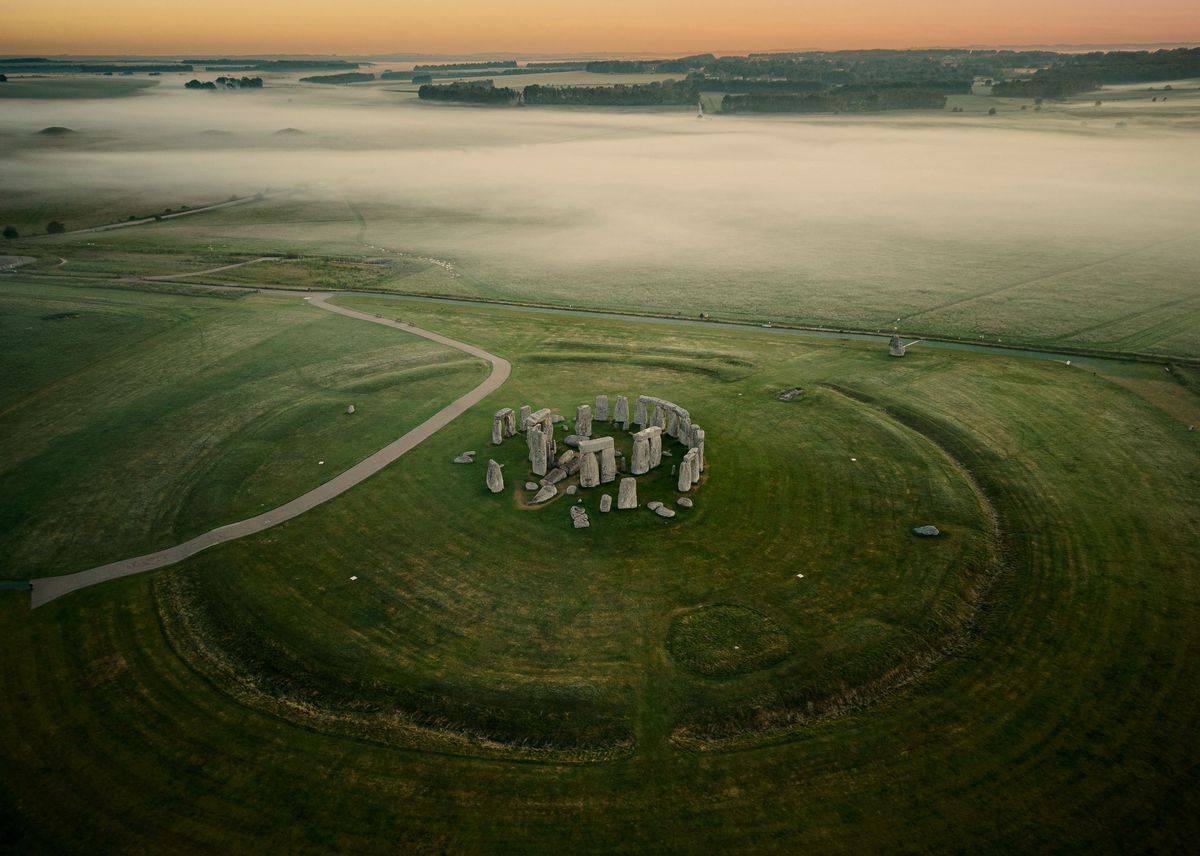
Stonehenge's Famous Altar Stone May Be From Scotland, Over 700 Kilometers Away
Favicon 
www.iflscience.com

Stonehenge's Famous Altar Stone May Be From Scotland, Over 700 Kilometers Away

The Altar Stone at Stonehenge may have been sourced from northeast Scotland, at least 700 kilometers (434 miles) away from its final placement in southwest England. It’s not clear how prehistoric humans managed to transport the 6-ton rock to the other side of the British Isles, but the new research adds further intrigue to the story of the famed Neolithic site.Construction at Stonehenge began around 5,000 years ago, with multiple modifications and additions made over the following 2,000 years. It was previously thought that the henge was comprised of two rock types: the large iconic sarsen, likely sourced around 25 kilometers (15.5 miles) away near Marlborough, plus the smaller bluestones, collected from the Preseli Hills in southwest Wales.For centuries, it had been assumed that the Altar Stone, a large sandstone block measuring 5 by 1 meters (over 16 by 3 feet) buried flat in the heart of the monument, was one of the Welsh bluestones, but recent research showed that wasn’t the case.To uncover its mysterious origins, scientists from Curtin University and Aberystwyth University took a closer look at its geochemical makeup. When I found out that it was Scottish, my team and I thought: ‘No way did people move this. It's just too far.’ It's completely unprecedented.Anthony Clarke“The Altar Stone is a sandstone made up of individual grains, kind of like grains at the beach that have been squished together, and some of these grains are minerals that contain uranium. Over geological time, uranium will decay to lead and we know the rate at which that decay process occurs. So in a way, each of these grains is almost like a miniature atomic clock,” Anthony Clarke, lead author and PhD student at Curtin University’s School of Earth and Planetary Sciences, told IFLScience.“If we date several of these grains within the Altar Stone, it allows us to build up a fingerprint of ages, like a barcode, a serial series of numbers. That can be statistically compared to source rocks throughout Britain and Ireland. When we did that, it was very much distinctly Scottish,” he explained.The Altar Stone is the flat stone seen here underneath two bigger fallen Sarsen stones.Image credit: Professor Nick Pearce/Aberystwyth UniversityIn particular, the Altar Star shares some uncanny similarities with the Old Red Sandstone found in the Orcadian Basin in northeast Scotland, around 750 kilometers (466 miles) away from Stonehenge.“When I found out that it was Scottish, my team and I thought: ‘No way did people move this. It's just too far.’ It's completely unprecedented,” Clarke added. “Even today, a journey from Scotland [to southwest England] is pretty arduous. Back then, the land was heavily forested. There were mountain ranges: the Pennines, the Cairngorms, the Grampians, and the Southern Uplands. It was boggy,” he noted.Blown away by the distance, the team explored the possibility that the rock was moved southwards across the British Isles by glaciers. However, they found that almost all the ice flows over the past 1 million years had gone northwards, the opposite direction of the rock’s movement. There’s also no sign of ice movement on the stone, either.         This led them to conclude that the only way the Altar Stone could have traveled this huge distance was by boat. Plenty of archaeological evidence shows that marine transport routes were well-established across Neolithic Europe and people had developed surprisingly sophisticated vessels around this time. While the transit of the Altar Stone would be the longest recorded journey for any stone used in a monument during this period, it’s not a totally crazy idea that it was shipped all the way down Britain’s coast.“It seems that maybe the ancient world was a lot more connected than we might think,” Clarke concludes.The new study is published in the journal Nature. 
Like
Comment
Share
Showing 16478 out of 56670
  • 16474
  • 16475
  • 16476
  • 16477
  • 16478
  • 16479
  • 16480
  • 16481
  • 16482
  • 16483
  • 16484
  • 16485
  • 16486
  • 16487
  • 16488
  • 16489
  • 16490
  • 16491
  • 16492
  • 16493

Edit Offer

Add tier


Select an image
Delete your tier
Are you sure you want to delete this tier?

Reviews

In order to sell your content and posts, start by creating a few packages. Monetization

Pay By Wallet

Payment Alert

You are about to purchase the items, do you want to proceed?

Request a Refund