www.theamericanconservative.com
The New National Defense Report Misses the Point
Politics
The New National Defense Report Misses the Point
The main threat to American safety comes not from abroad, but from Washington.
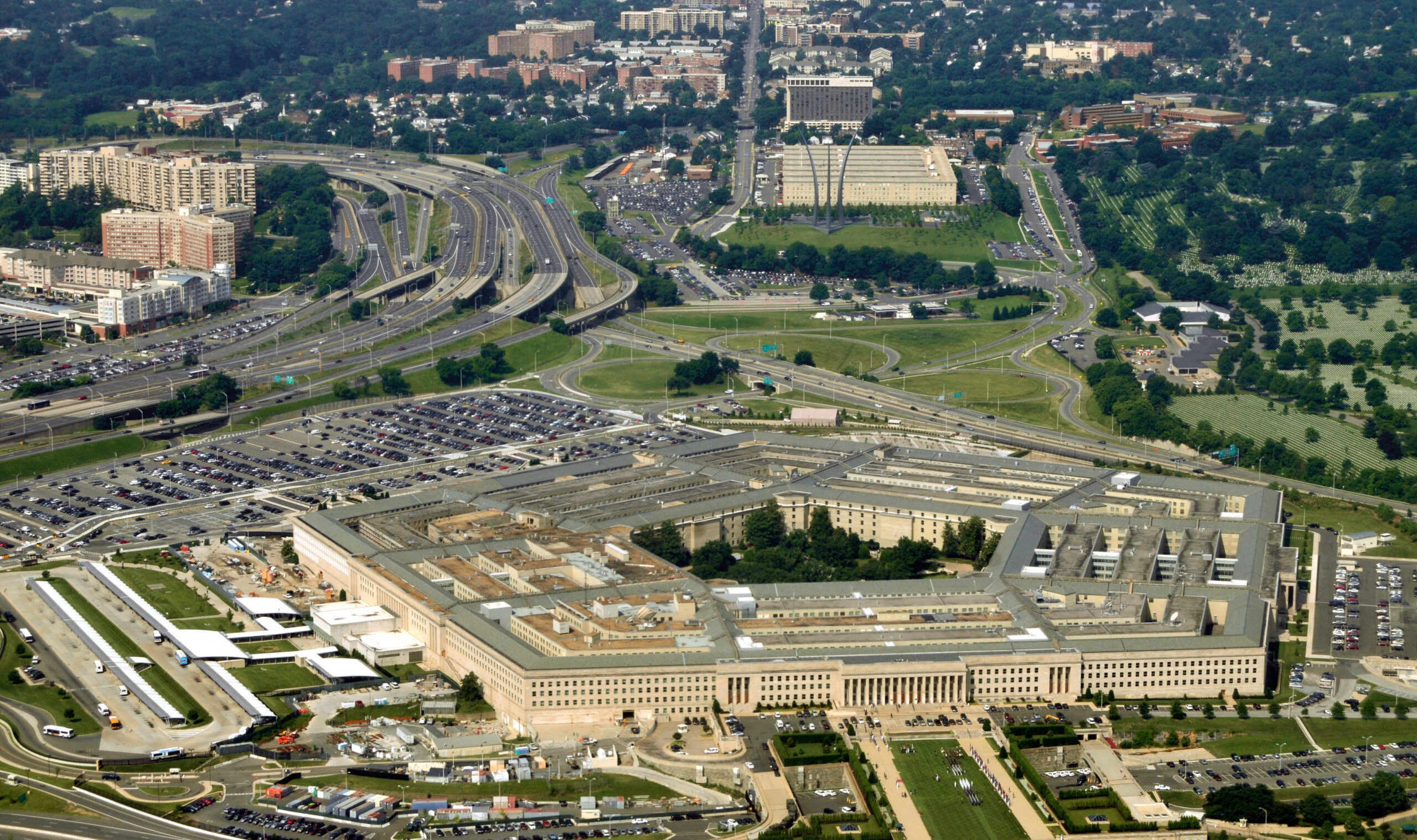
The Pentagon. (Frontpage/Shutterstock)
The American public must be informed, explains the Commission on the National Defense Strategy in a new report. Despite war propaganda daily flooding Washington, the CNDS complained that people “have been inadequately informed by government leaders of the threats to U.S. interests—including to people’s everyday lives—and what will be required to restore American global power and leadership.”
In the Commission’s view, the United States is at great risk. Threats are multiplying around the globe. Only great effort can save the country. Americans must turn over more of their money and sacrifice more of their liberties. They must be scared into compliance.
In fact, this is nonsense. For decades the United States has been the most secure great power ever. The U.S. has dominated its continent and entire hemisphere since the mid-19th century. Surrounded by deep waters east and west and weak neighbors north and south, America is largely invulnerable to attack.
Which enabled it to become the most dominant great power ever. With middling effort at home, the U.S. turned into the decisive power abroad. World War II left America as the globe’s most powerful nation, with half the world’s economic production as a foundation for the world’s most sophisticated military. Almost all of its allies remain dependent on US money and production. Today’s world is becoming multipolar, but military threats against the continental US remain minimal, other than assorted nuclear arsenals, most importantly Russia’s.
With Americans living in an extraordinary security cocoon, the 9/11 attacks came as a shock. Of America’s many conflicts, only the Civil War occurred at home. And it ended 159 years ago. Compare the U.S. to the other major powers. Russia, Germany, China, France, Japan, Ukraine, Iran, Iraq, South and North Korea, and so many other nations have been attacked, invaded, occupied—often repeatedly, and sometimes by the U.S.
The fact that Washington almost always fights overseas demonstrates that US policy is usually offensive. Most of what America does militarily has little to do with its own security. Wars of choice have been constant, which explains President Joe Biden proudly informing journalist George Stephanopoulos that “I’m running the world.” (Or at least purporting to.)
Yet the Commission is worried, declaring, “The threats the United States faces are the most serious and most challenging the nation has encountered since 1945 and include the potential for near-term major war.” Worse, apparently, than during the Cold War and Korean War. China is “the pacing and global threat.” Russia is the “chronic and reconstituting threat.” Iran, North Korea, and terrorism constitute “an axis of growing malign partnerships.”
Indeed, warned the CNDS,
There is a high probability that the next war would be fought across multiple theaters, would involve multiple adversaries, and likely would not be concluded quickly. Both China and Russia independently have global reach and have committed to a ‘no-limits friendship,’ with additional partnerships developing with North Korea and Iran, as described previously. As U.S. adversaries are cooperating more closely together than before, the United States and its allies must be prepared to confront an axis of multiple adversaries.
The commissioners quail before this supposedly imposing phalanx: “Although China poses the most consequential threat to the United States and its allies, all five adversaries threaten vital American interests and cannot be ignored. Attempts to deprioritize theaters and significantly reduce U.S. presence—notably in Europe and the Middle East—have emboldened U.S. adversaries and required the United States to surge forces back.”
Hence America faces an emergency. What to do? Mobilize the public! Spend more money on the military! Station more troops overseas! More of everything is required. We must even be prepared, apparently, to invade China and Russia: “Landpower remains central to American security, no matter the adversary or theater. In large-scale operations, the Army remains critical to dominating adversaries.”
Yet there is a lot less to this seemingly daunting threat list than initially meets the eye. Terrorism is only a minor national problem (individual victims understandably feel differently). It is best addressed by doing less overseas, especially the bombing missions, foreign occupations, and miscellaneous interventions that trigger foreign hostility and vengeful attacks.
Iran and North Korea are nasty regimes but have no intrinsic interest in tangling with America. For instance, if Washington were not in the Middle East backing both Israel and the Sunni Gulf monarchies, the Iranian ayatollahs would pay the U.S. little mind. Today the Biden administration is preparing for war with Iran, not to defend America but Israel—a regional superpower, with conventional superiority, nuclear weapons, and security relations with leading Arab states. Pyongyang directs abundant threats against the U.S. because the U.S. is there, on and around the peninsula threatening the North day and night. If Washington left the Republic of Korea, vastly more powerful than the Democratic People’s Republic of Korea, to defend itself, America would hear little more from DPRK Supreme Leader Kim Jong-un. The U.S. should ignore rather than confront Tehran and Pyongyang.
Russia is no threat to America. Moscow has no territorial conflicts or inevitable disputes with the U.S. In fact, the two governments have cooperated against Islamic terrorism and nuclear proliferation. Russia is authoritarian, but neither ideological nor evangelistic. Vladimir Putin has been in power for more than a quarter century and originally demonstrated no animus to America. Putin’s attitude changed after the allies did their best to antagonize all Russians with an aggressive, even reckless foreign policy.
As for territorial conquest, Putin, though a criminal aggressor, is no Hitler. In 2008, he promoted preexisting separatism in South Ossetia and Abkhazia against Georgia, which he attacked after it fired on Russian troops. He invaded Ukraine after years of warnings against bringing Kiev into NATO—which the allies did indirectly by bringing NATO into Ukraine. Putin’s government is challenging the Biden administration elsewhere in retaliation for Washington helping to kill thousands of Russian soldiers in Ukraine. The U.S. could defuse today’s Russian threats by adopting the “humble foreign policy” that candidate George W. Bush once promoted and stopping attempts to dominate everywhere up to Russia’s border. As for Europe’s security, why cannot a continent with ten times the GDP and three times the population of Russia protect itself?
Finally, there is the People’s Republic of China. Even if it is the “pacing” challenge, as the Commission claimed, Beijing is not a serious military threat to America. The Chinese Communist Party is Leninist, determined to hold on to power, rather than Marxist, determined to revolutionize the world. Nevertheless, Beijing has become an important geopolitical rival. It possesses a large and sophisticated economy and is the world’s greatest trading nation. Its armed forces are ranked third in the world, amid an ongoing nuclear buildup. Required is a nuanced and multinational response.
The primary bilateral battleground is economic, not military. Although Chinese military power is expanding, that doesn’t mean the threat is significant, at least in the sense of putting America’s people, territories, independence, and liberties at risk. Beijing has neither the desire nor the ability to attack the United States, conquer its Pacific possessions, exclude it from global markets, or otherwise turn America into a tributary state.
There is a military issue, but it involves U.S. influence in East Asia. Members of the Washington Blob, like Biden, continue to believe that they are entitled by birth to “run the world.” As such, their objective is not to defend America from attack by China, but to coerce China, along with any other nation so ill-mannered as to reject U.S. hegemony.
Beijing seeks what America has, dominance in its own region. If the U.S. refuses to accommodate a more powerful PRC, military friction is inevitable and military conflict is possible, perhaps likely. Nevertheless, while the U.S. benefits from its unnatural role in East Asia and surrounding waters—effectively ruling the Pacific up to China’s shores—that position is not vital to American security, and thus does not warrant war with a serious conventional power that possesses nuclear weapons over interests it believes to be vital.
The U.S. should not be indifferent to increasing Chinese influence. Rather, it should help friendly states acquire the wherewithal necessary for their own defense and encourage them to work together to constrain the PRC. They can rely on anti-access/area denial strategies, just as Beijing does against Washington. America has committed to the defense of its treaty allies, most importantly Japan, Philippines, and South Korea, but what matters is their independence, so far not threatened by Beijing, rather than their control over every barren rock that they claim in contested waters. The U.S. should calibrate its commitments to its interests, avoiding war over peripheral matters.
The most incendiary issue is Taiwan, which matters to China both because of history, having been lost to Japan during “the century of humiliation,” and security, since possession by a hostile power would threaten the Chinese homeland. Although Beijing’s objective is to regain control through coerced negotiation, it is widely believed that the PRC would act militarily if Taiwan declared independence. Although there is no evidence that the Xi government has any firm deadline in mind, some Western analysts believe that an impatient China might act in the coming years.
Like Russia’s attack on Ukraine, a Chinese assault on Taiwan, though a moral atrocity, would be only a geopolitical inconvenience for America. From a U.S. security standpoint, the island is useful in impeding the PRC, not defending America. Taiwan is not worth a war, one against a nuclear power which has both nationalistic ego and serious security interests at stake. Washington should promote other forms of deterrence, not risk this nation’s very survival.
The report warns “that the U.S. military lacks both the capabilities and the capacity required to be confident it can deter and prevail in combat.” Confidence to do what? Americans should not expect to defeat China and occupy Beijing. What matters is preventing China from defeating the U.S. and occupying Washington, D.C. Which we can do.
The Commission on the National Defense Strategy’s report reads like a long litany of militaristic screeds emanating from America’s military industrial think tank university complex. The proposed solution is always a frenzied military buildup and war against all.
The world may be dangerous, but the U.S. remains surprisingly secure. The greatest threats against America result from Washington policymakers making other nations’ enemies America’s own. How to better safeguard U.S. interests? Stop confusing them with the wishes of foreign friends and fantasies of Washington officials.
The post The New National Defense Report Misses the Point appeared first on The American Conservative.


 News Feed (Home)
 Popular Posts
 Events
 Blog
 Market
 Forum
 Headline News
 VidWatch
 Game Zone
 Top PodCasts