reasonstobecheerful.world
Fighting Global Warming, One Abandoned Oil Well at a Time
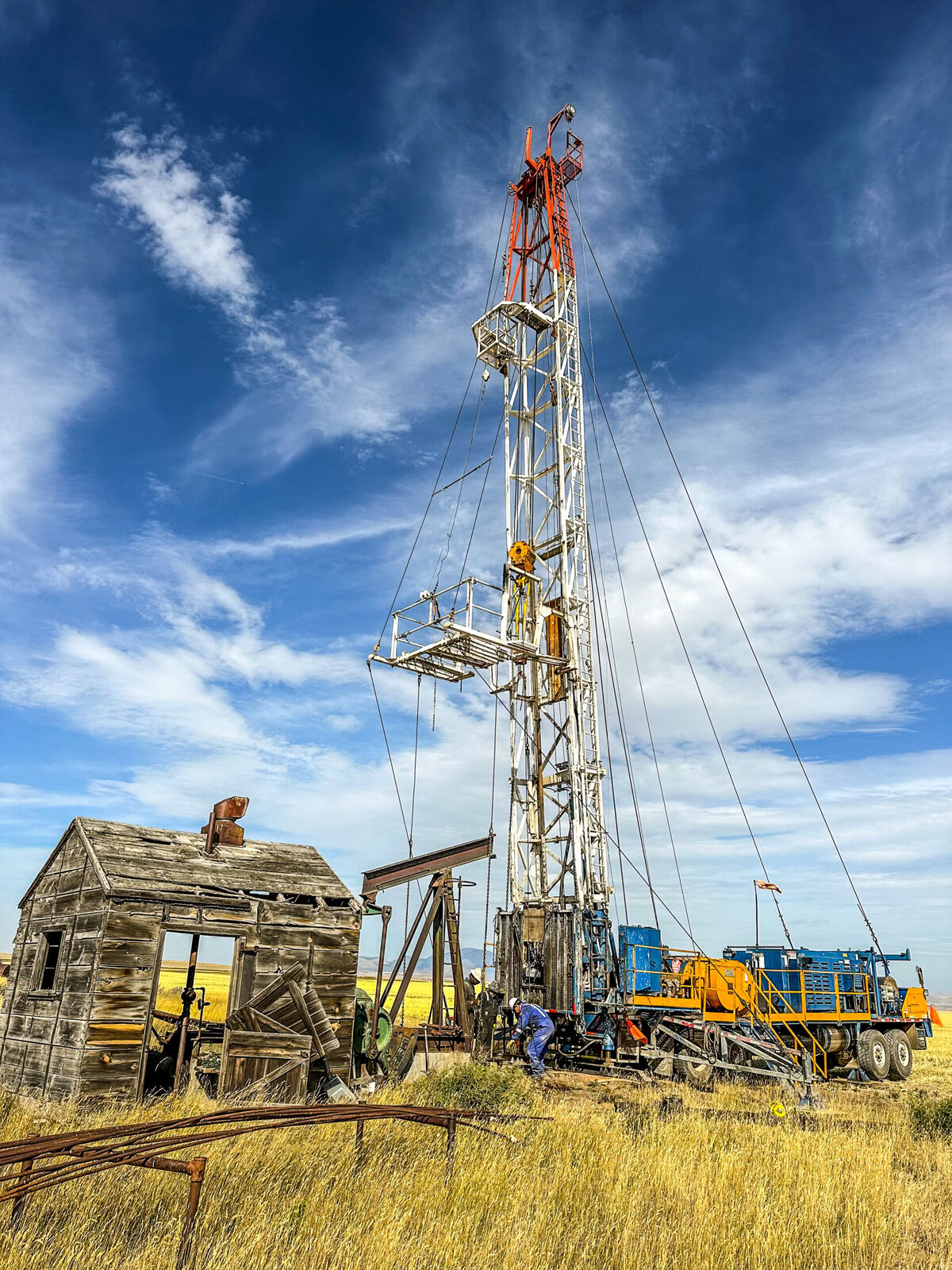
Curtis Shuck was inspecting wheat crops with farmers in rural Northern Montana in 2019 when he followed a rotten-egg stench and spotted corroded metal surrounding a borehole. The discovery he stumbled upon would change his life, and eventually the trajectory of carbon emissions in the US: He came across an abandoned oil well that spewed pollution, including methane, into the air and surrounding fields. Once he realized what he was looking at, he identified other wells across the surrounding landscape, left behind in the 1990s after the Gulf War tanked crude prices.
“I couldn’t believe what I saw,” Shuck says with his heavy Texan drawl. “I was just at the wrong place at the wrong time. Or I was at the right place, depending on how you want to look at it.”
The pollution left such a deep impression on the former oil and gas executive that he immediately wanted to take action. His plan: to plug as many oil wells as possible. Before the day was over, he had come up with a name for a nonprofit, Well Done, and registered the domain name TheWellDoneFoundation.org from his truck.
Though Shuck had been working in the oil industry for decades, he was shocked to learn how many wells are simply abandoned. Courtesy of Well Done
What started out as the epiphany of one hard-charging man has since led to the capping of 45 wells in 14 states. “We just capped our 45th well in Akron, Ohio,” Shuck says by phone from the departures hall at the airport in Portland, Oregon, on his mission of crisscrossing the country to find the most urgent wells. “Through that, we have saved over one million tons of CO2e. That’s what’s so exciting about our work. It’s literally gas on, gas off. The benefit is immediate.”
This is the story of one man making a sizable difference, but also of the toxic legacy the oil and gas boom has left all over the US. Curtis Shuck is mitigating global warming one well at a time.
An unbelievable 3.7 million abandoned oil and gas wells litter the country and belch more than 300 kilotons of methane or 8.2 million metric tons of CO2e every year, according to the Environmental Protection Agency. More than half of these wells (58 percent) are unplugged and at least 126,000 wells are “orphaned,” meaning regulators can no longer find a company or owner to hold accountable. Maybe the oil company went out of business or bankrupt — and landowners and communities are frequently left with the destruction after oil producers have moved on. Often records have gone missing, and nobody even knows where all the old wells are located. “That number just keeps increasing exponentially as oil companies go out of business,” Shuck adds.
Curtis Shuck. Courtesy of Well Done
About 10 percent of the abandoned wells emit large amounts of methane, a greenhouse gas significantly more potent than carbon dioxide in the short term, because of its heat-trapping potential. Studies have found that swift actions to cut methane emissions could slow Earth’s warming by 30 percent. The worst well Shuck plugged was emitting more than 10,000 grams of methane per hour. Some also leak other pollutants and brine into surrounding fields or waterways. “It is actually quite difficult to assess how much emission is really occurring,” says Adam Peltz, a senior lawyer at the Environmental Defense Fund. “You could go measure on a Tuesday afternoon and again on Thursday morning and get two completely different results.”
The oil graveyards have only recently begun to draw attention as major contributors to climate change that demand urgent action. Though Shuck had been working in the oil industry for decades, first as the president of Red River Oil Services in North Dakota, supplying drilling rigs, and then as a transportation and logistics expert for the Port of Vancouver, “I never knew that many wells were simply abandoned,” Shuck says. “That was the industry’s dirty little secret, and nobody wanted anything to do with it.”
He plugged the first well in 2020 “out of our piggy bank, with my and my wife’s savings.” To this day, he does not draw a salary from Well Done. While still working as a consultant for transportation logistics, he says, “plugging oil wells is my side hustle that takes 90 percent of my time.”
Among the dozens of requests he receives every month from landowners, regulatory agencies and communities, he prioritizes the “most urgent wells.” Factors include not only the amount of methane and other carcinogens an orphaned well emits, but also how close the well is to a community and how severe the impacts of its pollution. “I’ve worked on abandoned wells that leak oil into the waterways,” he gives as an urgent example. “That’s so alarming you want to get to work right away.”
Crushed by negative news?
Sign up for the Reasons to be Cheerful newsletter.
[contact-form-7]
Once Well Done “adopts” a well, the organization accepts full financial responsibility. “We have to be careful on the front end because these wells are so expensive. We don’t want to load ourselves up too much with liabilities,” he cautions. “We have more wells than cents.”
Well Done’s 10 employees, including Shuck’s wife Stacey, work with landowners, local residents, stakeholders and regulatory agencies to raise the necessary funds, secure permits and hire a team on the ground. “Sometimes we get permits really quickly, sometimes it takes longer, but generally, we give ourselves a year to cap a well,” Shuck says. He emphasizes that he works with local service companies and workers whenever possible, to build relationships with the community, but he also organizes “field camps,” where even people with no prior experience in the industry can learn to measure methane output and help the nonprofit.
This well in Ohio was found to be leaking natural gas, posing a risk to the livestock living on the property. Courtesy of Well Done
Each well is different, but capping most abandoned wells requires pouring thousands of pounds of cement down the hole to keep the gas down. While the average cost is around $75,000, the worst well, a “super-emitter,” as Shuck put it, cost him more than $375,000 because he first had to clean out the failing old infrastructure before he could start capping.
But why is a nonprofit taking care of cleanups that should be the responsibility of the oil producers or the state?
Each state has different laws, but until recently, most state laws were rather lenient in allowing producers to let their oil wells sit idle, and oil producers were rarely held accountable for the destruction they left behind. Recognizing the urgency of the issue, the Biden administration restored Obama-era emission standards for the oil industry, and in 2021, it allocated $1.36 billion to measure and reduce methane emissions plus nearly $5 billion to plug orphaned wells, aiming for an 80 percent reduction in methane emissions from the oil and gas sector.
This sounds like a lot of money, but it is far from enough: In California alone, more than 41,000 wells sit idle, and the Sierra Club estimates that cleaning and plugging all wells in California will cost $23 billion.
Well Done works with landowners, local residents, stakeholders and regulatory agencies to raise funds, secure permits and hire a team on the ground. Courtesy of Well Done
“Well, you could wait around for federal money if you want to wait a long time,” says Shuck, who has received no federal money for capping wells but has applied for some state grants. Well Done gets funding from private donors and some companies, including oil and gas companies. Sometimes locals and climate activists band together to fundraise for a problem well in their neighborhood. “The problem is so large and so urgent in terms of need, we’re just in the getting-shit-done business,” Shuck says. “We celebrate every well we finish. The problem is not going away anytime soon, and if you like immediate results, you just do the work.”
As of April 2024, the Bureau of Land Management now requires oil and gas companies to set aside more funds for well-plugging before they receive a drilling permit, but even by the Bureau’s own calculations, this recent initiative won’t suffice and in any case, it doesn’t cover the toxic wells from the past.
“There’s been a tremendous amount of industry pushback against these reforms because their business model for decades has been to avoid plugging these wells, and the huge cost is currently being externalized to the public,” says Adam Peltz, who helped draft the federal orphan well closure funding legislation. Nevertheless, he is convinced the problem can be solved, both by stringent policies and by putting pressure on the culprits. “There is no excuse to orphan a well. Exxon makes $40 billion a year in profit,” Peltz points out. “Exxon alone could plug half the wells in the United States with its profits if it wanted. People often talk about small mom-and-pop-operators whose livelihood depends on their business, and I believe this is a problem that should be socialized among the industry and not socialized to the public.”
He also sees the economic upside: plugging the most urgent wells, he notes, “creates thousands of well-paying blue-collar jobs. If we get this right, in addition to taking care of groundwater contamination, methane emissions and explosive risks, this is a huge economic opportunity.” He mentions the Louisiana Chamber of Commerce Foundation that is connecting small businesses in the oil patch with federally funded orphan well closure opportunities.
Become a sustaining member today!
Join the Reasons to be Cheerful community by supporting our nonprofit publication and giving what you can.
Join
Most states and some cities are now trying to negotiate with oil producers to get them to take responsibility for properly cleaning up abandoned wells. For instance, Culver City was the first city in California to pass an ordinance to close all oil wells by the end of this decade. Assistant City Manager Jesse Mays stresses that Culver City sought dialogue with the oil producers early on to make sure the companies would cap the wells rather than leaving the costs to taxpayers. “We decided that it would be better and more productive for us to come to an agreement with both of our best interests in mind,” he says. “As opposed to just passing our ordinance, writing them a letter demanding they comply and leaving it at that.” However, Mays was unable to provide crucial details about the extent of the capping, and admitted the city extended permits in exchange for the assurance of well capping. Versions of these negotiations currently play out all over the US.
Curtis Shuck stays clear of pointing blame: “Whether you are a climate crusader or a climate denier, a Republican or Democrat, capping these wells is simply the right thing to do, and I try to find common ground as the basis for our projects.”
Shuck’s flight is being called. He’s off to Montana, to start working on capping his 46th well.
The post Fighting Global Warming, One Abandoned Oil Well at a Time appeared first on Reasons to be Cheerful.



 News Feed (Home)
 Popular Posts
  Events
  Blog
Blog  Market
  Forum
Forum  Headline News
 VidWatch
 Game Zone
 Top PodCasts