www.historydefined.net
11 of the deadliest wildfires in history
Wildfires are one of the most destructive natural disasters. They can occur naturally, such as by lightning strikes or by human-made sparks.
Ranging from a low smolder just below the soil to flames licking the sky from the tops of forests, wildfires vary in size and scope. While many wildfires are necessary for local environments to survive, they also can easily grow to untameable size and cause immense destruction.
Wildfires have become more common and more destructive in recent years, forcing many to consider the widespread impacts of climate change. Let’s take a look at 12 of the worst wildfires in human history.
The Black Saturday Bushfires (2009) – Australia
The Black Saturday Bushfires of February 7, 2009, were one of Australia’s most catastrophic natural disasters. After three days of record-setting high temperatures, fire authorities declared a full fire ban, but it was not enough.
On February 7, a fire that had started in a state park days before jumped containment lines and began what the Australian Deputy Prime Minister called “one of the darkest days in Australia’s peacetime history.”
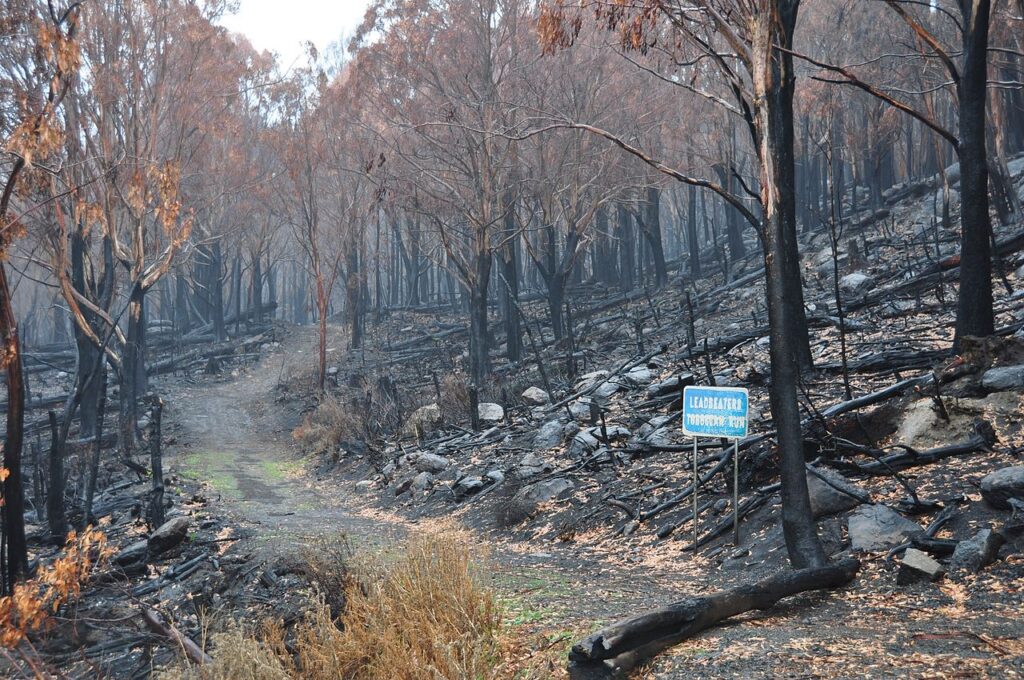
Lake Mountain toboggan run after 2009 Black Saturday bushfires. Peter Campbell
Fueled by extreme heat, high winds, and prolonged drought conditions, the fires swept through Victoria, engulfing entire communities in flames.
The fires resulted in over 500 casualties and destroyed thousands of homes, businesses, and infrastructure, including the almost total destruction of the town of Marysville.
The scale and ferocity of the Black Saturday Bushfires shocked the nation and prompted widespread reforms in firefighting strategies, land management practices, and community preparedness to mitigate the risk of future disasters.
The Peshtigo Fire (1871) – United States
The Peshtigo Fire was the deadliest wildfire in recorded history, devastating the town of Peshtigo, Wisconsin, and surrounding areas. It is typically overlooked because the Great Chicago Fire occurred the same day, October 8, and made nationwide headlines with its destruction, although the Peshtigo Fire was far more destructive by nearly every measurable count.
People fleeing the fire into a river.
The logging industry’s extensive slash-and-burn practices meant huge fires were set to clear land during an incredibly dry season. These fires, combined with heavy winds and a drought, allowed the fire to quickly spread across millions of acres of forestland.
Estimates suggest that between 1,200 to 2,500 lives were lost, and $122 million worth of damage was done. The Peshtigo Fire’s scale and intensity were so immense that it created its own tornado-like weather, making it one of the most tragic and catastrophic wildfires in history.
The Great Fire of 1910 – United States
The Great Fire of 1910, also known as the Big Blowup, was a catastrophic series of wildfires that raged across the western United States, primarily in Idaho, Montana, and Washington, during August 1910.
Fueled by drought, high winds, and dry timber, the fires quickly spread, consuming over 3 million acres of forestland. The blaze claimed the lives of at least 87 people, including firefighters and civilians, and destroyed numerous towns and settlements.
Result of wildfire “hurricane” in a heavy stand of Idaho white pine on Little North fork of St. Joe River, Coeur d’Alene, Idaho
The Great Fire of 1910 remains one of the most significant and devastating wildfires in American history, prompting significant reforms in firefighting techniques and forest management practices.
The 2018 California Wildfires – United States
The 2018 California Wildfires were a series of devastating wildfires that ravaged northern California during the summer and fall of 2018. Among the most destructive was the Camp Fire, which destroyed the town of Paradise.
It became the deadliest and most destructive wildfire in California’s history, with over 18,000 buildings destroyed and $16 billion in damages, over half of the total damages from all of the fires; it was then bypassed in each of the next two years by more destructive fires.
The Woolsey Fire near Malibu on November 9, 2018. Cyclonebiskit
The fires collectively scorched hundreds of thousands of acres (2% of the entire state), forced widespread evacuations, and resulted in over 100 fatalities. The fires were the largest in California history but were bypassed by fires in each of the two following years, prompting a revision of fire policy in the state.
The Black Dragon Fire (1987) – China and Russia
The Black Dragon Fire of 1987 was a catastrophic wildfire that swept across large swathes of forestland in China, even reaching into the Soviet Union.
Fueled by drought conditions and strong winds, the fire consumed over 18 million acres of forest or 1/6th of China’s entire timber supplies. The blaze caused over 500 casualties and did inconceivable damage to local ecosystems, burning 2.5 million acres of land in one of the largest fires in history.
The Black Dragon Fire underscored the importance of effective firefighting strategies, forest management practices, and international cooperation in mitigating the impact of wildfires in vulnerable regions worldwide.
The Ash Wednesday Bushfires (1983) – Australia
The Ash Wednesday Bushfires of February 1983 were a series of devastating wildfires that swept across the Australian states of South Australia and Victoria. Fueled by extreme heat, strong winds, and dry vegetation, the fires rapidly spread, destroying thousands of homes, farms, and businesses.
The fires claimed the lives of 75 people and injured hundreds more, killed nearly half a million animals and livestock, and led to over $800 million in insurance claims, making it one of Australia’s deadliest natural disasters.
Sydney Oats
The tragedy prompted significant improvements in bushfire preparedness, firefighting capabilities, and community resilience measures in Australia, shaping wildfire management practices for years to come.
Despite these new measures, the Black Saturday Bushfires still surpassed this damage to become the worst Australian wildfire in 2009.
The Great Hinckley Fire (1894) – United States
The Great Hinckley Fire was a devastating wildfire that swept through parts of Minnesota on September 1, 1894.
The massive fire destroyed 200,000 acres of land and killed nearly 500 people, destroying multiple towns across the region as flames grew to over 200 feet tall and fire whirls spread quickly.
Ruins of downtown Hinckley after the 1894 fire.
The destruction of local forests had a longstanding impact on the region, known for its logging industry. It remains one of the deadliest wildfires in American history and led to the introduction of the first fire warden of Minnesota to prevent a similar future tragedy.
The Yellowstone Fires (1988) – United States
The Yellowstone Fires were a series of wildfires that swept through Yellowstone National Park in 1988. Park rangers had allowed natural fires to burn through the park throughout the year, monitoring their behavior but ruling they were safe based on the assumption they would be controlled by a typical wet summer.
However, the rain did not come as expected that year and the fires spread exponentially even as rangers attempted to control the blaze.
Throughout the summer of 1988, the fires scorched approximately 793,000 acres of land or a third of the park.
Despite initial controversy and criticism over the management approach of delaying fire prevention, the fires ultimately played a vital ecological role in the park’s ecosystem, rejuvenating forests and promoting new growth.
The Yellowstone Fires highlighted the complex relationship between wildfires and ecosystem health, leading to revised fire management policies.
The Black Summer Bushfires (2019-2020) – Australia
The Black Summer Bushfires, occurring during the Australian summer of 2019-2020, were a series of unprecedented wildfires that ravaged large parts of Australia, affecting nearly 80% of all Australians in some way. Fueled by record-breaking temperatures, prolonged drought, and strong winds, the fires burned millions of acres of land, destroyed thousands of homes, and devastated wildlife habitats.
The fires claimed the lives of 33 people and an estimated 3 billion animals, making it one of the most catastrophic wildfire seasons in Australian history.
Efforts to manage the fires and repair damage cost twenty times that of the fires in 2009 and attracted global attention due to the potential influence of climate change.
The Fort McMurray Wildfire (2016) – Canada
The Fort McMurray Wildfire of 2016 was a devastating wildfire that swept through the city of Fort McMurray in Alberta, Canada. Suspected to be human-caused, the fire quickly spread, forcing the evacuation of over 80,000 residents and destroying thousands of homes and buildings, scorching over 1.5 million acres of land, and costing over $7 billion, becoming the most expensive natural disaster in Canadian history.
The fires also cost the region over $70 million a day as oil fields in the area shut down for worker safety, halting the production of 700,000 barrels of oil a day and contributing to the rise of global oil prices.
Siberian Taiga Fires (2003) – Russia
Despite its global reputation as a largely frozen plateau, Siberia has seen an uptick in forest fires in recent decades that have become some of the most destructive in human history.
In 2003, a series of fires raged across Siberia, reaching into China and Mongolia as well, creating a plume of smoke that stretched as far as Kyoto, Japan.
While not many details of the fire are known, scientists have studied the satellite images of the fires and concluded that the fumes were so extensive that they counteracted nearly all of the emissions cuts that the European Union began working towards with the Kyoto Protocol, furthering the struggle against climate change. The post 11 of the deadliest wildfires in history first appeared on History Defined.


 Rumble

 News Feed (Home)
 Popular Posts
  Events
  Blog
Blog  Market
  Forum
Forum  Headline News
 VidWatch
 Game Zone
 Top PodCasts