YubNub Social YubNub Social
    Advanced Search
  • Login

  • Night mode
  • © 2026 YubNub Social
    About • Directory • Contact Us • Privacy Policy • Terms of Use • Android • Apple iOS • Get Our App

    Select Language

  • English
Install our *FREE* WEB APP! (PWA)
Night mode
Community
News Feed (Home) Popular Posts Events Blog Market Forum
Media
Headline News VidWatch Game Zone Top PodCasts
Explore
Explore Jobs Offers
© 2026 YubNub Social
  • English
About • Directory • Contact Us • Privacy Policy • Terms of Use • Android • Apple iOS • Get Our App

Discover posts

Posts

Users

Pages

Group

Blog

Market

Events

Games

Forum

Jobs

Science Explorer
Science Explorer
2 yrs

Almost 18 Million Adult Americans Have Had Long COVID
Favicon 
www.sciencealert.com

Almost 18 Million Adult Americans Have Had Long COVID

That's 7% of the US population.
Like
Comment
Share
Conservative Voices
Conservative Voices
2 yrs

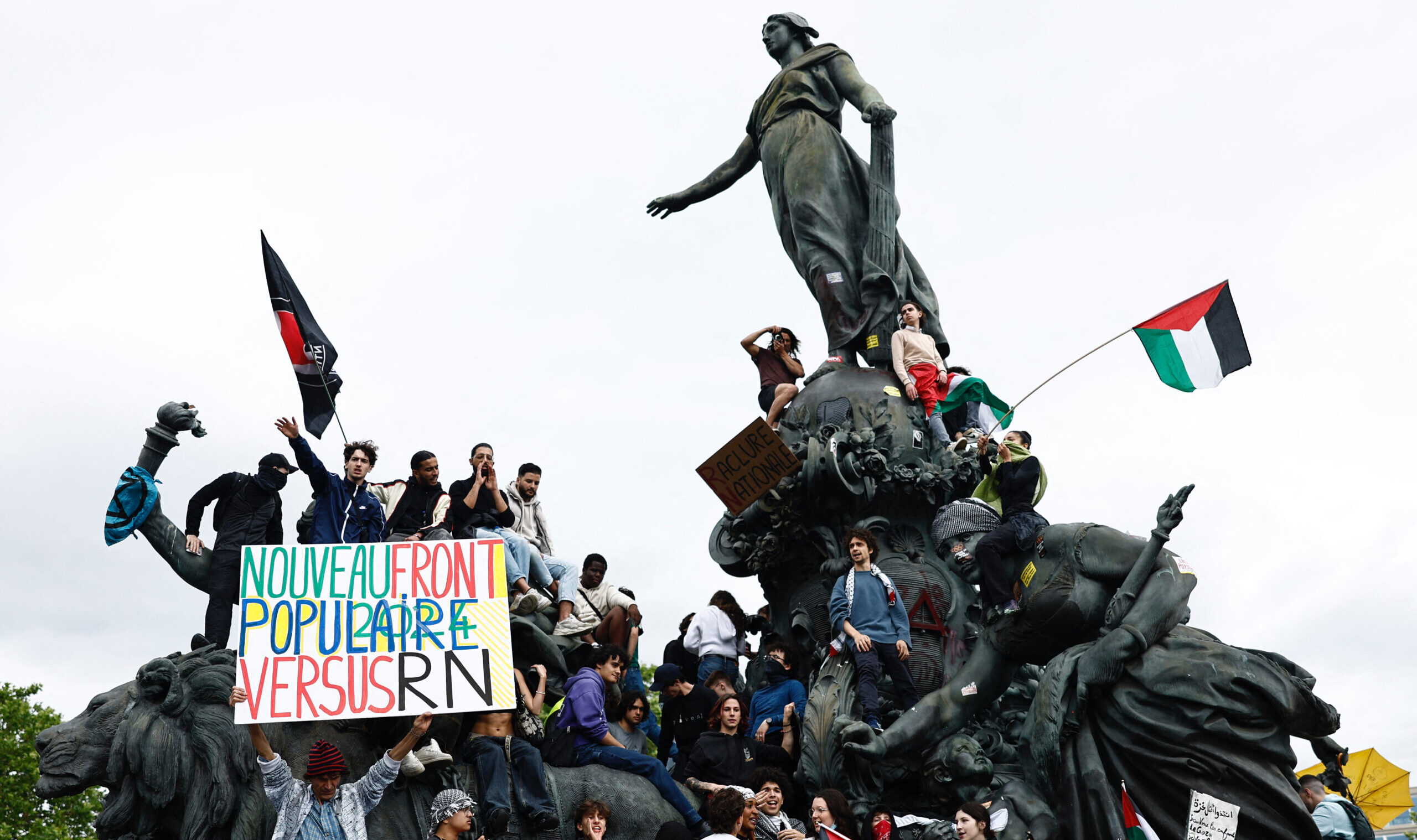
Can France’s Rassemblement National Rally Allies?
Favicon 
www.theamericanconservative.com

Can France’s Rassemblement National Rally Allies?

Foreign Affairs Can France’s Rassemblement National Rally Allies? A coalition between the RN and the Gaullists could be mutually beneficial. Credit: SAMEER AL-DOUMY/AFP via Getty Images France’s Fifth Republic is “impervious” to political extremes—or such has been the contention of generations of political scientists. The regime’s institutional design has indeed hampered outsiders. France’s president and lower house of parliament are chosen in two-round contests that are usually held within months of each other. The provision for a run-off and the near-simultaneous election of the executive and legislature act as a firewall against upstarts.  But on Sunday night, for the first time in the history of the Fifth Republic, the firewall crumbled: The Rassemblement National trounced both President Emmanuel Macron’s ruling coalition (Ensemble) and a left-wing alliance (the Nouveau Front Populaire) in the first round of elections for the National Assembly. The RN–the perennial bete noire of French politics–scored a third of votes at the national level. In more than three dozen constituencies, the party attained an absolute majority in the initial ballot, removing the need for a run-off. The best-laid plans of Charles de Gaulle had come to naught amid the burgeoning popularity of the “far right.” Macron called these snap elections in the aftermath of a crushing defeat in the European elections, in which the RN doubled the vote share of his party. He cast the race for the National Assembly’s 577 seats as a “Who Governs?” election, believing the RN’s checkered past and inexperience would dissuade enough voters. Macron has now decisively lost that gambit: his Ensemble coalition stands to receive fewer than 100 mandates once the lower house of parliament is selected. After last night’s verdict, only two forces can govern: the RN or chaos.  The RN is unlikely to win an outright majority in the Assembly. The first question facing the party, the first test of rule versus chaos, is whether they will be able to form a governing coalition. Doing so challenges long-held norms of French political culture; yet the prospects are not so hopeless as they once seemed. The RN’s ascent has been at once gradual and vertiginous. Back in 2002, the party’s founder, Jean-Marie Le Pen, attracted a mere 20 percent of the vote in the second round of the presidential race. The French public consigned Le Pen père to the fever swamp as a Holocaust denier and an inveterate bigot. Marine Le Pen, who inherited the party from her father, has cared more about capturing power than lobbing antisemitic innuendos over the airwaves. Since taking the reins of the Front National (which she rechristened the RN, in a Gaullist flourish), she has pursued a strategy of dédiabolisation, or detoxification. Le Pen père—in the the tradition of the French right—vociferated against the Fifth Republic, deplored the French Revolution, defended the country’s wartime Vichy Regime, and held Catholic Mass at his rallies. Le Pen fille ends her rallies with chants of Vive la république, promotes herself as a defender of the country’s Jewish community, and recently voted to enshrine the right to abortion in the French constitution. Marine Le Pen’s personal convictions aside, she has proven unwavering in this politics of respectability–so much so that she purged her own father from the party’s ranks.  Marine Le Pen’s RN, freed of paternal encumbrances, can federate many Frenchmen behind its central message: opposition to mass migration and emphasis on the need to restore the authority of the state. The RN’s social profile is no longer restricted to the rogues’ gallery of old: the veterans of Algerie francaise, the nostalgics of Philippe Pétain, the flotsam and jetsam of the Legitimist movement. Le Pen fille’s faction in large measure resembles French society, attracting growing numbers of professionals and elites. The party’s candidate for the premiership is the TikTok star and gendre idéal Jordan Bardella. The party’s new facade has convinced some of the FN’s most determined opponents: Serge Klarsfeld, the famed Nazi-hunter, has appealed to French Jews to back the RN against the left-wing France Insoumise party. In the course of Marine Le Pen’s three presidential runs, the RN has expanded its electorate steadily. Le Pen fille failed to qualify for the run-off in 2012; Macron left her with 33 percent of the vote in 2017; she finally crossed the 40 percent mark in 2022. Macron has pursued divisive policies in his second term that have only aided the RN’s rise, notably a pension reform raising the age of retirement from 62 to 64. Last summer’s race riots further convinced many that mass migration represents an existential threat for the country. The RN’s ascent in the polls has accelerated due to these developments.  Despite the RN’s historic breakthrough, the party’s securing of a majority in parliament is far from a fait accompli. Macron’s Ensemble and the left’s Nouveau Front Populaire have already begun to unite in a front republicain. France’s run-offs can feature three—and even four—candidates in the case of high turnout. The first round results could have produced triangulaires-races between Ensemble, the NFP, and RN in about half of the constituencies. But the NFP and Ensemble have vowed to withdraw third-place finishers in these districts. This accord, announced on live television the night of the election, reduced the RN’s chance of clinching a majority in real time:  The networks BFM-TV and CNews revised down their prediction for the RN’s performance in the second round, from 260–320 seats to 240–270 seats (the party needs 289 seats for a majority). As of press time, Philippe Lemoine, a philosopher and number-cruncher, predicts 265–285 seats for the RN and 16–23 seats for the moderate-right Républicains. The most probable outcome of the second round is a hung parliament. Macron, according to news reports, hopes to assemble a technocratic coalition from among the non-RN parties. But the idea that such disparate factions, running from communists to moderate conservatives, could come to terms seems far-fetched. The French constitution dictates that the new parliament cannot be dissolved for a year. French presidents dispose of broad executive powers, but require a docile parliament to exercise them. Macron’s “arc républicain” might soon descend into chaos and produce a full-blown constitutional crisis. France’s Républicains could save the country from a stalemate. The right-wing party, the much-diminished heirs of De Gaulle, splintered in the run-up to these elections. Eric Ciotti, LR’s erstwhile chief, led several dozen candidates into an alliance with the RN. Ciotti’s move, a break with the republican right’s time-honored cordon sanitaire, precipitated a schism in the party. The LR’s civil war has descended into melodrama—Ciotti at one point locked his opponents out of the party’s headquarters to prevent them from expelling him.  LR’s brass could still follow the same path as their maverick. François-Xavier Bellamy, the party’s standard-bearer in the European elections, has opined that “the far left represents the greater danger” for France. He has refused in private conversations to dismiss the possibility of participating in a coalition with the RN. LR’s other bigwigs have declined to endorse a front républicain, advising adherents to vote their conscience.  On the morrow of the run-off, LR could hold the position of kingmaker, and will have to make a fateful choice: maintain the cordon sanitaire in the name of republican probity or discard it to form a working majority with the RN. LR, which shares much of the RN’s program on migration and security, could advance an ambitious legislative program. LR’s presence in the coalition might also blunt the RN’s latent authoritarian tendencies, ensuring respect for the rule of law and the Fifth Republic’s institutions. The party’s cooperation with the far-right might, on the other hand, deprive it of a raison d’étre and send many of its voters into the arms of Macron’s center. LR’s chiefs ought to pray for the discernment of the late and lamented De Gaulle. The post Can France’s Rassemblement National Rally Allies? appeared first on The American Conservative.
Like
Comment
Share
Conservative Voices
Conservative Voices
2 yrs

From Globalism to America First Geoeconomics
Favicon 
www.theamericanconservative.com

From Globalism to America First Geoeconomics

Foreign Affairs From Globalism to America First Geoeconomics Trump continues to provide a stronger paradigm for American economics in 2024. Credit: Scott Olson/Getty Images With the recent emergence of two adversarial geopolitical blocs, the fantasy of a “liberal world order,” which is currently driving President Joe Biden’s foreign economic policy, must be buried. The old globalist geoeconomic policies are nothing short of a security risk in the tense geostrategic environment created by the revisionist and expansionist actions of the authoritarian bloc of China, Russia, Iran, and North Korea.  While the Biden administration did keep in place Trump’s tariffs and introduced some additional trade restrictions against China, it also gutted semiconductor export controls with indefinite exemptions for several of the world’s largest chip-makers and its “small yard, high fence” policy is not far-reaching enough to confront China. We are not seeing today the decisive policy adjustments demanded by this historical moment. It is time for an America First geoeconomic strategy: A comprehensive plan for America’s foreign economic relations that starts with the successful policies of the Trump administration but expands and adapts them to reflect today’s sharpened conflict with the authoritarian bloc. To members of the global economic elites and the Washington foreign policy establishment alike, Trump’s economic policies are heresy. He challenges China with tariffs and decoupling, he wants to increase oil and gas production and eliminate subsidies for green energy, and he promises to stop illegal immigration and deport massive numbers of illegal aliens. Such policies are not only at odds with the liberal internationalist grand strategy of the post-Cold War era but, its critics argue, also plainly wrong and self-defeating from a cost-benefit perspective according to traditional economic models.  Nevertheless, Trump’s policies make perfect sense when one progresses from a narrow economic analysis to incorporate strategic considerations, or what national security experts refer to as geoeconomics. In plain English, Trump’s foreign economic policies are solidly grounded in both foreign security and domestic prosperity American interests. They introduce essential economic adjustments to account for foreign security threats. The former National Security Adviser Robert O’Brien makes the same point persuasively in a recent article: Trump’s economic policies are sharply focused on increasing the prosperity of the American people and not on solving “global challenges” as liberals would prefer. After all, as the 2017 National Security Strategy aptly put it, “economic security is national security.”  Trump’s three most consequential and controversial economic policies were decoupling selectively from China, pursuing American energy dominance, and cracking down on illegal immigration. All three should be revived and expanded in a second Trump term.  First, the most important strategic challenge facing the United States today, and likely in its history, is China’s quest for Asian and eventually global hegemony. In response, the United States must urgently decouple from China in all national security-related sectors and, over time, selectively in other areas as well. The Biden administration’s weaker versions of this policy, like “de-risking”, are too timid. The U.S. and China are in a new cold war, not merely in a “competition,” as the Biden administration calls it. As Oren Cass has warned, many Washington policymakers and business leaders wrongly assume that the U.S. and China can still have an economically symbiotic relationship despite their incompatible geostrategic goals: “No one considered seriously an integration of the American and Soviet economic systems. We only countenanced a coupling with China because we assumed wrongly that it would lead to [China’s] economic and political liberalization.”  There are several policy options for Washington to decouple its economy from Beijing’s in a way that minimizes economic costs to U.S. consumers and businesses. First, the U.S. should increase domestic production of strategically important products such as microchips and semiconductors. Second, when manufacturing in the U.S. is not feasible, Washington should reconfigure global supply chains through “friend-shoring.” In order to eliminate Chinese companies from the supply chains, the U.S. and its partners should incentivize and pressure corporations in strategic industries to shift production out of China and to other lower-cost countries. The apparel industry has already done so in response to grave human rights violations in China. The U.S. and its allies should also help developing countries interested in hosting these companies in the design of economic incentives packages for private companies from the free world. Third and last, Washington needs to disentangle capital and investment flows between China and the United States, and enlist other Free World countries to this cause as well. As Robert Lighthizer, Trump’s U.S. Trade Representative, told Congress, China’s civil-military fusion strategy and the overt or covert control exercised by the Chinese Communist Party over Chinese companies implies that Western investments in putatively private companies end up supporting the Chinese civil-military industrial complex.  The second major area in which geopolitical calculations shape Trump’s foreign economic policy is the pursuit of “energy dominance.” Not only would lowering the cost of energy through exploitation of America’s oil and gas resources provide the American people with a cheap source of energy and lower inflation, but such a policy would also strengthen America’s geostrategic position vis-à-vis China and its expansionist partners. Trump’s energy policy starts from the fact that the United States is endowed with enormous reserves of oil and gas, and world-class industrial know-how in energy extraction, refining, and transportation. Therefore, Washington has the ability to achieve not just energy independence and security, but global energy dominance through decisive impact on world energy prices and supply.  Therefore, it should be an American priority to use its oil and gas strategic assets to advance American interests in the global energy market, an arena in which geopolitical considerations have always mattered just as much as pure commercial ones. A key element of this policy should be a recognition that fossil fuels will not be replaced in the foreseeable future by renewables. It is therefore important that the U.S. produces so much natural gas that it can also supply its European allies and help them decrease their dependence on Russian gas. This would be for the U.S. both a geopolitical win and a financial success. At the same time, the U.S. should continue to invest in the research and development of other energy resources to maintain its position at the forefront of the global energy industry. Third and last, the Trump administration adopted strict policies on border security and immigration to keep Americans safe and prosperous. President Biden is focused on the financial benefits of migration to the overall U.S. economy and, in line with globalist tenets, on the presumed duty of Americans to raise living standards around the world. Biden encouraged the migration of millions of people, both legally and illegally. In recent speeches, former president Trump decried the current chaos at our southern border. He pointed out that it creates an acute terrorism risk and is responsible for the death of over 100,000 Americans every year through the smuggling of fentanyl and other drugs. The current illegal immigration wave also reduces the quality of life of Americans by crowding public schools, straining the medical system, and increasing criminal activity. Reinstating the border control measures of the Trump administration and initiating mass deportations of illegal aliens would reverse many of these severe risks and harsh costs imposed on the American people. The foreign economic policies of the Trump administration blended strategic and economic considerations for the security and prosperity of the American people. It is time to abandon the current globalist approach and adopt pragmatic measures such as the ones proposed above to establish an America First geoeconomics paradigm. The post From Globalism to America First Geoeconomics appeared first on The American Conservative.
Like
Comment
Share
Bikers Den
Bikers Den
2 yrs ·Youtube General Interest

YouTube
This Could've Ended Bad
Like
Comment
Share
Worth it or Woke?
Worth it or Woke?
2 yrs

The Forge
Favicon 
worthitorwoke.com

The Forge

The post The Forge first appeared on Worth it or Woke.
Like
Comment
Share
Classic Rock Lovers
Classic Rock Lovers  
2 yrs

Ozzy Osbourne’s favourite Paul McCartney song
Favicon 
faroutmagazine.co.uk

Ozzy Osbourne’s favourite Paul McCartney song

No band had a greater influence on tehe Black Sabbath singer. The post Ozzy Osbourne’s favourite Paul McCartney song first appeared on Far Out Magazine.
Like
Comment
Share
Conservative Voices
Conservative Voices
2 yrs

‘All America Lies at the End of the Wilderness Road’
Favicon 
spectator.org

‘All America Lies at the End of the Wilderness Road’

It has been precisely 248 years since the patriots of ’76 affixed their lives, fortunes, and sacred honors to the cause of national independence, and their posterity today appears to be more confused and unsure of who they are and where they come from than at any other point in the nation’s history. This is not an organic development, nor an unfortunate accident of history, but a byproduct of a concerted and intentional campaign — begun more than 50 years ago — to abstract America out of existence, replacing the entirely real nation and people with a series of “principles” and abstract maxims that melt down our actual heritage and identity into a thin classroom theory. This political project has been advanced, in slightly different (though ultimately quite similar) forms, by the establishment Right and Left alike. But it is perhaps most evident today on the Left, which — after having spent the past decade lecturing anyone who was unfortunate enough to be within earshot about America’s unique evils — has suddenly rediscovered “patriotism,” or at least something that resembles it enough to convince the most gullible members of the electorate. (It’s just a coincidence, of course, that this rediscovery coincided with the precise moment that Democrats regained control of the White House). The most recent example of this tendency came from Barack Obama, who took the nation’s 248th Independence Day as an opportunity to tell us exactly what he thinks of America. “The Fourth of July,” the former president wrote, “is about celebrating the big, bold, inclusive experiment that is our American democracy. And it has always been an experiment. Our democracy has never been guaranteed, which means we can’t take it for granted. We need to keep fighting for it, keep improving it, and keep making sure it reflects the better angels of our nature instead of the worst. That, more than anything, is what America is all about.” I came of political age in 2016, so Obama’s presidency was just before my time. But one thing I have learned, in the years since, is that he had — and still has — a sort of diabolical genius for smuggling radical ideas into seemingly blasé, vaguely patriotic-sounding statements. This is a distinctive tendency in modern progressive rhetoric, but Obama is perhaps the single best representative of it. The aforementioned July 4 post is one such example of this. With a series of brief, breezy passing remarks, the statement makes America so abstract that it may as well not exist at all. As I noted on X, “if they weren’t paying close attention, statements like this would probably strike most Americans as broadly unobjectionable. You have to actually read closely — and slowly — to understand the breathtaking radicalism of a statement like this. Then, and only then, you’ll realize that if the fundamental meaning of America is to ‘keep improving,’ then America doesn’t mean anything at all. It really is merely an abstract proposition, a set of aspirations that we’ve never quite reached.” Obama’s patriotism, and the broader genre of progressive patriotism it represents, is a thin, conditional affair: America is good so long as it continues to become more and more like the country that they wish it was. (“I believe in the country American could be” is a simple, succinct summarization of this view that one hears, from time to time, in moments where the Left feels compelled to express some kind of affection for their country). It is a contractual patriotism, and when America fails to live up to its side of the bargain, progressives swiftly default on theirs. The four years of vicious, totalizing anti-Americanism that the nation was treated to during the Trump years — followed by the sudden reversal that occurred almost immediately after Trump left office — is a testament to this dynamic. But America is not an abstraction. It is neither an idea (as neoconservatives on the Right would tell you) nor a dream of what might be (as progressives on the Left would have you believe). It is a place, a people, and a shared way of life, that — beleaguered as it may be — remains wonderful and unique and exceptional in a dazzling array of ways. More importantly still, it is ours. It is our home. We have obligations to it that precede any ideology or partisan commitments. What is America? America is front porches, high school proms, skyscrapers, small-town museums tucked away on the corner of Main Street, the roar of the crowd in a football stadium, and highway diners where the waitresses never let your coffee cup make it to empty. America is the secret wonders lying at the end of a wilderness road, the hidden worlds, right here in your own country, lying in wait for you to discover. America is anybody with a car and a little gas money making off across the magical continent, chasing “all that raw land,” as Jack Kerouac wrote, “and all that road going, and all the people dreaming in the immensity of it.” It’s mountains that block out the sky, salt flats that stretch on into the horizon, canyons so deep it gives you vertigo just to look down them. It’s the misty ancient rocks of Maine, the vast darkness of the forests of Oregon, the ethereal red rocks of Utah and New Mexico. It’s turkey on Thanksgiving, presents under the tree on Christmas, candy on Halloween, firecrackers on the Fourth of July. It’s Neil Armstrong stepping out onto the moon, Miles Davis crooning on the trumpet, Babe Ruth sending another one into the bleachers. It’s all that and much more besides, and it belongs to us, and only us, and no one else other than us. Don’t let anyone — right, left or center — ever tell you otherwise. “All America,” wrote T.K. Whipple, “lies at the end of the wilderness road, and our past is not a dead past, but still lives in us. Our forefathers had civilization inside themselves, the wild outside. We live in the civilization they created, but within us the wilderness still lingers. What they dreamed, we live, and what they lived, we dream.” The post ‘All America Lies at the End of the Wilderness Road’ appeared first on The American Spectator | USA News and Politics.

Like
Comment
Share
Conservative Voices
Conservative Voices
2 yrs

The Religious Bifurcation Splitting America’s Future
Favicon 
spectator.org

The Religious Bifurcation Splitting America’s Future

One of the largest cultural shifts in the last hundred years has occurred in the world of American religion. In the early 1970s, just one in twenty adults in the United States told survey administrators that they had no religious affiliation. Over the next two decades, that number would imperceptibly creep up to 7 percent, but few outside the academic community paid much attention to the rise of the “nones.” However, around 1991, the slope of that line became impossible to ignore.  Between 1991 and 1998, the share of Americans with no religious affiliation doubled from 7 percent to 14 percent. By 2012, nearly one in five respondents indicated that they were “nones” in the General Social Survey. The trend line continued its upward trajectory, and, by 2021, almost 30 percent of Americans claimed no religious affiliation. Among members of Generation Z (those born in 1996 or later), the percentage of “nones” now exceeds 40 percent. Thus, there’s ample reason to believe that the rise of the “nones” will continue for the next several decades. Many believe that this data points to the conclusion that religion is receding in the United States and that we will soon become a country resembling Western European nations like Denmark or Sweden, where churches have become museums and faith has no place in the public square. However, a closer examination provides reason to reject this hypothesis. Just because a significant portion of Americans have left houses of worship over the last three decades does not mean that religion is fading in the United States. In fact, the opposite may be true. Subscribe to The American Spectator to receive our latest print magazine, which includes this article and others like it. Consider this simple fact. In 1972, 17 percent of all American adults were classified as evangelicals based on the answers they gave to a series of religious affiliation questions in the General Social Survey. By 2018, that same share had risen to 23 percent. In the early 1970s, there were approximately thirty-five million American evangelicals, and that number had surged to seventy-five million by the late 2010s. The “nones” are rising, but not at the expense of American evangelicalism. In reality, evangelicalism in the United States may never be stronger than it is right now. In the 1970s, about 45 percent of evangelicals reported attending religious services nearly every week or more. According to data collected in 2021, that share has now risen to above 60 percent. So, not only have evangelicals grown in size by forty million over the last several decades, but the overall religious devotion of those evangelicals has also never been higher. We’ve seen other religious traditions, such as Black and mainline Protestants, hold steady when it comes to their religious attendance. A growing number of people are leaving religion behind, but, for those who remain attached to a religious tradition, devotion has never been stronger. One outlier in the previous graph, however, is Roman Catholics. In the 1970s, about half of all Catholics reported attending Mass nearly every week or more. That percentage has plummeted over the last several decades. Currently, only a quarter of Catholics are weekly Mass attenders, which is the lowest percentage of any Christian group. In the 1970s, Catholics were easily the most religiously engaged. But there is emerging anecdotal evidence that suggests a resurgence in some types of Catholicism. In the last few years, there has been an explosion in parishes that offer the traditional Latin Mass, and reports indicate that the number of participants in this expression of the Catholic faith has grown rapidly, while attendance at contemporary Masses continues to wane. This article is taken from The American Spectator’s latest print magazine. Subscribe to receive the entire magazine. This points to a reality that scholars of religion have been aware of for decades: demanding religious traditions tend to retain adherents and attract new members at higher rates than religious groups that do not require much from their followers. What this means is that groups with stringent rules about marriage, family, worship, and dress, such as Hasidic Judaism, are growing rapidly. Another rapidly expanding group is Pentecostal Christianity; certain sects prescribe that women maintain long hair and wear skirts. One potential explanation for the success of these groups is their insularity. Many adherents are at their house of worship on a daily basis, which affords members a tremendous opportunity to build social bonds with other members of the congregation. These groups thrive because members are taught to lean on each other for their needs and to reject larger society. On the other hand, the religious traditions that have seen the most dramatic declines in the last several decades are the ones that do not create a clear separation between them and the rest of the world. In the late 1950s, over half of all Americans were members of a mainline Protestant church, e.g., United Methodist, Episcopalian, and the United Church of Christ. The leaders of these denominations once had tremendous influence on more than spiritual matters; they were able to shape culture and politics in their own image. The collapse of the mainline, however, is unmistakable; just take a look at the membership records of the largest denominations. The Disciples of Christ has seen its numbers decline by 74 percent since 1987. For the Epsicopalians, the drop is 38 percent. It’s 43 percent for the Evangelical Lutheran Church of America. In total, the mainline has lost over ten million members in just the last three decades. Why has this happened? Some scholars claim that these denominations made religion too easy. They did not require members to set themselves apart from the world; instead, they encouraged them to treat their neighbors more generously and be better parents while neglecting to implore attenders to have their lives radically changed by their faith in Jesus Christ. Thus, over the last thirty years, Americans who were marginally attached to religion have slowly slipped away from houses of worship and become part of the increasing number of “nones.” In essence, American religion has gone through a purifying process, much like a chef making a reduction on a stovetop. What began as a large pot of liquid with some spices and seasonings has reduced to half the volume but with a much more concentrated flavor. Those who were lukewarm about their attachment to religion have evaporated from the pot, leaving only the most devout believers with the strongest attachment to their faith. In the end, what the United States will be left with in a decade or two is a tremendous amount of religious polarization. The share of Americans with no religious affiliation will likely reach 40 percent — the highest on record. But, on the religious side of the spectrum, there will be increasing numbers of evangelicals, traditional Catholics, Latter-day Saints, Orthodox Christians, and Muslims who have never been more devoted to their faith. This will inevitably make governing more difficult. The United States Constitution prescribes a system of governance that is predicated on compromise. Even in the best of times, securing an agreement among Congress and the president for a major policy change can be nearly impossible.  The future of American society will be a constant state of conflict between a large, organized group of individuals who want to reshape the United States in alignment with their religious values and a growing number of Americans who pay no heed to religious texts or traditional values. Ultimately, the cultural shift that may put an end to the American experiment could be the growing phenomenon of religious polarization. Ryan Burge is a statistician of American religion and a Baptist pastor. Subscribe to The American Spectator to receive our latest print magazine on the future of religion in America. The post The Religious Bifurcation Splitting America’s Future appeared first on The American Spectator | USA News and Politics.
Like
Comment
Share
Conservative Voices
Conservative Voices
2 yrs

Reining in the Regulators: Loper Bright Enterprises and the Chevron Decision
Favicon 
spectator.org

Reining in the Regulators: Loper Bright Enterprises and the Chevron Decision

Amid decisions about presidential immunity and abortion pills, the Supreme Court heard a case regarding the overregulation of New England fishermen that may not seem important. However, the court’s decision in Loper Bright Enterprises v. Raimondo offers the promise of reducing the aggravation, expense, and intrusion of government regulation for almost every American business and citizen. Indeed, the hidden monetary costs of regulation are now running annually at $14,000 per family in the United States. A decision that reins in the costly government regulators is one that deserves our attention. Why is this 6–3 decision, Loper Bright, involving commercial fishing already sending shock waves through the federal regulatory apparatus and producing loud objections from the pro-regulation Left? The facts of Loper Bright vividly dramatize its impact upon a group of hardworking owners of fishing businesses that face what many American face, namely, regulatory overkill. Put briefly, in this case, National Marine Fisheries Service (NMFS), a federal agency that regulates the size of commercial fishing catches to prevent “over-fishing,” simply went too far. Fishing enterprises operating in New England waters, like the New Jersey-based, family-owned company Loper Bright Enterprises, had already put up with government observers required to be on board their vessels to assure compliance with limits on catches. If that was not enough, the NMFS decreed under new regulations that the fishermen must pay the salaries of the observers, which would cost each boat owner about $710 per day. That was too much to take without putting up a fight. Though Loper Bright Enterprises and other commercial fishing companies that joined in the lawsuit lost in the lower federal courts, the Supreme Court agreed to take their case and has now ruled in their favor, and therefore in favor of all overregulated Americans. What did the Supreme Court do to tighten the reins on the regulators? Since 1984, the courts had been governed by the language of a case called Chevron (Chevron U.S.A. Inc v. Natural Resources Defense Council). That case required the courts to follow a process when they were called upon to review federal agency regulations challenged in court by a business or individual refusing to accept regulations that seemed excessive. However, if the agency successfully claimed that the U.S. Congress had been silent or ambiguous in defining the powers of the agency, then the courts had to defer to the reasonable interpretation of the federal agency. Since “ambiguity” was relatively easy to find, often because Congress regularly produced poorly drafted legislation, the courts were put in the position of having to defer to the interpretation of the federal agency. Following the Chevron formula, called “judicial deference,” repeatedly meant a victory for the regulators and a loss for the citizen or business challenger. In fact, in the Loper Bright case, the lower federal courts “deferred” to the NMFS using Chevron. Fortunately, the Supreme Court, long unhappy with Chevron, abandoned the Chevron approach, overruled it, and vacated (canceled) the holdings of the lower courts. That meant a win for Loper Bright and its fellow commercial fisheries in New England and a loss for the federal agency. But what does Loper Bright mean for other American businesses and citizens? It means that the four-decade-long “Chevron era” is now over. The Chevron case that quickly became the favorite of the federal courts, cited in a remarkable 11,760 judicial decisions and adding 1,000 new citations each year, is now a dead letter. Cases like Loper Bright, where an administrative agency claimed power well beyond what Congress intended, will be greatly diminished. The boldness of the regulators in grabbing more regulatory power will be made less likely.       How did the court extricate itself from forty years of Chevron? The Supreme Court opinion is both measured and hard-hitting at the same time. The substance of the opinion begins where most beginning law students start, with well-deserved attention to Chief Justice John Marshall’s opinion in the 1803 case of Marbury v. Madison. In that landmark case, Marshall declared that “[I]t is emphatically the province and duty of the judicial department to say what the law is.” For decades between Marbury and Chevron, it was the role of the federal courts under Article III of the Constitution to discern the meaning of a statute passed by the legislative branch. Even with the New Deal expansion of the administrative state, Chief Justice John Roberts reminds us in the Loper Bright decision, the courts “still adhered to the traditional understanding that questions of law were for courts to decide, exercising independent judgment.” But there is more. Roberts cites the Administrative Procedure Act (APA) passed by Congress in 1946, clearly designed to check federal regulatory agency excesses. The opinion stresses that the APA warns agencies that it “remains the responsibility of the court to decide whether the law means what the agency says [it means].” Unfortunately, writes Roberts, the APA was basically ignored by Chevron. Simply put, “Chevron turns the statutory scheme for judicial review of agency action upside down.” The decision in Loper Bright restores the rightful authority of the courts under Article III of the Constitution and the APA to engage in the interpretation of the statutes that Congress passed. This interpretative function is arguably the primary activity of the appellate courts. In Loper Bright, the court’s proper authority has been unambiguously returned to them. In case there is any doubt, the Roberts’ opinion bluntly refers to Chevron as misguided, flawed, unworkable, at odds with Article III, and the APA, fostering instability, and undermining of the rule of law. The message is pointed and unmistakable. The era of federal court deference to the interpretations of regulatory agencies is over. As Justice Neil Gorsuch puts it in his concurring opinion, “the court places a tombstone on Chevron that no one can miss.” What will Loper Bright mean for the regulatory future? First, it will likely produce a flurry of court challenges by businesses and individuals to proposed regulations, since the absence of Chevron will make the playing field between litigants and federal agencies more even. Secondly, federal executive agencies — the EPA, the EEOC, OSHA, IRS, the NLRB, and the many other federal executive agencies — will be more cautious in drafting proposed new regulations under their rule-making powers now that they do not have the advantage that deference to their interpretations gave them under Chevron. Will the overruling of Chevron create instability for prior decisions? Chief Justice Roberts makes the answer to that question clear: “We do not call into question prior cases that specific agency actions are lawful … despite our change in interpretive methodology.” In summary, the courts will return to their proper interpretative role and the federal agencies will be required to stay within the powers given them by Congress, no less, but no more. The post Reining in the Regulators: <i>Loper Bright Enterprises</i> and the <i>Chevron</i> Decision appeared first on The American Spectator | USA News and Politics.
Like
Comment
Share
Conservative Voices
Conservative Voices
2 yrs

Six States Put Abortion on the Ballot, With More to Follow
Favicon 
spectator.org

Six States Put Abortion on the Ballot, With More to Follow

As of this week, citizens of six states will vote on abortion-related ballot initiatives come Nov. 5. Efforts to place similar initiatives on the ballot are underway in five additional states. In many states, pro-abortion efforts are raking in far greater contributions than the pro-life groups opposing the proposals. As much as it would help to change hearts and minds, pro-life advocates could stand to put their money where their mouth is, too.  Keeping Abortion Legal Though abortion is already legal in New York and Colorado, pro-abortion activists are hoping to enshrine abortion access in the states’ constitutions.  In New York, which only limits abortions after fetal viability, the Equal Rights Amendment would expand the state constitution’s ban on discrimination to include “ethnicity, national origin, age, disability, sex, sexual orientation, gender identity, gender expression, pregnancy, pregnancy outcomes and reproductive healthcare and autonomy.” The amendment would create protections for women who obtain abortions and has received support from pro-choice Democrats, as well as Planned Parenthood of Greater New York, Planned Parenthood Action Fund, and the National Institute for Reproductive Health.   Colorado currently has no limits on abortion, and the Colorado Right to Abortion and Health Insurance Coverage would add a right to abortion to the state constitution and permit the use of public funds for abortions. The initiative needs a supermajority of 55 percent of votes to pass, but support for the amendment is well-funded and well-organized. According to Ballotpedia, Coloradans for Protecting Reproductive Freedom has reported $4.48 million in contributions and $3.67 million in expenditures in support of the initiative. By contrast, opposing groups Pro-Life Colorado Fund and Vote No on 89 have registered $1400 and spent just over $200.  In Maryland, too, abortion activists have added the Maryland Right to Reproductive Freedom Act, which would enshrine the state’s permissive abortion laws into the constitution.  (RELATED: Chemical Abortion Enables Democrat Anti-Life Agenda) In Nevada, pro-abortion activists have put the Nevada Right to Abortion Initiative on the ballot, which would grant constitutional protection to the state’s existing laws, which permit abortion up to 24 weeks. As of April 1, the supporting PAC raised over $3.2 million in contributions, while the opposing PAC reported no contributions. The next deadline for scheduled reports is mid-July, though it’s unlikely that the group opposing the initiative can regain lost ground. Challenging Abortion Bans with Direct Democracy For other states, however, pro-abortion ballot initiatives are more than just political theater. Florida voters will weigh in on Governor Ron DeSantis’s six-week ban via ballot proposal this November. The Right to Abortion Initiative would provide a constitutional right to abortion prior to fetal viability.  In April, polling among registered voters in Florida indicated that about sixty percent of voters support expanding abortion access up to fetal viability — the threshold necessary for the initiative to pass. But other polls signaled greater uncertainty about the referendum’s outcome. Data published in April by Forbes indicated that 42 percent of voters planned to vote in favor of expanding abortion access, 25 percent of voters would vote against the initiative, and about 32 percent of voters were undecided.  Unfortunately, American elections generally follow a simple rule: Whoever spends the most money wins. As of last month, the pro-abortion Floridians Protecting Freedom campaign raised $32.26 million in contributions, compared to $270 thousand raised by Florida Voters Against Extremism, the group organized in opposition to the initiative.  Returning to Roe Pro-abortion activists are hoping to circumvent abortion bans in South Dakota, as well. Constitutional Amendment G, the Right to Abortion Initiative, would replace the state’s total ban with the original framework from Roe v. Wade. Under Constitutional Amendment G, the state could not regulate abortion in the first trimester of pregnancy, could regulate abortion in the second trimester only when “reasonably related to the physical health of the pregnant woman,” and could regulate or fully prohibit abortion in the third trimester except for when “medically necessary.” (RELATED: Abortion Isn’t Funny) Unlike other ballot initiatives, contributions in support of and opposition to South Dakota’s constitutional proposed amendment are relatively balanced. As of May 15, Dakotans for Health had raised $350 thousand in support of the Roe framework, and Life Defense Fund had raised $267 thousand in opposition to the initiative.  Polling conducted by South Dakota State at the end of 2023 indicated that “there is not a majority in either the pro-life or pro-choice direction on abortion policy.” About 48 percent of voters supported the pre-Dobbs framework, with 40 percent opposed. Though South Dakota’s abortion laws maintain an exception for maternal health, the majority of voters objected to the lack of an exception for cases of rape and incest. Fifty-nine percent of voters strongly supported an exception in that instance, with an additional 18 percent of voters saying they “somewhat support” the exception. Ballot Initiatives Pending Five additional states could place abortion on the ballot in the coming weeks and months. In Missouri and Montana, proposals are awaiting legislative approval by the legislature before they are added to the ballot. In Nebraska, competing groups just submitted the requisite signatures for their respective ballot proposals — one that would create a constitutional right to abortion, and one that would codify the state’s existing 12-week abortion ban in the state constitution. In Arizona, too, pro-abortion activists have submitted twice as many signatures as needed to put the proposal to a vote in November. The only state facing a barrier thus far is Arkansas, which still needed 5,800 signatures on Wednesday afternoon before its July 5 filing deadline.  We’ve heard quite a lot about how this election is a critical juncture for our democracy. That up to eleven states will take a vote on the mass industrialized slaughter of the unborn indicates that our sacred democracy may have taken a wrong turn decades before the 2024 ballots were printed.  Mary Frances Myler is a contributing editor at The American Spectator. She graduated from the University of Notre Dame in 2022.  READ MORE by Mary Frances Myler:  Pornhub Blocks Access in Five States with New Age-Verification Laws More Catholics Believe in the Eucharist than Previously Thought Sen. Vance, Rep. Cloud Introduce Legislation to Dismantle DEI The post Six States Put Abortion on the Ballot, With More to Follow appeared first on The American Spectator | USA News and Politics.

Like
Comment
Share
Showing 21705 out of 56670
  • 21701
  • 21702
  • 21703
  • 21704
  • 21705
  • 21706
  • 21707
  • 21708
  • 21709
  • 21710
  • 21711
  • 21712
  • 21713
  • 21714
  • 21715
  • 21716
  • 21717
  • 21718
  • 21719
  • 21720

Edit Offer

Add tier


Select an image
Delete your tier
Are you sure you want to delete this tier?

Reviews

In order to sell your content and posts, start by creating a few packages. Monetization

Pay By Wallet

Payment Alert

You are about to purchase the items, do you want to proceed?

Request a Refund