YubNub Social YubNub Social
    Advanced Search
  • Login

  • Night mode
  • © 2026 YubNub Social
    About • Directory • Contact Us • Privacy Policy • Terms of Use • Android • Apple iOS • Get Our App

    Select Language

  • English
Install our *FREE* WEB APP! (PWA)
Night mode
Community
News Feed (Home) Popular Posts Events Blog Market Forum
Media
Headline News VidWatch Game Zone Top PodCasts
Explore
Explore Jobs Offers
© 2026 YubNub Social
  • English
About • Directory • Contact Us • Privacy Policy • Terms of Use • Android • Apple iOS • Get Our App

Discover posts

Posts

Users

Pages

Group

Blog

Market

Events

Games

Forum

Jobs

Gamers Realm
Gamers Realm
2 yrs

How to craft the Totem of Return in LEGO Fortnite
Favicon 
www.pcinvasion.com

How to craft the Totem of Return in LEGO Fortnite

If you plan to take on the Expert Mode in LEGO Fortnite, you might need more help. This is where the Totem of Return comes into play. LEGO Fortnite: How to craft the Totem of Return  To create these totems, you have to earn a resource called Storm Cores. These cores can be earned by defeating the tougher enemies in Expert Mode called Storm Wild enemies, who only appear in this mode. They hit harder, can withstand more damage, and seem to move faster. So when fighting these creatures, ensure you have health items to buffer attacks. Your best bet would be food items from animals. They’re more common and easier to come by. Plus, you make stronger health items with them. Image: Epic Games Upon earning a core, you’ll get the recipe to craft the Totem of Return. The more you earn from Storm Wild enemies, the more totems you can bank.  How does the Totem of Return work? It’s in the name. When you die in Expert Mode, you get sent back to your bed. So, in case you...
Like
Comment
Share
Gamers Realm
Gamers Realm
2 yrs

How to spray Metallica concert images in Fortnite
Favicon 
www.pcinvasion.com

How to spray Metallica concert images in Fortnite

The Metallica collab event gives us tons of new tasks to complete. Some are more obtuse than others, so let me show you how to spray Metallica oncert images in Fortnite. How to use the Metallica spray in Fortnite The quest description is a little unhelpful, as it suggests you need to use a specific spray for the challenge. All you need to do is head to one of the designated spots and bring up your emotes and sprays wheel (down on Dpad). If you’re standing in the right place, the only available spray is the Metallica one you need for the challenge. Screenshot: PC Invasion You do not need to own any special Sprays. Don’t do what I did and sift through your Spray collection, as you already have everything you need. I’m not big on Sprays myself, but you get the Metallica Spray to use whenever you like after beating the challenge. Where should I go for the Metallica spray challenge? Screenshot: PC Invasion You can see every available location for the c...
Like
Comment
Share
Gamers Realm
Gamers Realm
2 yrs

How to start and access Pathfinder WOTR Dance of Masks
Favicon 
www.pcinvasion.com

How to start and access Pathfinder WOTR Dance of Masks

Once you finally get your hands on A Dance of Masks DLC for Pathfinder WOTR, how can you start and access the new content? There are a few prerequisites to gaining access to the new adventure, so let’s review them. Pathfinder WOTR Dance of Masks: How to start and access the DLC Screenshot: PC Invasion Many players may be wondering if you must create a whole new character to experience the Dance of Masks DLC for Pathfinder Wrath of the Righteousness. In short, you can access and start the adventure for A Dance of Masks in Pathfinder WOTR by making it to Act 5 and entering the Citadel. Since this DLC happens at the start of Act 5 of the main campaign for Pathfinder, if you’re past that point you won’t be able to start A Dance of Masks. I’d make sure that you have a character save file ready that’s just before Act 5, preferably Act 4. Essentially, I wouldn’t advise you to create a new character for the DLC unless you’re willing to p...
Like
Comment
Share
Daily Signal Feed
Daily Signal Feed
2 yrs

BREAKING: Supreme Court Delivers Procedural Ruling On Abortion Drugs
Favicon 
www.dailysignal.com

BREAKING: Supreme Court Delivers Procedural Ruling On Abortion Drugs

The U.S. Supreme Court ruled Thursday that pro-life doctors do not have standing to challenge the Food and Drug Administration’s removal of safety restrictions on abortion drugs. The court issued a unanimous ruling in two combined cases that deal with the FDA’s regulation of abortion drugs, FDA v. Alliance for Hippocratic Medicine and Danco Laboratories LLC v. Alliance for Hippocratic Medicine. Justice Brett Kavanaugh delivered the opinion of the Court, in which he wrote that even though the plaintiffs have “sincere legal, moral, ideological, and policy objections to elective abortion and to the FDA’s relaxed regulation of mifepristone,” because they do not prescribe or use the abortion drug mifepristone, and the FDA is not requiring them to “do or refrain from doing anything,” “the plaintiffs lack standing to challenge FDA’s actions.” “In 2016 and 2021, the Food and Drug Administration relaxed its regulatory requirements for mifepristone, an abortion drug,” the justice said. “Those changes made it easier for doctors to prescribe and pregnant women to obtain mifepristone.” “Several pro-life doctors and associations sued FDA, arguing that FDA’s actions violated the Administrative Procedure Act,” he continued. “But the plaintiffs do not prescribe or use mifepristone. And FDA is not requiring them to do or refrain from doing anything.” “Rather, the plaintiffs want FDA to make mifepristone more difficult for other doctors to prescribe and for pregnant women to obtain,” Kavanaugh wrote. “Under Article III of the Constitution, a plaintiff ’s desire to make a drug less available for others does not establish standing to sue. Nor do the plaintiffs’ other standing theories suffice. Therefore, the plaintiffs lack standing to challenge FDA’s actions.” Justice Clarence Thomas emphasized in his concurring opinion that the ruling is all about standing, noting that the opinion is in line with his dissent in June Medical Services v. Russo. “Just as abortionists lack standing to assert the rights of their clients, doctors who oppose abortion cannot vicariously assert the rights of their patients,” he wrote. The Alliance for Hippocratic Medicine is a group of medical professionals committed to upholding “the fundamental principles of Hippocratic medicine,” including “protecting the vulnerable at the beginning and end of life, seeking the ultimate good for the patient with compassion and moral integrity, and providing health care with the highest standards of excellence based on medical science.” These medical professionals were represented by Alliance Defending Freedom (ADF). “Women should have the ongoing care of a doctor when taking high-risk drugs,” ADF senior counsel Erin Hawley, who argued the case before the Supreme Court, said in March. “The FDA betrayed women and girls when it removed the necessary in-person doctor visits that protected women’s health and well-being.” “The FDA’s own label for abortion drugs says that roughly one in 25 women who take them will end up in the emergency room,” added Hawley, who is married to Sen. Josh Hawley, R-Mo. “Yet, the government continues to defend its reckless actions that jeopardize women’s health and safety.” The drug central to the case is the abortion drug mifepristone, first approved by the FDA in 2000 as part of a two-part drug combo with misoprostol to abort babies very early on in pregnancy. The FDA had formerly required a slew of safety restrictions, such as requiring that only a doctor could dispense mifepristone, that the mother would have to get the abortion drugs in person, and that the mother could only abort her baby using abortion drugs up until the seventh week of pregnancy. Moms also would have to make three visits to the doctor to get the drugs: the first to take mifepristone, the second to take misoprostol, and the third to confirm that the baby was dead. In 2016, the FDA eliminated requirements for the doctors who prescribe mifepristone to report “adverse events,” or nonfatal complications that ensued from the abortion drugs—meaning, that unless a mother dies, the abortionists don’t have to report complications from the drugs. ADF has argued that that further obscures “the truth” about abortion drugs. Also in 2016, the FDA also reduced the number of required doctors office visits for women getting abortion drugs from three to one, and it stopped requiring doctors prescribe the abortion drugs. And in 2021, the FDA stopped requiring that abortion drugs be dispensed to mothers in person, which allowed women to receive them through telehealth appointments and by mail—though the agency had explicitly warned that abortion drugs should not be purchased over the internet “because they will bypass important safeguards designed to protect their health.” (That language has since been removed from the FDA’s website.) The ruling comes just short of two years after the Supreme Court ruled, in Dobbs vs. Jackson Health Women’s Organization, the overturning of Roe v. Wade in June 2022. In a statement following the decision, Heritage Foundation legal fellows Thomas Jipping and Melanie Israel emphasized that the decision is “not the final judgement on the safety or effectiveness of mifepristone.” “While legal technicalities might allow Biden’s FDA to continue manipulating its safety rules to push a pro-abortion agenda at the expense of health and common sense, women and girls taking these chemical abortion drugs are still in danger and largely left to fend for themselves,” Jipping and Israel said. They added: “Policymakers should be on the side of women’s safety by, at a minimum, demanding that the FDA follow its own original safety guidelines, not give abortion drugs a pass because of radical abortion ideology.”      This is a breaking news story that will be updated. The post BREAKING: Supreme Court Delivers Procedural Ruling On Abortion Drugs appeared first on The Daily Signal.
Like
Comment
Share
Hot Air Feed
Hot Air Feed
2 yrs

Question of the Day: 'Pro-Palestinian Protest' or Terrorist Crime Scene?
Favicon 
hotair.com

Question of the Day: 'Pro-Palestinian Protest' or Terrorist Crime Scene?

Question of the Day: 'Pro-Palestinian Protest' or Terrorist Crime Scene?
Like
Comment
Share
Hot Air Feed
Hot Air Feed
2 yrs

Shhhhhh...You Can't Talk About THAT!
Favicon 
hotair.com

Shhhhhh...You Can't Talk About THAT!

Shhhhhh...You Can't Talk About THAT!
Like
Comment
Share
Science Explorer
Science Explorer
2 yrs

Turns Out, Billionaires Can Go To Space To (Temporarily) “Benjamin Button” Themselves
Favicon 
www.iflscience.com

Turns Out, Billionaires Can Go To Space To (Temporarily) “Benjamin Button” Themselves

Amongst the super-rich, it’s almost a requirement at this point to try some wacky way of halting the irrepressible march of time. Anti-aging strategies range from the positively vanilla – drink lots of water and wear sunscreen – to the still-quite-tame cosmetic surgery options, to the extremely expensive and bizarre (penis rejuvenation, anyone?). But what if all you had to do was take a quick trip into space? A package of new papers is giving us our most detailed look yet at what happens to the human body during short-term spaceflight. Samples collected from the first all-civilian crew of SpaceX’s Inspiration4 mission have been analyzed, as we approach the third anniversary of the mission’s return from a successful few days orbiting the Earth at a height of 575 kilometers (357 miles) – that’s about 160 kilometers (99 miles) further away than the ISS. While the crew was in orbit, they gathered copious scientific data, including blood and skin swab samples from their own bodies, overseen by the mission’s chief medical officer and physician assistant Hayley Arceneaux. The crew spent much of their time in orbit conducting science experiments.Image credit: SpaceX/Inspiration4Scientists at over 100 institutions across more than 25 countries have worked together to coordinate the analysis effort since the mission’s splashdown, culminating in the recent publication of the Space Omics and Medical Atlas (SOMA) package, which also comprises data from a variety of other missions like the NASA Twins Study.“Civilian participants have different educational backgrounds and medical conditions compared to astronauts with career-long exposure to spaceflight. Understanding their physiological and psychological responses to spaceflight and their ability to conduct research is of utmost importance as we continue to send more private astronauts into space,” explained Dr Emmanuel Urquieta, chief medical officer at the Translational Research Institute for Space Health (TRISH), in a statement.Amongst the wealth of interesting results, some of the most striking findings concerned what happened to the astronauts’ DNA.Telomeres, DNA, and cellular agingEvery crewmember experienced lengthening of their telomeres during the flight. Telomeres are the protective caps on the ends of chromosomes, which get shorter during our lives as our bodies’ cells undergo continuous cycles of replication. Eventually, the telomeres become so short that they lose their protective power.Telomere shortening is a signal that a cell is reaching the end of its useful life and a hallmark of cellular senescence – itself intrinsic to the aging process. For a long time, scientists have been experimenting with ways of boosting longevity by slowing telomere shortening.Since the Inspiration4 crew all showed evidence of telomere lengthening during their brief sojourn into the cosmos, it can be said that they got genetically “younger” during the mission. “It's really a remarkable finding in a number of ways and helps us solidify our findings,” commented Susan Bailey, a professor at Colorado State University, in a press briefing discussing the research.In case any multimillionaires out there are already picking up the phone to Elon Musk to secure their spot on the next mission, we should let you know that this telomere lengthening was unfortunately temporary. Not only do they shrink again when you’re back on terra firma, they actually end up shorter than before.“It's one of the things that doesn't quite get back to where you were when you started,” said Bailey. “We think that there is a real opportunity to think about long-term health outcomes for astronauts once they return to Earth and how we can better monitor and improve that outcome.”So, for the full Benjamin Button experience, you’d probably need to be thinking about settling in space for the long haul, rather than just a weekend mini-break. The same telomere lengthening was previously observed in NASA astronaut Scott Kelly after his one-year stint in orbit back in 2015. At the time, this was a huge surprise to scientists, who presumed that the stress of a space mission would have the opposite effect.“We think it's the DNA's equivalent to hormesis,” professor of genomics, physiology, and biophysics Chris Mason told Space.com. “It's the effect that we see when you stress the body, for example in the gym, your muscles get sore, but the body responds by building strength.”The mission's chief medical officer, Hayley Arceneaux, is a trained physician assistant and bone cancer survivor. She became the first human in space with a prosthetic leg when she flew with Inspiration4.Image credit: Inspiration4 crewBut again, any positive effect on telomeres comes with a whole host of tradeoffs in the rest of the body. Inevitable exposure to radiation in space can damage DNA unless countermeasures are imposed, something the SOMA data is helping scientists explore. There are immune system changes to contend with, a small percentage of which appear to persist for at least three months when astronauts return to Earth. Another of the studies in the collection found alarming evidence that lengthy space travel can permanently damage the kidneys, meaning that unless protective treatment is given, any future Mars colonizers will only be making it back home if their ships are equipped with dialysis machines.We also know that time in orbit has some impact on the cardiovascular system, even in the short-term, which seems to be highly variable between people. That’s before you even get to the psychological implications – it’s not for everyone. Space physiology studies like this are always limited by sample size – the Inspiration4 crew numbered only four individuals – which is another reason why the accumulated data in the SOMA package makes it such a valuable resource. “Frequent space travel is on the horizon and more commercial spaceflight participants are eager to venture forward,” said TRISH’s executive director Dr Dorit Donoviel. “We must plan appropriately and ensure scientific research in space is performed as accurately and safely for everyone.”    Time in space does make you – temporarily – genetically younger. The rest of your body, on the other hand, might be aging even faster. And your DNA is just going to immediately age back up again as soon as you return to Earth. All things considered, if Benjamin Button-ing is your thing, and until we have Starfleet levels of medical tech at our disposal, perhaps it’s worth getting back to basics with some good ol’ water and sunscreen. The SOMA package of papers has been compiled into a Nature collection, accessible here.  
Like
Comment
Share
Science Explorer
Science Explorer
2 yrs

4,000-Year-Old Minoan Labyrinth Found In Crete, Home Of The Minotaur
Favicon 
www.iflscience.com

4,000-Year-Old Minoan Labyrinth Found In Crete, Home Of The Minotaur

In Greek mythology, the island of Crete provides the setting for a legendary battle between the heroic Theseus and the half-human, half-bull monstrosity known as the Minotaur, which is said to have lived inside a maddening labyrinth. And while there’s little truth to this fable, archaeologists have just discovered a monumental labyrinthine structure atop a Cretan hill.According to a statement from the Greek Ministry of Culture, the unusual construction is the first of its kind to be discovered in Crete and was likely built by the Minoans between 2000 and 1700 BCE. Often regarded as the first true civilization in Europe, the Bronze Age Minoan culture is famed for its monumental palaces and innovative writing system.The newly discovered labyrinth is located at an altitude of 494 meters (1,621 feet), at the summit of Papoura Hill, and was found during the installation of a radar system for a new airport servicing the town of Kastelli. Officials have announced that the construction of the airport will still go ahead, but that a new location will be found for the radar equipment so that the ancient site can be excavated and protected.Consisting of eight concentric circular walls – with an average thickness of 1.4 meters (4.6 feet) – the unusual structure measures 48 meters (157 feet) across and covers a total of 1,800 square meters (19,375 square feet), with the maximum height of the surviving walls estimated at 1.7 meters (5.6 feet). The labyrinth is divided into four zones by a series of radial walls that intersect the various rings, while small openings act as passageways between these sections.At the center of the labyrinth is a circular building, which is also divided into four quadrants. According to the Ministry of Culture, the full layout and total height of the confusing structure remain unknown, but will hopefully be revealed as excavation work continues.The labyrinth's monumental size and prominent location hint at its symbolic importance.Image credit: Greek Ministry of CultureIn all likelihood, the site was built around the time that the very first Minoan palaces were erected. Based on the distribution of animal bones within the inner rings of the maze, experts believe it probably served as a ceremonial space where rituals involving offerings and feasts were conducted.Despite the temptation to draw parallels between this stunning discovery and the mythological lair of the Minotaur, it’s highly unlikely that the two are connected. For one thing, the hideous bull-man creature is said to have lived in an underground labyrinth in the ancient town of Knossos, so the locations don’t match.So far, no evidence that the Minotaur or his subterranean hellhole existed has ever been discovered – and it probably never will. Still, the appearance of a labyrinth on the island of Crete is sure to excite mythology lovers.
Like
Comment
Share
Science Explorer
Science Explorer
2 yrs

Video Shows Uncontacted Tribe Beg For Food From Miners Who Destroy Their Land
Favicon 
www.iflscience.com

Video Shows Uncontacted Tribe Beg For Food From Miners Who Destroy Their Land

A shocking new video shows members of an uncontacted tribe in Indonesia approach the miners who are destroying their land, begging them for food. The footage (below) is a tragic insight into the Hongana Manyawa people whose existence is being threatened by nickel mining, driven by the demand for electric car batteries.“We don’t know if or how long they will survive after the encounter. They could have contracted any number of diseases which are deadly to them. Or they may starve – the reason they came out of their territory is because their shrinking territory cannot feed them,” Survival International, the NGO that shared the video, said in a statement sent to IFLScience.The Hongana Manyawa, which means “People of the Forest” in their language, live on the island of Halmahera and are one of the last nomadic hunter-gatherer tribes in Indonesia. There are an estimated 300 to 500 uncontacted members of the tribe, as well as 3,000 Hongana Manyawa people who were contacted in the 1980s and maintain some contact with the wider world.Halmahera is the site of some of the world’s largest unexploited nickel reserves. With demand for electric cars only set to rise in coming years, it’s expected that mining operations in Halmahera will ramp up, posing a very real existential threat to the Hongana Manyawa.          Some have claimed the recent video indicates the tribe wants to make contact – but that’s simply not true. Survival International spoke with a contacted Hongana Manyawa person who said her people are starving to death as a result of their ancestral rainforest being cleared for mining. In the wake of this footage going viral, one of Indonesia’s top politicians, AA LaNyalla Mahmud Mattalitti, called on the government to protect the Hongana Manyawa and asked Halmahera’s North Maluku provincial government to revisit their land planning regulations.Weda Bay Nickel, a company partly owned by French mining company Eramet, started mining operations on the island in 2019, and have plans to ramp up their efforts in the decades to come. “Eramet – if you can imagine such an oxymoronic thing – sees themselves the Greta Thunberg of mining companies. They think they're the good guys who are mining for electric car batteries,” Callum Russell, Asia Research and Advocacy Officer at Survival International, told IFLScience in October 2023.“It's a deep irony that these people literally call themselves Hongana Manyawa – 'People of the Forest’ – and yet they're the ones being destroyed in the name of the green transition,” continued Russell.
Like
Comment
Share
Science Explorer
Science Explorer
2 yrs

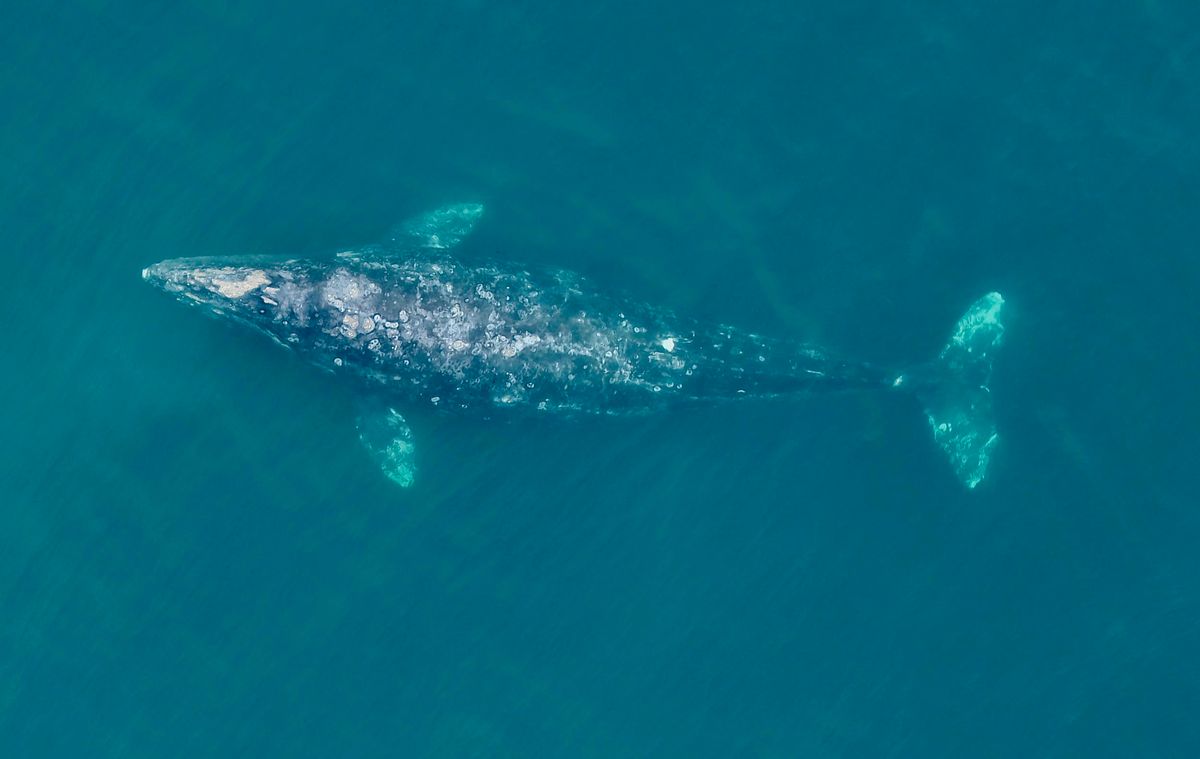
Gray Whales In The Pacific Ocean Are Shrinking By As Much As 13 Percent
Favicon 
www.iflscience.com

Gray Whales In The Pacific Ocean Are Shrinking By As Much As 13 Percent

Change is afoot along the Pacific Northwest coast. While hordes of crabs and spiders might be invading New York, something slightly different is happening to the whale population on the other side of the country. Scientists studying gray whales (Eschrichtius robustus) have found that they seem to be shrinking. Over in the North Atlantic, right whales have already been seen to be shrinking too. The Eastern North Pacific (ENP) population of gray whales is thought to be around 14,500 individuals; a small subset of this group is called the Pacific Coast Feeding Group (PCFG) and consists of around 212 whales that forage in shallow coastal waters between California and Vancouver Island. Using aerial images and data from previous years, the team set about comparing the body size of whales born in different years. The team measured 130 individual gray whales over the seven-year study period. They found that a whale born in 2020 was estimated to reach an average maximum length 1.65 meters (5.4 feet) shorter than any animal born in the 1980s. For a PCFG gray whale that grows to be 11.6-12.5 meters long when fully grown (38-41 feet), that is a loss of more than 13 percent of their total length. The results suggest this decline started around the year 2000.A gray whale born in 2020 is expected to reach an adult body length that is 1.65 meters (5.4 feet) shorter than a gray whale born prior to 2000.Image credit: Oregon State University“This could be an early warning sign that the abundance of this population is starting to decline, or is not healthy,” said K.C. Bierlich, co-author on the study and an assistant professor at Oregon State University’s Marine Mammal Institute in Newport, in a statement.The team thinks this decrease in body size will have consequences for the individuals in terms of behavior and ecology. Gray whales rely on energy reserves throughout the winter months – a smaller body size will limit the extent of these reserves and could impact their survival and reproduction. “And whales are considered ecosystem sentinels, so if the whale population isn’t doing well, that might say a lot about the environment itself,” continued Bierlich.The decline in body length was especially pronounced in the females, which used to be typically larger than the male whales, but in the study were found to be the same size or even smaller.  “With them being smaller, there are questions of how effectively these PCFG gray whales can store and allocate energy toward growing and maintaining their health. Importantly, are they able to put enough energy toward reproduction and keep the population growing?” Bierlich said.The team plans to investigate further into what could be causing the decrease in whale size. There is some suggestion that ocean conditions have changed as a response to climate change, which could be contributing; other suggestions include a decrease in habitat quality due to human activities. Two proxies of habitat quality, the mean Pacific Decadal Oscillation index and the mean ratio between upwelling intensity and the number of relaxation events, were highlighted; these are thought to be changing with climate change, which could influence foraging conditions for the gray whales and thus their shortening length. The foraging grounds also need further investigation, write the authors, and they raise questions around why the whales would continue to use these areas if this habitat is associated with a reduction in body length. The study is published in Global Change Biology.
Like
Comment
Share
Showing 24422 out of 56670
  • 24418
  • 24419
  • 24420
  • 24421
  • 24422
  • 24423
  • 24424
  • 24425
  • 24426
  • 24427
  • 24428
  • 24429
  • 24430
  • 24431
  • 24432
  • 24433
  • 24434
  • 24435
  • 24436
  • 24437

Edit Offer

Add tier


Select an image
Delete your tier
Are you sure you want to delete this tier?

Reviews

In order to sell your content and posts, start by creating a few packages. Monetization

Pay By Wallet

Payment Alert

You are about to purchase the items, do you want to proceed?

Request a Refund