YubNub Social YubNub Social
    Advanced Search
  • Login

  • Night mode
  • © 2026 YubNub Social
    About • Directory • Contact Us • Privacy Policy • Terms of Use • Android • Apple iOS • Get Our App

    Select Language

  • English
Install our *FREE* WEB APP! (PWA)
Night mode
Community
News Feed (Home) Popular Posts Events Blog Market Forum
Media
Headline News VidWatch Game Zone Top PodCasts
Explore
Explore Jobs Offers
© 2026 YubNub Social
  • English
About • Directory • Contact Us • Privacy Policy • Terms of Use • Android • Apple iOS • Get Our App

Discover posts

Posts

Users

Pages

Group

Blog

Market

Events

Games

Forum

Jobs

Classic Rock Lovers
Classic Rock Lovers  
2 yrs

What did the Ramones mean by “Blitzkrieg Bop”?
Favicon 
faroutmagazine.co.uk

What did the Ramones mean by “Blitzkrieg Bop”?

The band's debut single. The post What did the Ramones mean by “Blitzkrieg Bop”? first appeared on Far Out Magazine.
Like
Comment
Share
Conservative Voices
Conservative Voices
2 yrs

The Longhouse Comes for ‘Lomez’
Favicon 
spectator.org

The Longhouse Comes for ‘Lomez’

When the New York Times profiled Obama staffer Ben Rhodes in 2016, Rhodes made no secret of his frustration with the media: “The average reporter we talk to is 27 years old.… They literally know nothing.” But if there’s anything worse than a 27-year-old journalist still wet behind the ears, it’s an older journalist who acts like a petulant child.  This week, investigative journalist Jason Wilson published an article in the Guardian revealing the identity of the anonymous X account “Lomez,” which has over 74,000 followers. Wilson identified Jonathan Keeperman, a former lecturer at the University of California-Irvine, as “the man behind” the pseudonym and the founder of Passage Publishing, an avant-garde “new right” publishing house.  The secret is out now, but Wilson didn’t spark the moral outrage he clearly hoped for. Far from undermining Lomez, the dox simply makes the X user more sympathetic. He seems normal, smart, and successful — a far cry from the Left’s bogeyman of “far right” conservatives. As Lomez himself posted on Tuesday:  [T]he Guardian has exposed a family man with a loving wife and many beautiful children, who played college basketball, worked for Google, traveled the world, then had a 10-year career in academia before starting a highly successful publishing company. In the days since Wilson’s article appeared, Lomez’s X account has gained nearly 20,000 new followers. But Wilson’s attempted hatchet doesn’t just fail to land a blow — his Guardian piece actually serves as proof of concept for one of Lomez’s political hobby horses. In February 2023, First Things published an article by Lomez titled “What is the Longhouse?” Referencing the communal buildings built by some indigenous cultures to house extended families, the online Right employs the phrase to describe the forms of our postmodern culture. Lomez defines the “longhouse” thus:  It refers at once to our increasingly degraded mode of technocratic governance; but also to wokeness, to the “progressive,” “liberal,” and “secular” values that pervade all major institutions. More fundamentally, the Longhouse is a metonym for the disequilibrium afflicting the contemporary social imaginary. In particular, though, the longhouse is a feminizing phenomenon, patterned off what Lomez calls the “remarkable overcorrection of the last two generations towards social norms centering feminine needs and feminine methods for controlling, directing, and modeling behavior.” The “den mothers” of the longhouse act as hall monitors who subject their victims to indirect sniping and endless HR-style bureaucracy rather than direct confrontation.  Under the conditions of the longhouse, the worst excesses of female stereotypes are heightened. The longhouse leads to immature women and emasculated men, all of whom conduct themselves like petty tween girls. Wilson ought to consider himself a member of the tribe. Not long ago, we had a word for what Wilson attempts to pass off as journalism: stalking. Wilson “repeatedly contacted Keeperman requesting comment on this reporting, at a personal Gmail address and a Passage Press address,” in addition to leaving a “voicemail message at a telephone number that data brokers listed as belonging to Keeperman, but which carried a message identifying it as belonging to a member of his household.”  But Wilson only obtained that phone number from the data brokers after maniacally scouring the internet — and beyond — for every available shred of personal information. He hunted down domain registrars, LLC registrations, mailing addresses connected to various registrations, and property records. When Lomez mentioned in an X post that he was the third child in his family, Wilson cross-referenced the post with “a parent’s published biography” and dug up Keeperman’s father’s obituary.  And then, because Wilson evidently hadn’t gone far enough, he got in touch with a former colleague of Keeperman, who “positively identified Keeperman’s voice” from guest appearances on various podcasts. Wilson found photos of Keeperman in a “third-party archive of his wedding photos” that linked to his “wife’s name on Facebook.” He found records from Keeperman’s time on the University of California, San Diego, men’s basketball team, from his “accomplished” high school football and basketball careers, and from his 1996 bar mitzvah.  This kind of sleuthing isn’t normal behavior — it’s pathological. And this is exactly the kind of man the longhouse aims to cultivate. To solidify their power, proverbial den mothers subvert stereotypically “male” behavior with “punitive measures typical of female-dominated groups—social isolation, reputational harm, indirect and hidden force,” Lomez explains.  As such, the longhouse is characterized “in particular [by] the exchange of privacy—and its attendant autonomy—for the modest comforts and security of collective living.” In a paradigm where masculinity is inherently suspect, men gain approval from the longhouse by reveling in their own emasculation; Wilson’s article is an exercise of this sort. “To be “canceled” is to feel the whip of the Longhouse masters,” Lomez wrote in First Things last year. But, if Wilson’s article means anything at all, those den mothers seem past their prime. Mary Frances Myler is a contributing editor at The American Spectator. She graduated from the University of Notre Dame in 2022.  READ MORE by Mary Frances Myler:  Biden’s Green Energy Policies Help China, Not America Biden’s Plan to Reschedule Marijuana Is Half-Baked It’s Apparently ‘Racist’ to Protect Children From Parental Drug Use The post The Longhouse Comes for ‘Lomez’ appeared first on The American Spectator | USA News and Politics.
Like
Comment
Share
Conservative Voices
Conservative Voices
2 yrs

‘Our Republican Legacy’ Is Not What the Washington Post Claims
Favicon 
spectator.org

‘Our Republican Legacy’ Is Not What the Washington Post Claims

Former U.S. Sens. John Danforth of Missouri, William Cohen of Maine, and Alan Simpson of Wyoming — Republicans one and all — have taken to the op-ed pages of the Washington Post to headline: Between Trump and Biden, what should real Republicans do? How Republicans should think about 2024 and beyond. In their piece, the three — decent, thoughtful, and good former public servants one and all — begin by asserting: Millions of Republicans are struggling with the question of how to vote in November. Not mentioned? Per the results of the GOP primaries, former President Donald Trump received 14,922,942 votes — which is to say, just shy of 15 million. So, quite clearly, there are “millions of Republicans” who are decidedly not “struggling with the question of how to vote in November.” They are for Donald Trump. Period. The senators go on to say that they believe the country needs a “healthy” two-party system, a belief doubtless shared by all these millions they mention — and don’t mention. And, to the senators, a return to “traditional Republicanism” is the goal. The senators write: Recently it has become popular to assert that this traditional brand of Republicanism is dead, replaced by a new populist, radical version. We disagree. In our view, traditional Republicanism, though currently in eclipse, is no more extinct than the sun was over portions of the country on April 8. And all of us who believe in it must do what we can to ensure its expeditious return. To facilitate this comeback, we and other former GOP officeholders and officials are not leaving the party, but instead forming a new organization within it — “Our Republican Legacy.” One can only shake one’s head at the lack of historical memory. Apparently, none of the three recall that sentiments exactly like these were expressed by Establishment Republicans as Ronald Reagan’s political star was rising. Allow me to recall from my own piece in this space in 2015: Vice President Nelson Rockefeller dismissed Reagan as “a minority of a minority” who “has been taking some extreme positions.” New York’s Republican Senator Jacob Javits: Reagan’s positions are “so extreme that they would alter our country’s very economic and social structure and our place in the world to such a degree as to make our country’s place at home and abroad, as we know it, a thing of the past.” Illinois Republican Senator Charles Percy said Reagan’s candidacy was “foolhardy” and would lead to a “crushing defeat” for the Republican Party. “It could signal the beginning of the end of our party as an effective force in American political life.” Former President Gerald Ford: “I hear more and more often that we don’t want, can’t afford to have a replay of 1964.” If the Republican Party nominates Ronald Reagan “it would be an impossible situation” because Reagan “is perceived as a most conservative Republican. A very conservative Republican can’t win in a national election.” Asked if that meant Ford thought Reagan can’t win, Ford replied to the New York Times: “That’s right.” The Times story went on to observe that Ford thought “Mr. Reagan would be a sure-loser in November” and that Reagan held “extreme and too-simple views.” Then there was the media of the day on Reagan: New York Times: Reagan’s candidacy is “patently ridiculous.” New York Times: “The astonishing thing is that this amusing but frivolous Reagan fantasy is taken so seriously by the news media and particularly by the President (Gerald Ford). It makes a lot of news, but it makes no sense.” New Republic: “Ronald Reagan to me is still the posturing, essentially mindless and totally unconvincing candy man that he’s been in my opinion ever since I watched his first try for the Republican nomination evaporate in Miami in 1968.” New Republic: “Reagan is Goldwater revisited…He is a divisive factor in the party.” Harper’s magazine: “That he should be regarded as a serious candidate for President is a shame and an embarrassment for the country at large to swallow.” The former senators go on to say: [There are] five principles that historically have defined our party and been universally accepted across its membership. In their words, these five principles are listed as: The Constitution Union Fiscal responsibility Free enterprise Peace through strength They continue: In short, this group will be a catalyst for a movement to reassert traditional Republicanism against the populist version it has become under Donald Trump. This is something new. Many Republicans have given up on trying to winch their party out of the populist ditch. National resistance has been missing. Our Republican Legacy will provide that resistance and do so with credible leadership and sufficient funding and will continue as a force well beyond the November election. “Populist ditch”? The senators should take note of this message from historian and Reagan biographer Craig Shirley’s bookThe Search for Reagan: The Appealing Intellectual Conservatism of Ronald Reagan. Shirley wrote the following, bold print for emphasis supplied: Reagan changed the Republican Party from one of the elitists, Eastern concerns, and country clubs to one more Western, more conservative, and more populist.  He took seriously his words, “The New Republican Party I envision will not be, and cannot be, one limited to the country club-big business image,” in his groundbreaking 1977 speech to a group of young Washington conservatives. He then elaborated: “Our task is not to sell a philosophy, but to make the majority of Americans, who already share that philosophy, see that modern conservatism offers them a political home. We are not a cult; we are members of a majority. Let’s act and talk like it. The job is ours and the job must be done. If not by us, who? If not now, when? Our party must be the party of the individual. It must not sell out the individual to cater to the group. No greater challenge faces our society today than ensuring that each of us can maintain his dignity and his identity in an increasingly complex, centralized society.” In other words, taken altogether, “the populist version” that the GOP “has become under Donald Trump” is a process that began with President Ronald Reagan. What these senators are proposing is returning the GOP to the much-losing pre-Reagan “traditional” and decidedly elitist party that Reagan called “the country club-big business” party. The senators end by saying: For those who boast that traditional Republicanism is dead we issue this challenge: Tell us — tell the nation — precisely how and why you disagree with this group’s five defining principles. Tell us how the embrace of these principles would contradict the ideals of this great nation. And tell us how their abandonment would make our nation stronger. On the Constitution? Safe to say, when Trump departed the White House, he specifically noted this: One of the things we’re very, very proud of is the selection of almost 300 Federal judges and three great Supreme Court justices. And every single one of these Trump nominees supported the Constitution. Just to pick one at random, whom Trump appointed to the Supreme Court, take Judge Brett Kavanaugh. Trump’s nominee is well on record saying: “Read the text of the Constitution as written, mindful of history and tradition.” … “[O]ne factor matters above all in constitutional interpretation and in understanding the grand sweep of constitutional jurisprudence — and that one factor is the precise wording of the constitutional text.” Which is to say that supporting the Constitution was core doctrine with Trump nominees like Justice Kavanaugh. Support for the Union? Trump has been to every state in the Union over time, most recently going to New Jersey — a “blue state” that he deliberately made a point of not ignoring in his campaign. Some 100,000 Americans turned out to hear him. (READ MORE from Jeffrey Lord: Trump and the Significance of the Wildwood Rally) Fiscal responsibility? In fact, as these senators well know, fiscal responsibility is the job of Congress. And, sadly, as I learned firsthand working for a House Budget Committee congressman during the Reagan era, it isn’t Democrats alone who spend relentlessly. Republicans in Congress signed on for those enormous spending bills, many supporting spending binges on their home state’s favorite projects. One would be curious about the records of these three senators when it came to spending federal dollars in their home states. Safe to say, one suspects they did not turn off the federal spigot. Free enterprise? Trump’s entire pre-presidential career was spent in the world of free enterprise, building the Trump Organization from scratch. Peace through strength? A Reagan mantra in which Trump and his supporters believe. Ukraine was invaded not in Trump’s term but during Biden’s. Vladimir Putin did not dare invade when Trump was in the White House because he knew that Trump was a staunch supporter of peace through strength. Again, the senators end by saying: For those who boast that traditional Republicanism is dead we issue this challenge: Tell us — tell the nation — precisely how and why you disagree with this group’s five defining principles. Tell us how the embrace of these principles would contradict the ideals of this great nation. And tell us how their abandonment would make our nation stronger. To be clear, what is dead is the idea, as Reagan put it, of a once-traditional Republican Party that, in Reagan’s words, was “limited to the country club-big business image.” First with Reagan, now with Trump, millions of Republicans have rallied to the party of what Reagan called “modern conservatism.” Alas, as exhibited in their op-ed, these three former senators simply don’t get it. The elitist “Republican Legacy” of the country club and big business that they miss is not coming back — and shouldn’t. Somewhere Ronald Reagan is shaking his head. The post ‘Our Republican Legacy’ Is Not What the <i>Washington Post</i> Claims appeared first on The American Spectator | USA News and Politics.
Like
Comment
Share
Conservative Voices
Conservative Voices
2 yrs

Will Democrats Pay a Price for Their Cynical, Crumbling Lawfare Strategy?
Favicon 
spectator.org

Will Democrats Pay a Price for Their Cynical, Crumbling Lawfare Strategy?

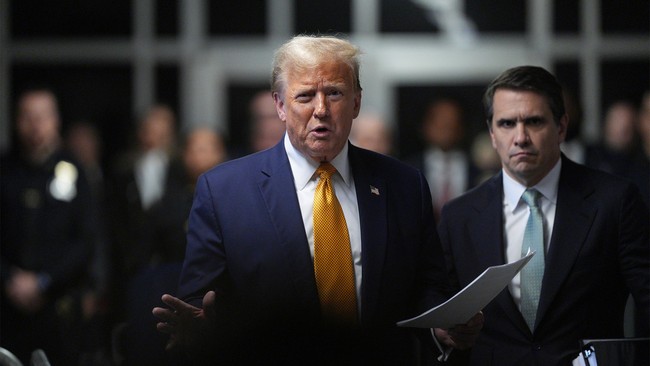
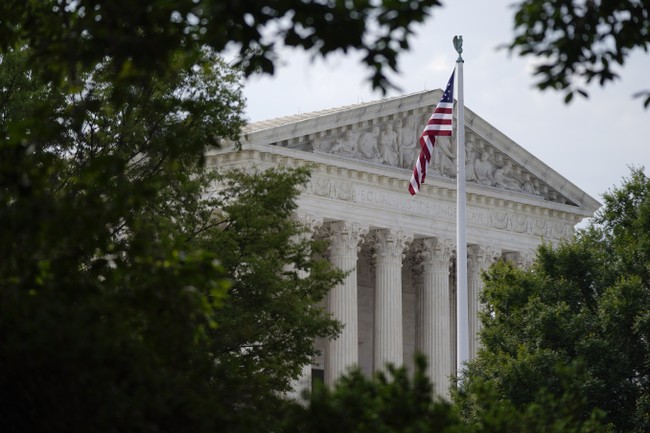
President Joe Biden, who wears bespoke sneakers to prevent embarrassing collapses and whose command of the English language rivals that of most kindergarteners, is in bad political shape. Uncle Joe’s reelection campaign faces an uphill climb, given his disastrous handling of the economy — including a formal recession and four-decade-high inflation — and his abetting a catastrophic and historically unprecedented invasion on our southern border. Cynicism and a sense of malaise are ubiquitous, and Americans overwhelmingly think the nation is headed in the wrong direction. Monday’s New York Times/Siena College poll reflects this: former President Donald Trump currently leads in five of the six most crucial swing states. Given their terrible candidate, the candidate’s awful track record, and their tremendous (if unjustified) fear that a second Trump term would pose an existential threat to “our democracy” (which they disingenuously claim to care about), it is unsurprising that Democrats have resorted to some of the slimiest tactics imaginable to derail Trump’s comeback bid and push their senile octogenarian across the November finish line. Properly skeptical of their chances to topple Trump in a fair mano-a-mano, the Democrat-lawfare complex in 2023 conjured up four separate criminal prosecutions — two federal probes and two state probes — targeting the 45th president. After all, if you can’t beat him, then prosecute and incarcerate him! All in the name of “our democracy,” naturally. (READ MORE: Robert J. Costello, Esq., Should Be Trump’s Defense Witness No. 1) Suffice it to say that the Democrat lawfare complex’s brazen, cynical attempt to subvert our constitutional order in the name of saving it has not gone according to plan. In Washington, D.C., Special Counsel Jack Smith’s crown-jewel case against Trump, pertaining to the 2020 presidential election and the Jan. 6 jamboree at the U.S. Capitol, has been interrupted by the U.S. Supreme Court. The justices stepped in to assess the thorny constitutional question of the scope of immunity from criminal prosecution for former presidents, and a decision is not expected until late June. The most likely result is a mixed opinion that holds some “core” Article II presidential functions are immune from post-presidency prosecution, but other acts are not. This would require a remand to the trial court for fact-finding to determine which legal category the acts in Smith’s indictment fall into. That trial court finding could then be appealed, too. There is virtually no chance Smith can wrap this all up before November. In Florida, Smith’s other federal case has not been more successful. The Florida prosecution, pertaining to Trump’s post-presidency handling of classified documents at his Mar-a-Lago estate, had at least some potential on the legal merits. But Smith wildly overplayed his hand by charging Trump with violating the controversial World War I-era Espionage Act, and the proceedings have frequently been set back due to the strenuous demands of the Classified Information Procedures Act — a 1980 statute first introduced in the Senate, ironically, by then-Sen. Joe Biden (D-Del.). Recently, Judge Aileen Cannon indefinitely postponed the trial start date, which had initially been scheduled for May 20. There is again little to no chance Smith can reach a jury before November. (READ MORE: Trump’s Best Witnesses for the Defense: Prosecutors) The case in Fulton County, Georgia, which once seemed the most perilous of them all due to Georgia’s sprawling Racketeer Influenced and Corrupt Organizations Act, the far-left Atlanta jury pool, and the potential for high-profile prosecution witnesses, has gone totally off the rails. Ever since January, the only questions in the case have not been substantive legal issues such as whether Trump oversaw a grand conspiracy to “overturn an election,” but tabloid fodder such as whether Fulton County District Attorney Fani Willis and her illicit extramarital lover and appointed special prosecutor, Nathan Wade, are too compromised to bring the case. The trial court’s finding that only one of them must recuse is now pending before a Georgia appellate court, and it is likely the Supreme Court of Georgia will weigh in, too. This case isn’t reaching a jury before November, either. That leaves the ongoing drama in New York City, where a literal porn “star” (Stormy Daniels) and a convicted felon (Michael Cohen) are aiding the George Soros-funded prosecutor’s case of — well, he hasn’t exactly told us what it is. We surmise the case entails alleged New York State fraudulent bookkeeping charges in furtherance of a federal campaign finance law violation — which doesn’t even fall into the local district attorney’s jurisdiction. The prosecution is about to rest its case, and we don’t even know for sure what the actual black-letter legal case is. On Thursday, the “star witness” convicted felon’s testimony was so bad that far-left CNN anchor Anderson Cooper remarked: “I think if I was a juror in this case watching that, I would think ‘this guy is making it up as he’s going along.'” Brutal. (READ MORE: Marjorie Taylor Greene Went After GOP Speaker. Guess Who Lost?) The Democrats’ strategy is failing. But it is up to the American people to make them pay for it. To find out more about Josh Hammer and read features by other Creators Syndicate writers and cartoonists, visit the Creators Syndicate website at www.creators.com. COPYRIGHT 2024 CREATORS.COM The post Will Democrats Pay a Price for Their Cynical, Crumbling Lawfare Strategy? appeared first on The American Spectator | USA News and Politics.
Like
Comment
Share
Conservative Voices
Conservative Voices
2 yrs

Get the Feds and States Out of the Student Loan Business
Favicon 
spectator.org

Get the Feds and States Out of the Student Loan Business

My previous four installments in this series have proposed, inter alia, that (i) laws be enacted like those of FIRREA to hold university trustees and directors personally and individually liable in tort, for compensatory and punitive damages, for misfeasance and nonfeasance; (ii) there be a two-year moratorium banning all foreign money and foreign students from entering American universities; and (iii) universities be barred from offering academic tenure to professors. No one proposal, if actualized, will restore our colleges and universities to normalcy and end the Hate America brainwashing to which our children and grandchildren presently are being subjected. But if implemented as a complete package, they can move the needle of the compass back to giving our students an honest education. Herewith my next proposal in this package: get the feds and states out of the student loan business. No matter how hard a democracy’s government tries, it cannot competently disburse or oversee money. There are too many political incentives to spend recklessly. The politicians may not be addicted to opium, but they all are addicted to O.P.M. — Other People’s Money. So they build bridges to nowhere in Alaska. The California high-speed rail line — from Los Angeles to San Francisco — was projected in 2008 to be finished by 2020 at the large sum of $33 billion; yet the noodle-headed voters approved the bond issue. By 2022, 14 years later, they still were working on only the first phase, the “starter line,” which would not connect with either Los Angeles or San Francisco but now was projected for completion by 2030 and estimated at a revised $113 billion. Government cannot handle money wisely. Each politician adds local projects in “Christmas Tree” legislative packages so that, at reelection time, he or she can campaign on having “brought home the bacon.” The federal government is not a bank. If it were, it would become insanely insolvent, owing creditors something like $34 trillion. Come to think of it, that’s where we are now. That alone is reason for the feds not to be lending money to university students. When we lend them money, where does that money come from? When we pierce through the gobbledygook and cut to the chase, we essentially have to borrow it from countries like China so that we then can “lend” it to university students. We presently owe China $775 billion. We have lost $197 billion on student loans (unrelated to Biden’s loan forgiveness) in the past 25 years. When we do lend, we lend an almost unlimited amount of money to fund tuition, dorm rent, food costs, textbooks, and all else. On one hand, students can borrow to an annual maximum of between $5,500 and $12,500 for college (undergraduate studies) and up to $20,500 each year for graduate school. However, if willing, Mom and Dad can borrow every last penny still owing through a vehicle called a Parent PLUS Loan. So students at an expensive college — and they all are — end up owing tens of thousands after four years of “schooling.” In other words, if the college and dorm cost $60,000 per year, and the junior or senior student gets $15,000 in scholarships, he or she may borrow up to $7,500 to cover the remaining $45,000. And the parents can borrow the remaining $37,500 without even proving an ability to repay it later. By the time the kid graduates, he or she owes close to $50,000, and the parents owe their own separate $100,000-plus. Make sense? Now let’s think it through a bit more carefully. Imagine America decides that each and every American must own a new car. Not “should” own, but “must.” Well, many Americans cannot afford a new car. But, again, let’s say it is not your choice; you are compelled to buy a new car. Let us reasonably assume a new car can cost as low as $20,000 (Mitsubishi Mirage, Kia Forte, Hyundai Elantra, etc.) Let’s say huge numbers of voters revolt and say they cannot afford a new car right now with food up through the Bidenomics roof, skyrocketing gasoline and home energy prices, and a basic car wash as high as $30. But they have no choice — by fiat. So, to calm the voters, the feds announce they will lend unlimited funds as needed for every person to buy that mandated new car, and repayments will not start for four years. In that scenario, what will happen? Many people unwisely will decide: “Hey, if the money is not coming out of my pocket now, why should I buy a Nissan Versa or a Chevy Trax if I can get a Tesla? I’ll buy me a $65,000 car now and figure out loan repayments later. Maybe I’ll have a better-paying job in four years. Maybe my house value will go up. Maybe I will inherit money. Maybe I will be dead. Buy now, pay later.” Meanwhile, as it becomes clear that the feds really are lending full amounts for every single American to buy a new car — even if they do not and never will have the money to repay — the car companies will start inflating their prices. Why not charge $60,000 for that $20,000 Forte, Elantra — or, fittingly, the Mirage — if price is no obstacle because the government is writing each customer’s check? And if the Mirage now inflates to $60,000, then the Tesla has to rise above $100,000. Why not charge through the roof if the feds will borrow from China to lend it to every American without a ceiling on cost? That is why colleges suddenly cost $30,00–$45,000 a year and more. And Ivy League–type private colleges cost $65,000 (with Columbia at nearly $70,000). Everyone can afford it — even though they cannot — because the feds will lend the full cost without regard to whether the university tuition and dorm rent are fairly priced. In a variation of Field of Dreams: (i) If you charge it, they will pay; (ii) people will come; and when the bills come due, (iii) ease his pain. Universities become awash in cash, charging highest-ever prices for a product not remotely related to fair market value. What do they do with all that cash? Loaded with bucks, universities pay even mediocre tenured professors six-figure salaries. Thus, much of America was scandalized when it was revealed that Harvard’s best-known plagiarist and incompetent fired university president was returning to her previous position that pays … $900,000 a year. Other university millions are spent on DEI — “Diversity, Equity, and Inclusion” — departments, racist offices fabricated out of whole cloth. For example — deep breath — the University of Michigan reported spending $18 million a year on its DEI department and 142-person staff. DEI? More like DIE. The DEI vice provost is paid $380,000 plus all benefits imaginable. Talk about privilege. But that’s not all! A closer investigation later found that UMich actually has more than 500 staff working full- or part-time on DEI with an aggregate salary-and-benefits annual cost of $30.68 million. Well, at least the federal government ultimately gets repaid on the loans and makes a pretty penny along the way, just as successful private banks do by charging interest. Right? Wrong. There is a reason Joe Biden has been forgiving student loans like crazy. First, a great many student borrowers — an entire generation, from the river to the sea, and from the ocean to the ocean — have come to realize that they cannot now and never will be able to pay off their loans. They cannot both (i) make monthly payments and also (ii) afford to live. So they cannot afford to get married. Cannot afford to have kids. Cannot afford to buy homes. They may end up in those “encampments” longer than they planned, financially wiped out for life. What to do? Biden’s approach: “forgive” the debts and thereby try to buy an election by swaying the under-30 vote. The federal government must get out of the student-loan business. But if that happens, who will lend prospective students the money needed for college? First, not all students should be in college. If they are going to waste four years taking pointless courses like “Queer and Feminist BIPOC Traditions from Decolonial Abolitionist Perspectives,” while emerging unable to write a coherent and correctly spelled paragraph, they are better off learning a marketable good-paying trade or skill that offers more than courses in “Puppet Art,” “How to Watch Television,” and “The Sociology of Miley Cyrus.” But even for those who stick with college, let them borrow straight from the colleges and universities without the federal middleman. Lenders can make fortunes from charging interest; look at banks. Look at home loan mortgages. Let the universities likewise lend at interest and get rich without the feds helping out. Where will the universities get the money to lend? They have billions in endowments. In all, American universities are sitting on $839 billion in endowments. Consider the below list of private universities and their endowments: Harvard University, $49.495 billion Yale University, $40.747 billion Stanford University, $36.495 billion Princeton University, $34.059 billion Massachusetts Institute of Technology, $23.453 billion University of Pennsylvania, $20.963 billion University of Notre Dame, $16.617 billion Northwestern University, $13.700 billion Columbia University, $13.643 billion Duke University, $13.238 billion Cornell University, $10.036 billion University of Chicago, $9.870 billion Vanderbilt University, $9.684 billion Dartmouth College, $7.930 billion University of Southern California, $7.463 billion Brown University, $6.201 billion New York University, $5.877 billion Amherst College, $3.342 billion Georgetown University, $3.299 billion Boston University, $3.129 billion Wellesley College, $2.889 billion George Washington University, $2.522 billion Smith College, $2.470 billion Bowdoin College, $2.424 billion Case Western Reserve University, $2.261 billion Tulane University, $2.108 billion Vassar College, $1.224 billion Villanova University, $1.220 billion Brandeis University, $1.216 billion Oberlin College, $1.199 billion Those are just some of the private university endowments. Public universities are similar: For example, University of California system-wide has an endowment of $17.689 billion. UC Berkeley has $2.915 billion. In terms of amount of endowment per student, the universities have plenty of cash available to lend. Princeton has $3.8 million per student. Yale has $2.8 million per student. Stanford: $2.1 million. Harvard: $2.03 million. MIT: $2.00 million. And so on. Thus, we see that universities are swimming in cash while the federal government, with a $34 trillion debt load, borrows from China to lend to students and parents to pay ever-rising exorbitant tuition and dorm rent, with that money ultimately funding DEI departments and courses taught even by America-phobes whom the universities import to ruin America’s children, haters like Columbia University’s imported professor Mohamed Abdou, whom the university proudly promotes as an “anarchist,” teaching his hate-filled Queer and Feminist BIPOC Traditions from Decolonial Abolitionist Perspectives. Really. If the government got out of the student-loan business, the universities still would have more than ample funds to lend at profitable interest, resulting in at least two stark changes: Since it would be their money, not an unlimited spigot from Uncle Sam, they would become financially more responsible; would cut back on DEI departments, nonsensical courses, and other profound waste; would and need to think twice before raising tuition and dorm rent through the roof each year. More importantly, as with successful banks versus those that go insolvent, lending on interest works for the lender only when the borrowers present a probability of repaying later. If the borrowers go broke, or fail to earn sufficiently, the universities will sustain enormous losses instead of reaping handsome profits. That will create a free-market incentive, slowly but surely, for universities to offer serious subjects that train minds and offer both intellectual stimulation and marketable education. If they are going to send kids into the world after four years with an aggregate loan debt of $250,000–$300,000 and great training in science, technology, engineering, mathematics, or certain very valuable social science learning and skills, all will reap. But if those kids, in debt with their parents for $300,000 after four years, emerge having majored in Gender Studies, they will be default risks. Go woke, go broke. No one “fix” can repair our broken college and university system in America. But a comprehensive shift, simultaneously implementing several of these proposals (and a few more), will turn the tide.  To receive Rav Fischer’s Weekly Extensive Torah Commentaries or to attend any or all of Rav Fischer’s weekly 60-minute live Zoom classes on the Weekly Torah Portion, the Biblical Prophets, the Mishnah, Rambam Mishneh Torah, or Advanced Judaic Texts, send an email to: shulstuff@yioc.org His 10-part exciting and fact-based series of one-hour classes on the Jewish Underground liberation movement (Irgun, Lechi, and Haganah) and the Rise of Modern Israel can be found here. In it, he uses historic video clips of Irgun, Lechi, and Haganah actions, decades of past Arab terrorist atrocities, as well as stirring musical selections from the Underground and video’d interviews of participants, to augment data, statistics, maps, and additional historical records to create a fascinating, often gripping, and scholarly enriching educational experience about issues that remain deeply relevant today as Israel engages in an existential war in Gaza against Hamas terrorism. His latest deeply moving weekly series of informational and inspirational programs on the Hamas Gaza war may be found here. His 40-part Bible Study series covering all of I Samuel (First Samuel) intensively with Talmudic and Midrashic commentaries, and now into II Samuel is now up here. The post Get the Feds and States Out of the Student Loan Business appeared first on The American Spectator | USA News and Politics.

Like
Comment
Share
Conservative Voices
Conservative Voices
2 yrs

Will Democrats Pay a Price for Their Cynical, Crumbling Lawfare Strategy?
Favicon 
townhall.com

Will Democrats Pay a Price for Their Cynical, Crumbling Lawfare Strategy?

Will Democrats Pay a Price for Their Cynical, Crumbling Lawfare Strategy?
Like
Comment
Share
Conservative Voices
Conservative Voices
2 yrs

Joy Cometh in the Morning
Favicon 
townhall.com

Joy Cometh in the Morning

Joy Cometh in the Morning
Like
Comment
Share
Conservative Voices
Conservative Voices
2 yrs

Welcome to the 'Parent Revolution'
Favicon 
townhall.com

Welcome to the 'Parent Revolution'

Welcome to the 'Parent Revolution'
Like
Comment
Share
Conservative Voices
Conservative Voices
2 yrs

Boos and Hisses for the Kansas City Kicker
Favicon 
townhall.com

Boos and Hisses for the Kansas City Kicker

Boos and Hisses for the Kansas City Kicker
Like
Comment
Share
Conservative Voices
Conservative Voices
2 yrs

Deeper Looker at Polls Show Biden is in Deep Trouble
Favicon 
townhall.com

Deeper Looker at Polls Show Biden is in Deep Trouble

Deeper Looker at Polls Show Biden is in Deep Trouble
Like
Comment
Share
Showing 28035 out of 56670
  • 28031
  • 28032
  • 28033
  • 28034
  • 28035
  • 28036
  • 28037
  • 28038
  • 28039
  • 28040
  • 28041
  • 28042
  • 28043
  • 28044
  • 28045
  • 28046
  • 28047
  • 28048
  • 28049
  • 28050

Edit Offer

Add tier


Select an image
Delete your tier
Are you sure you want to delete this tier?

Reviews

In order to sell your content and posts, start by creating a few packages. Monetization

Pay By Wallet

Payment Alert

You are about to purchase the items, do you want to proceed?

Request a Refund