YubNub Social YubNub Social
    Advanced Search
  • Login

  • Day mode
  • © 2026 YubNub Social
    About • Directory • Contact Us • Privacy Policy • Terms of Use • Android • Apple iOS • Get Our App

    Select Language

  • English
Install our *FREE* WEB APP! (PWA)
Night mode
Community
News Feed (Home) Popular Posts Events Blog Market Forum
Media
Headline News VidWatch Game Zone Top PodCasts
Explore
Explore Jobs Offers
© 2026 YubNub Social
  • English
About • Directory • Contact Us • Privacy Policy • Terms of Use • Android • Apple iOS • Get Our App

Discover posts

Posts

Users

Pages

Group

Blog

Market

Events

Games

Forum

Jobs

Science Explorer
Science Explorer
2 yrs

When Can Wildlife Photographers Intervene?
Favicon 
www.iflscience.com

When Can Wildlife Photographers Intervene?

This article first appeared in Issue 19 of our digital magazine CURIOUS. Fans of the David Attenborough BBC series Dynasties may remember a particularly harrowing scene in which a group of penguins got stuck in a ditch during a storm and couldn’t get out. It was a memorable episode, not only because of the desperate plight of the birds that would die if left to face the elements but also because the film crew made the difficult decision to break the “never intervene” rule that’s considered by some to be the golden principle of wildlife filmmaking.The idea is that, no matter how upsetting it gets, an animal in danger shouldn’t be saved by humans. However, as “wild” environments have become increasingly influenced by human activity, the outlook on if and when it’s ethical to intervene has been debated.Is it following nature’s course to let a turtle drown in fishing nets? What about letting fertile nests die during floods made worse by anthropogenically driven climate change? If we as a species are creating new and unnatural threats, is it our responsibility to undo them when presented with an opportunity to save an animal’s life?We spoke to the directors and producers of the BBC’s Planet Earth III, Matt Brandon, Mike Gunton, and Nick Easton, to see how they approached the tricky subject during filming. Episode one of the series presents the troubling case of Raine Island: a place that’s the largest known rookery on Earth for green turtles but is slowly sinking beneath rising sea levels.First Nations people have been protecting turtles here for thousands of years, and the Planet Earth III film crew got involved in helping some stranded turtles that would have otherwise perished on the rocks make it safely back into the ocean.What has been the rule about filmmakers intervening with wild animals?Matt Brandon (MB): I think the rules are changing, but one of the golden rules of wildlife filmmaking is that when you're witnessing a natural event, you really try not to get involved. It can be really difficult sometimes when you're watching those things, but that is the rule.Why are the rules changing?MB: What we're seeing now is that many of the things that our crews are witnessing around the world are no longer natural. We actually do cover that in one of our “The Making Of” sequences, where[…] Columbus crabs are floating in something like 12 million tonnes of plastic and discarded nets that are thrown into the ocean every year.How does that trash affect the crabs?MB: For the Columbus crabs, it’s no bad thing, they are actually adapting quite well. But for turtles, it can be absolutely tragic. Over the period where they were filming, [the crew] found numerous turtles trapped in nets and there was no way those turtles could survive, so they did step in and cut them free.Were they successful?MB: I think they were able to save all bar one of them, so that's probably the right choice and a justifiable thing to do.Do the crews operate alone or are there people on hand to help with these decisions?Mike Gunton (MG): We work with scientists and field workers so it's not just a crew themselves, it's often monitored or driven by working with scientific teams who make that decision as well.We saw teams helping out with stranded sea turtles on Raine Island. What was the story there?Nick Easton: I think to explain that Raine Island situation, there's also cultural sensitivities [at play].The Wuthathi people’s association with Raine Island [as the traditional custodians and owners] goes back 2,000 years at least. So, it's not our place to intervene, it’s their place in which we are guests, so we took their lead there and our crews helped.What can people expect from Planet Earth III?MG: What Planet Earth III does; I mean it still has all the DNA of Planet Earth[…] the cinematic, extraordinary, visually rich, jaw-dropping visuals, amazing animal dramas, magic carpet ride to the four corners of the planet. But it has this other context, which is that we're now in a new natural history, of a new time in our lives, where the planet is changing and there’s this huge force which Darwin would call a selection pressure. And that selection pressure is humanity.Planet Earth III is available now on BBC iPlayer.CURIOUS magazine is a digital magazine from IFLScience featuring interviews, experts, deep dives, fun facts, news, book excerpts, and much more. Issue 22 is out now.
Like
Comment
Share
Science Explorer
Science Explorer
2 yrs

The "Gateway To The Underworld" In Siberia Is Splintering Open
Favicon 
www.iflscience.com

The "Gateway To The Underworld" In Siberia Is Splintering Open

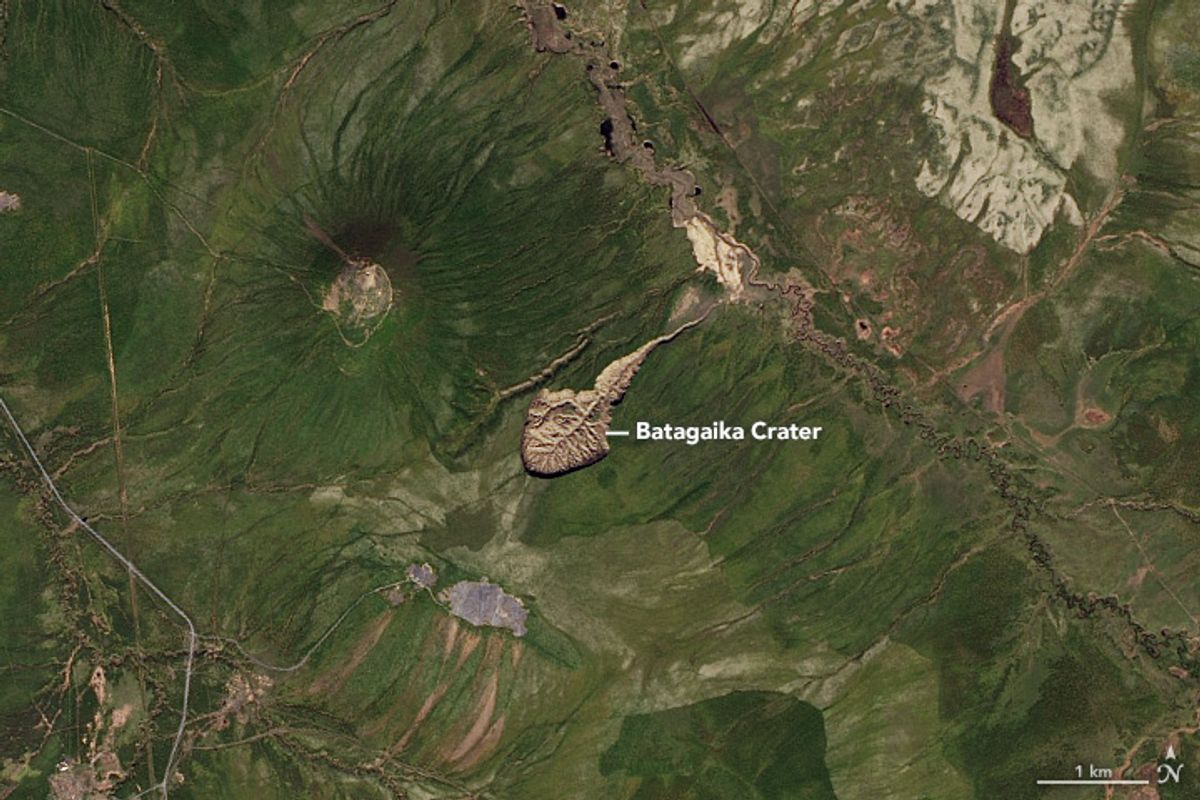
The Batagay megaslump, better known as Siberia’s “gateway to the underworld,” is up to its usual tricks. New research shows that the giant geological scar has grown up to 1 million cubic meters (35 million cubic feet) each year since 2014, pumping out thousands of tons of carbon as it fractures. The 1-kilometer-long (0.62-mile) slash in the landscape can be found in the Sakha Republic of Siberia in Russia’s eastern depths. In the 1960s, the tadpole-shaped crack was little more than an unassuming gully, but the tear has continued to rip open at an alarming rate over the past few decades amid rising temperatures that have thawed the permafrost in the area. Due to its extremely remote location, the megaslump avoided detection for years until it was first recognized on satellite imagery in 1991. It's ultimately the product of warming temperatures in the region associated with climate change. Permafrost in the soil was neatly holding the land together, but warming temperatures thawed the icy cement and undermined its structure. The land loosened and gave way, causing a deluge of debris to spread downhill toward the floodplain of the Batagay River. As the land continues to slump, more frozen soil is exposed to the warmth, causing the size of the slump to grow.In the latest study, scientists at the Lomonosov Moscow State University and the Melnikov Permafrost Institute, together with colleagues from Germany, carried out 3D geological modeling of the Batagay megaslump to better understand its past, present, and future.They found that the slump had mobilized around 35 million cubic meters (1.23 billion cubic feet) of ground since the 1990s. Around two-thirds of the material was ground ice, while the remaining third was permafrost sediments.It’s continuing to grow in size too. The researchers note the megaslump had a width of 790 meters (2,591 feet) in 2014, but expanded to 890 meters (2,919 feet) in 2019.While the Batagay megaslump is grandest in size, climate change is rapidly driving the emergence of new permafrost thaw slumps in the northernmost parts of the world. One study found thousands of climate-triggered landslide slumps in a High Arctic environment over recent decades. The situation is especially noticeable in Russia where nearly 65 percent of the ground is is comprised of permafrost. Back in August 2020, a gaping crater was blasted open after an explosive bubble of methane gas popped beneath the ground in the remote tundra of Siberia, spraying chunks of rocks and soil hundreds of meters across the Yamal Peninsula. The study is published in the journal Geomorphology.
Like
Comment
Share
Science Explorer
Science Explorer
2 yrs

NOAA Issues Warning Strongest Geomagnetic Storm In 20 Years Is About To Hit Earth
Favicon 
www.iflscience.com

NOAA Issues Warning Strongest Geomagnetic Storm In 20 Years Is About To Hit Earth

We do not know exactly when the peak of activity for this current solar cycle is going to be, but we are really close to it – and the Sun is not disappointing with its activity. For the first time since January 2005, the NOAA Space Weather Prediction Center has issued a severe Geomagnetic Storm Watch. A lot of high-speed plasma from the Sun is coming towards our planet, ready to slam into it.Our planet is good at protecting us thanks to its magnetic field, but it is important to be aware of the effects of the most powerful geomagnetic storms. A severe storm can cause widespread voltage control problems and create issues for the navigation and functioning of satellites – satellites that we need for everyday activity from communications to navigation. It can also create radio blackouts.   It is not only bad news, though. We are about to get some spectacular aurorae. As the solar plasma interacts with the Earth’s magnetosphere, particles will fly around and hit the atmosphere. Depending on the gas they interact with, they give different colors. The amount and energy of plasma coming is so significant that the aurorae will be visible at lower magnetic latitudes than usual – maybe as low as northern California in the US and as low as northern Germany in Europe. In the Southern hemisphere, Tasmania and the south island of New Zealand should have some celestial light show.Extreme Ultraviolet views of the Sun with flares released from the massive sunspot AR3664.Image Credit: NASA/SDO/AIAThe cause of all this is to be found in an enormous and extremely active sunspot. Called AR3664, it has released several solar flares over the last few days. The sunspot is as wide as 16 Earths side by side, so big you can see it with the naked eye. But please wear eclipse glasses! We do not want a repeat of the Google trend on eclipse day!There have been many coronal mass ejections released in this burst of activity. At least five of them are directed at Earth. It is possible that three of them might combined in a cannibal coronal mass ejection, a term that describes when a later coronal mass ejection is faster than the ones previously emitted. So it catches up to them, merges with them, and slams a tsunami of plasma on the planets on its path.Coronal mass ejections seen from the Sun in the last few days (the bright dots are Venus on the right and Jupiter on the left)Image Credit: NASA/ESA/SOHOThe plasma will begin to hit Earth from May 10 and will continue until May 12. The bulk of it hits on Saturday. A great time to get somewhere with a clear dark sky facing towards your nearest pole.   The are about 100 severe geomagnetic storms per solar cycle, so every 11 years or so. Extreme solar storms are much rarer with only four per cycle. But for example, the last one was a weird one with none of either. The last extreme geomagnetic storm was on Halloween 2003 and caused power outages in Sweden and damaged power transformers in South Africa.
Like
Comment
Share
Survival Prepper
Survival Prepper  
2 yrs

Survival Story: Steven Callahan — 76 Days Adrift in a Life Raft
Favicon 
www.survivopedia.com

Survival Story: Steven Callahan — 76 Days Adrift in a Life Raft

In 1981, Steven Callahan was a boat builder attempting to cross back across the Atlantic by himself in Napoleon Solo, a 21’ wooden sailboat. The post Survival Story: Steven Callahan — 76 Days Adrift in a Life Raft appeared first on Survivopedia.
Like
Comment
Share
Gamers Realm
Gamers Realm
2 yrs

Hi-Fi Rush is getting review bombed on Steam, sort of
Favicon 
www.pcgamesn.com

Hi-Fi Rush is getting review bombed on Steam, sort of

Following Xbox's surprise closure of Tango Gameworks, the creator of Hi-Fi Rush, players are positively review bombing the action game to show their support and, in some cases, demonstrate their disapproval of Xbox's decision. Continue reading Hi-Fi Rush is getting review bombed on Steam, sort of MORE FROM PCGAMESN: Best upcoming games, Best space games, Best new games
Like
Comment
Share
Gamers Realm
Gamers Realm
2 yrs

Anime Fantasy codes May 2024
Favicon 
www.pcgamesn.com

Anime Fantasy codes May 2024

What are the new Anime Fantasy codes? Anime and tower defense are a popular combination of genres in Roblox, and it's not difficult to see why. The thrill of pulling your favorite characters from One Piece, Naruto, Dragon Ball, and many other hit manga is incredibly tempting, especially if you get strong ones to keep your tower standing tall. However, this Roblox experience has a rather steep learning curve if you don't have many units, and this is where these Anime Fantasy codes come in handy. If you’re partial to anime games with tower defense mechanics, we’ve also got the latest Anime Last Stand codes and Anime Champions codes to help you stay one step ahead of the invading enemy. Continue reading Anime Fantasy codes May 2024 MORE FROM PCGAMESN: Best Roblox games, Roblox promo codes, Roblox music codes
Like
Comment
Share
National Review
National Review
2 yrs

Columbia Alumni Supporting Anti-Israel Protesters Pledge to Withhold $77 Million in Donations
Favicon 
www.nationalreview.com

Columbia Alumni Supporting Anti-Israel Protesters Pledge to Withhold $77 Million in Donations

The letter to Columbia University leaders condemns the ‘administration’s brutal repression of student speech and assembly.’
Like
Comment
Share
RedState Feed
RedState Feed
2 yrs

NEW: Secret Service Whistleblowers Calling for Action Over Vulnerability to 'Potential Insider Threats'
Favicon 
redstate.com

NEW: Secret Service Whistleblowers Calling for Action Over Vulnerability to 'Potential Insider Threats'

NEW: Secret Service Whistleblowers Calling for Action Over Vulnerability to 'Potential Insider Threats'
Like
Comment
Share
Trending Tech
Trending Tech
2 yrs

The Oura Ring will soon be able to gauge how ‘old’ your heart is
Favicon 
www.theverge.com

The Oura Ring will soon be able to gauge how ‘old’ your heart is

Cardiovascular age is a proxy for how “stiff” your arteries are. | Image: Oura Oura’s been busy this past year launching several new features — and folks with the Gen 3 version of the smart ring are about to get two more. At the end of May, the company will roll out cardiovascular age and cardiovascular capacity metrics for gauging long-term heart health. Emphasis on long-term. “The thing about cardiovascular age and cardiovascular capacity is that these are both metrics that you can actually impact,” explains Shyamal Patel, Oura’s head of science. Right now, Patel says, Oura’s current feature set has been much more focused on your near-term metrics. “With these features, we’re sort of introducing this idea of longer-term health. What are the things that you’re doing today? How are they contributing to your health... Continue reading…
Like
Comment
Share
Science Explorer
Science Explorer
2 yrs

Bilbies could hop back into mild climate zones, study finds
Favicon 
phys.org

Bilbies could hop back into mild climate zones, study finds

Bilbies bred in a sanctuary in Dubbo have provided researchers with vital clues about how they would fare in temperate Australia where they once thrived.
Like
Comment
Share
Showing 28929 out of 56670
  • 28925
  • 28926
  • 28927
  • 28928
  • 28929
  • 28930
  • 28931
  • 28932
  • 28933
  • 28934
  • 28935
  • 28936
  • 28937
  • 28938
  • 28939
  • 28940
  • 28941
  • 28942
  • 28943
  • 28944

Edit Offer

Add tier


Select an image
Delete your tier
Are you sure you want to delete this tier?

Reviews

In order to sell your content and posts, start by creating a few packages. Monetization

Pay By Wallet

Payment Alert

You are about to purchase the items, do you want to proceed?

Request a Refund