spectator.org
How a Church Fought Back Against a Liberal Takeover — And Won
Rarely if ever in American religious history has a Christian church body been able to repulse a concerted attempt by professional theologians to lead that church into the darkness of theological liberalism.
But that was what happened fifty years ago when theologically conservative laity and pastors rescued the Lutheran Church–Missouri Synod from such a fate. In 1974, 90 percent of the faculty (forty-five out of fifty professors) at the denomination’s foremost seminary, Concordia Seminary, and approximately 80 percent of the students walked off the St. Louis campus and into “exile” to start their own theologically liberal institution. Eventually, the group took about two hundred of the church body’s six thousand congregations with them, thus forming the Association of Evangelical Lutheran Churches.
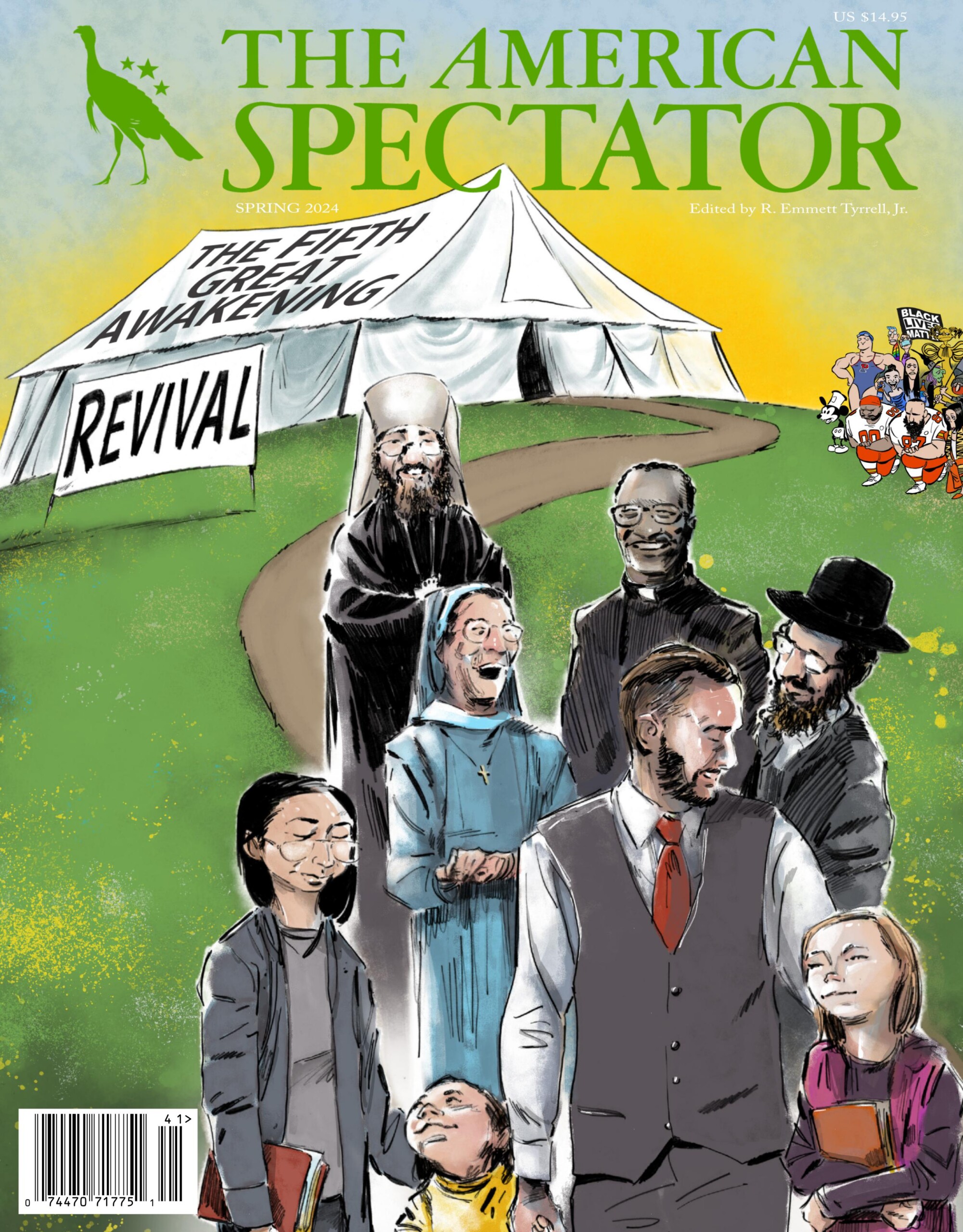
This article is taken from The American Spectator’s latest print magazine. Subscribe to receive the entire magazine.
It is a story with all the drama one would expect from a modern church splintering in plain sight. It featured tempestuous church conventions, rebellious student convocations, pompous faculty orations, protests and press conferences, and all the militant accouterments — black armbands and the like — one would expect of a winner-take-all showdown in the tumultuous 1970s. It ended with a theatrical exodus event that included a mock funeral for the seminary, boarded-up arches and gateways, the planting of memorial crosses on campus grounds, defiant speeches, and a triumphal march away from the campus into self-imposed exile.
The Theological Tempest
In a time when churches split over positions on sexual proclivities or thinly disguised political issues, if there is a silver lining to this particular ecclesiastical fissure, it is that, in a bizarre way, it is refreshing to see a church body fracturing over what the church should be about in the first place, that is, theology — or, more specifically, biblical interpretation.
Subscribe to The American Spectator to receive our latest print magazine, which includes this article and others like it.
That’s how this squabble started. It stemmed from the adoption of a hermeneutical method called historical criticism by certain members of the faculty of Concordia Seminary.
Historical criticism is a product of the Enlightenment, the age when science and reason were in ascendancy. It focuses on biblical hermeneutics, treating God’s written Word as though it is to be interpreted as a merely human document that is in principle no different from any other piece of ancient writing. By rejecting the notion of divine inspiration, historical criticism undermines the Bible’s authority, denies its miracles, and dismisses its historical accounts.
This method is a cornerstone of liberal theology and is widely utilized in the hermeneutical practices of mainline Protestants, including Presbyterians, Episcopalians, Methodists, and liberal Baptists and Lutherans. The Lutheran Church–Missouri Synod had avoided its taint until, in the early 1960s, reports began to filter through pastoral and lay ranks that certain professors at the seminary had embraced this interpretive method. Some professors were giving speeches and publishing papers asserting a troubling notion: that the Scriptures are not God’s written Word verbally inspired by the Holy Spirit but, rather, are self-contradictory.
From 1962 to 1969, synodical conventions — that is, biennial gatherings of the Lutheran Church–Missouri Synod at large, comprising pastors and laity — centered around the reports emerging from Concordia Seminary. Many attendees expressed concern about this doctrinal retreat into liberalism, prompting the convention to pass repeated resolutions reaffirming longstanding tenets of biblical orthodoxy. These resolutions included assertions that the biblical events were, in fact, historical and that the authors cited in the Scriptures were indeed responsible for their respective books. In short, the conventions declared that the Bible presents an infallible, historically accurate account of the Christian faith.
Preus v. Tietjen
In 1969, tensions within the synod mounted, as new men were elected to its two high-profile offices. They would face off — both as figureheads of their respective sides and personally — over the future of the church’s theology.
John H. Tietjen, a known ecumenist who promoted union among Lutherans despite doctrinal disagreement, was selected as president of Concordia Seminary. While Tietjen’s election was met with foreboding in traditional circles, the mood on the seminary campus was gleeful. According to the Lutheran Church–Missouri Synod’s official history of the walkout, “The expectation was that Dr. Tietjen’s election marked the beginning of a new day in which the more liberal theological and ecumenical views of the St. Louis faculty would triumph in the Synod.”
A few months after Tietjen’s ascension, the synod threw a cloud over liberals’ “new day” by electing Jacob A. O. Preus II as its next president. He was steeped in biblical orthodoxy and politically savvy — his father had been governor of Minnesota. At the time Preus was elected, he had been serving as president of the synod’s other seminary in Springfield, Illinois. Many pushing the synod leftward saw the election of Preus as a setback to their cause, while conservatives saw it for what it was — a reaction to the growing fear that the theology emanating from Concordia Seminary in St. Louis was departing significantly from the Scripture-based doctrinal position of the synod.
It did not take long for conflict to arise between the two men. Shortly after the convention, Preus, spurred by reports from conservative faculty members regarding the teachings at the seminary, commissioned a fact-finding committee. Their task: to interview Concordia Seminary professors about their doctrinal views.
The committee’s findings, which were reported by Preus, indicated that some faculty members were guilty of many of the charges leveled against them. These charges included confusion regarding the doctrine of Scripture, especially its verbal inspiration and inerrancy, as well as a commitment to the historical-critical method. Additionally, they cast doubt on Old Testament history; questioned whether Jesus actually spoke the words attributed to him in the Gospels; minimized the predictive prophecy of the Old Testament; and insisted that Moses did not write the Pentateuch, Isaiah did not write all of the book of Isaiah, and the apostle Paul did not pen all of the New Testament books attributed to him.
The theological crux of the matter centered around the authority of Scripture. Under Preus’s leadership, the conservatives staunchly maintained that the Bible serves as the foundation and guiding principle of the church’s doctrine. They emphasized that the essence of the Christian faith lies in the gospel of Christ, and they argued that Sacred Scripture, rather than human reason, defines the content of this salvific message.
The seminary professors tended to narrow the church’s teaching to just the Gospels; this practice is known as “gospel reductionism.” In this view, the Gospels alone are the standard that determines the church’s doctrine. Consequently, this approach marginalizes the teaching authority of God’s commands toward Christians and disregards certain aspects of the written Word, such as the Bible’s proscription against homosexual relations.
The Lutheran Church–Missouri Synod fact-finding committee, however, emphasized the authority of Scripture: “Whatever the text says is the meaning of the text. [That meaning] is to be accepted as such because it is the Word of God. Whether a text should be taken literally or in some other way is determined by the text itself — its grammar, context, etc.”
Watershed at the Rivergate
Everything came to a head at the 1973 synodical convention, which was held at the Rivergate Convention Center in New Orleans. The convention denounced the faculty majority’s position as contrary to the synod’s doctrinal position, as they deemed it “not to be tolerated in the church of God.” In addition, conservatives were set to oust Tietjen from his presidency via a floor vote. However, time constraints intervened and the matter was turned over to the seminary’s Board of Control, which had shifted, by a vote during that very convention, from liberal to conservative. Still, the convention offered Tietjen the opportunity to present his perspective. Standing at a floor microphone, he initially claimed that he had been “grievously wronged” by the convention. But then he declared that he also had good news for the delegates: “I forgive you,” Tietjen said, “because I think you really do not know what you are doing, and I think it is so that in time you will recognize what you are doing and you will grieve over this day.”
Tensions escalated rapidly. It took less than a week for the faculty majority at Concordia Seminary to stage a massive protest rally on campus — complete with processions, TV cameras, and the announcement of a protest movement calling itself Evangelical Lutherans in Mission. Subsequent to the protests, several Lutheran Church–Missouri Synod pastors complained about Tietjen. Tietjen refused to meet with the pastors to hear their complaints, and, because of his refusal, the seminary board could suspend Tietjen on the basis of a synodical rule.
The seminary board was eager to proceed with the suspension, but legal complications forced the board to back off. While it awaited confirmation of its authority to suspend the seminary’s president, multiple protests ensued, confidential reports were leaked to the press, Evangelical Lutherans in Mission launched its own alternative newspaper, and fifteen professors left their classrooms in the middle of the school year.
The Walkout
When Tietjen was finally suspended on January 20, 1974 — temporarily; he was still paid and enjoyed his benefits — the liberal majority at Concordia Seminary was ready for it. Student groups had already prepared “contingency plans” for “an eventual and expected crisis” at the seminary. At 8 a.m. on January 21, the morning following Tietjen’s suspension, the student body met in the seminary’s chapel and voted 274 to 94, with 15 abstentions, to boycott classes. The students then assembled in front of the seminary’s statue of Martin Luther for a “Here I Stand” moment. They read “A Student Resolution,” which detailed their grievances.
Later that same evening, the faculty majority voted to strike as well. Inventively, they attempted to shift blame for their decision to strike to the board. By suspending their boss, the faculty majority claimed, the board “had suspended all of us from our duties as teachers and executive staff members.”
Art by Bill Wilson
While the five faithful faculty members continued teaching classes to the fewer than one hundred students who also refrained from striking, student leaders marshaled about 250 seminarians to disperse around the country and spread their message. The faculty majority, meanwhile, began preparations for establishing a seminary-in-exile.
The penultimate act of defiance came on February 12. The faculty dispatched an ultimatum to the Board of Control declaring that they would return to teaching duties only if the synod agreed that they had all along been teaching “in accord with [the] doctrinal standard” of the Lutheran Church–Missouri Synod. If this did not happen by February 19 and if Tietjen was not restored to the presidency, then the faculty would continue to teach their students, “but it will not be under your auspices and not at the customary location,” they wrote. The theologically liberal faculty members were going to walk away from Concordia Seminary — and take their students with them.
The chairman of the Board of Control, E. J. Otto, summarized the board’s feelings in an interview on the synod’s radio station, KFUO: “We could not in good conscience bow to their ultimatum. Therefore, we in effect said to the faculty, ‘You will be in the classroom on Tuesday the nineteenth. You already have not worked for a month. If you are not in the classrooms on Tuesday, you will have terminated your connection with the seminary.’”
On Tuesday, February 19, neither the forty-five liberal faculty members nor the rebellious students of Concordia Seminary were in the classrooms. Instead, students and professors, some of the latter vested in academic garb, assembled in a long line and, preceded by a crucifer and banners, processed toward the campus quad, where some of the marchers, holding small white crosses, each with their name on it, planted them funereally in the campus quad. The solemn line then proceeded to the Luther statue, which was draped in black crepe. Several professors read from the Bible — one from Jeremiah, another from Lamentations. This was followed by prayers, the singing of the Common Doxology, and the sound of a dirge from the carillon bells.
And then the exiles tramped back to the seminary cafeteria for lunch.
The Aftermath
The seminary-in-exile, also known as Seminex and, later, Christ Seminary-Seminex, lasted for thirteen years. In 1987, it was incorporated into the Lutheran School of Theology in Chicago. The denomination spawned by the walkout, the Association of Evangelical Lutheran Churches, which comprised about 250 congregations, served as the catalyst for the formation, in 1988, of the Evangelical Lutheran Church in America.
The Evangelical Lutheran Church in America is proudly on the left these days, and it is beset by all the maladies of other mainline Protestant churches — plummeting membership, social-justice obsession, and sexual adventurism (endorsing same-sex marriage, transgender bishops, drag shows, and the like). Among the many lessons this story teaches is this: If the authority of the Sacred Scriptures is diminished, then the causes du jour take over.
Concordia Seminary, after a rocky year or two in the mid–1970s, quickly regained its stride and, within five years, returned to its pre-walkout enrollment. Its mother church, the Lutheran Church–Missouri Synod, has suffered membership dips, as have almost all American denominations in this secular age, but it has remained adamant in its conservative biblical theology. This commitment to orthodoxy was facilitated by the departure of the vast majority of the synod’s liberal faction fifty years ago in February 1974.
This chapter in church history imparts several lessons. First, it demonstrates that a church body equipped with theological education and fortified against criticism can effectively resist attempts by the Left to undermine its character. Additionally, it underscores the vital importance of safeguarding the sanctity of the Scriptures. When a church allows humans to usurp the authority rightfully belonging to the Bible, it becomes vulnerable to the prevailing social causes of the day. Evidence of this is as close as the nearest Protestant mainline church.
Subscribe to The American Spectator to receive our latest print magazine on the future of religion in America.
The post How a Church Fought Back Against a Liberal Takeover — And Won appeared first on The American Spectator | USA News and Politics.



 News Feed (Home)
 Popular Posts
 Events
 Blog
 Market
 Forum
 Headline News
 VidWatch
 Game Zone
 Top PodCasts