www.theamericanconservative.com
Are We Living Through Another 1850s?
History
Are We Living Through Another 1850s?
It’s difficult to see how these profound antipathies and fears will dissipate soon through any normal political processes.
When House Republicans dislodged Kevin McCarthy from the speakership last October and then struggled for three weeks to select a replacement, it struck many as entirely aberrational. Without a permanent speaker, the House couldn’t take up legislation, and Congress essentially stalled out like a rickety old truck. That wasn’t how Congress was supposed to work.
Yet in the decade leading to the Civil War, the House experienced three such stall-out crises: one, in December 1849, lasting three weeks; the others in 1855 and 1959, each lasting fully two months. The recurrent difficulty in electing a speaker signaled that the nation was hopelessly split over whether slavery would be allowed in the new southwestern territories acquired through James Polk’s war with Mexico.
“This is a fearful state of things, and may be the beginning of sorrows for our happy country,” lamented the St. Louis Democrat in December 1849. Indeed, American politics throughout the next ten years yielded multiple episodes of governmental dysfunction, waves of civic animosity, bursts of violence, and finally disunion and war.
That poses a question: With America fraught with greater political tension and venomous discourse than the country has seen since the Civil War era, could we be heading into a new time of domestic bloodshed?
Many have suggested as much. Richard Haass, former president of the Council of Foreign Relations, views the situation as “truly dangerous” and says he wouldn’t rule out “widespread political violence or even dissolution.” Robert Kuttner, the liberal writer and Brandeis professor, declares that judicial overreach by conservatives feels like “the run-up to a civil war.” A conservative commentator named Vance Byers, writing in The American Mind, suggests that the unruly political forces of this campaign year “could plausibly lead to violence.” The only questions, he adds, are “the scale of the violence and whether the American union will ultimately survive it.”
Such warnings reflect a growing perception that today’s civic discord echoes the enmity that swirled through the country in the 1850s. A gnawing question for anyone pondering the parallels between then and now is whether that long-ago conflict could have been prevented. Perhaps it could have, but a close study of those years suggests that the sectional conflict became, at some point, inevitable.
Why? In part because the slavery issue at the heart of the conflict became widely viewed by northerners as an issue of the highest moral significance. History suggests that political adjudication becomes extremely difficult, sometimes even impossible, when the central issues of the day are viewed in moral terms.
Before Polk’s expansionism, for example, the slavery question in America, though troublesome, seemed to merely simmer over the flames of politics. It was widely assumed that the odious institution would eventually fade away on its own. Notably, Henry Clay’s great Missouri Compromise of 1820 sought to pacify the anxieties generated by the issue primarily by maintaining a balance of political power between slave and free states. Implicit in the outcome was that there was no need for any northern agitation against the institution; it merely needed to be managed as it dwindled away.
But Polk’s territorial acquisitions generated a powerful new sense of moral urgency throughout the North. Intellectuals and politicians now invoked the sanctity of a “higher law” that transcended man’s law, including the Constitution, whose Framers had accepted slavery as a legacy institution of the South in order to get the document ratified. The eloquently antislavery novelist Harriet Beecher Stowe reflected the views of many when she excoriated Sen. Stephen A. Douglas of Illinois for having “moved over to the side of evil” when he “scoffed at the idea that there was a law of God higher than any law or constitution of the United States.”
Douglas’s outlook of “popular sovereignty” (let territorial voters decide) certainly reflected his moral obtuseness on slavery, but it also represented an effort to find a middle ground. For Stowe and other like-minded people of the North, there could be no middle ground.
Related to the moral dimension was a sense that the slavery issue had become “definitional,” meaning the country’s very essence was defined by its policy on slavery. Northerners increasingly embraced the conviction that living in a country that permitted slavery simply wasn’t acceptable. This conviction took on added force with a provision in Clay’s later compromise, in 1850, that bolstered the injunction that northerners must help capture and return fugitive slaves, thus implicating antislavery northerners in a system they considered morally repugnant. This became untenable in the North, especially when southern slaveholders declared a constitutional right to take their slaves at will into the new lands.
Then Chief Justice Roger Taney issued the Supreme Court’s infamous Dred Scott decision upholding the right of slave transport into the territories and declaring that American blacks, free or enslaved, had no right of U.S. citizenship. The issue’s moral dimension immediately became paramount as more and more northerners viewed slavery extension as tantamount to slavery entrenchment.
The South, meanwhile, reacted to the growing northern handwringing by insisting that slavery posed no moral questions at all. Southern intellectuals produced elaborate arguments extolling slavery as a generator of progress and civilization. Employing ballot-box manipulations and raw violence, southerners sought to dominate the new Kansas territory as a bulwark of bondage for further expansion and concocted heady plans for acquiring Cuba and Central America as additional slave territories.
Further, the South grappled with undulating waves of fear—fear of violent slave revolts spurred by northern antislavery agitations; of financial ruin without their chattel labor force; and more generally of the growing power of the North in population, wealth, and political might. That led to the widespread southern feeling that the only means of preserving the southern way of life was secession.
Secession isn’t a word heard in today’s political discourse. And yet an extensive poll of 35,307 Americans conducted earlier this year by YouGov, a UK-based market research firm, revealed that some 23 percent of the U.S. population would actually favor the secession of their state from the union. For Texas Republicans, the figure was 44 percent. These are remarkable findings, suggesting rumblings of pessimism and anxiety reminiscent of the 1850s.
Certainly no issue in America today carries the kind of profound moral weight that animated the American North on the slavery issue in the 1850s. But more and more Americans these days view politics as hinging upon moral questions and fundamental disputes over the country’s national identity. Further, questions involving the fate of the republic and of various American subgroups are generating intensifying civic fears.
The fault line roiling the nation today is a political struggle between the nation’s knowledge-sector elites centered along the coasts and in the large interior cities and university towns vs. what can generally be defined as heartland America, essentially the Trump constituency.
The elites embrace an ethos of globalism, which leads to open borders, free trade, anti-nationalism, cultural liberalism, and a foreign policy driven by humanitarian fervor. Since around the 1970s, this rising privileged class has proved extremely adept at gaining dominance over many major American institutions, including the Democratic Party, prestigious universities, influential think tanks and NGOs, popular culture, big finance, big tech, big corporations, and most of big media. As the late conservative polemicist Samuel Francis observed, throughout the postwar years (including the Reagan years), the right fought over ideas while the left fought for power.
Analyzing this power consolidation, Ron Brownstein of Atlantic Media conjured up what he called the “coalition of the ascendant,” including racial minorities, immigrants, millennials, and highly educated whites. And one more: “just enough blue-collar Midwestern whites to put the president over the top.”
Over the years this ascendant coalition has manifested a strongly moralistic bent. Its leaders are universalists, meaning they see themselves as guided by hallowed principles of humanity that transcend petty nationalism and other parochial concerns. They view their opponents as hidebound racists and xenophobes. Once the morality-based issue of gay marriage was settled in their favor, they promptly moved on to the next morality-based crusade of transgender rights. It appeared back in 2016 that Brownstein’s coalition would consolidate power firmly under the banner of Hillary Clinton.
Then along came Donald Trump, almost alone among major politicians of either party in perceiving the powerful new fault line that had emerged in American politics. He spoke for the heartland folks that historian and Wall Street Journal columnist Walter Russell Mead has described as “Jacksonians,” meaning they reject the elite concept of America as dedicated to the fulfillment of a universal mission of global betterment. Rather they see America’s governmental role as fulfilling “the country’s destiny by looking after the physical security and economic well-being of the American people in their national home.” These people feel besieged by the power and programs of their own national elite.
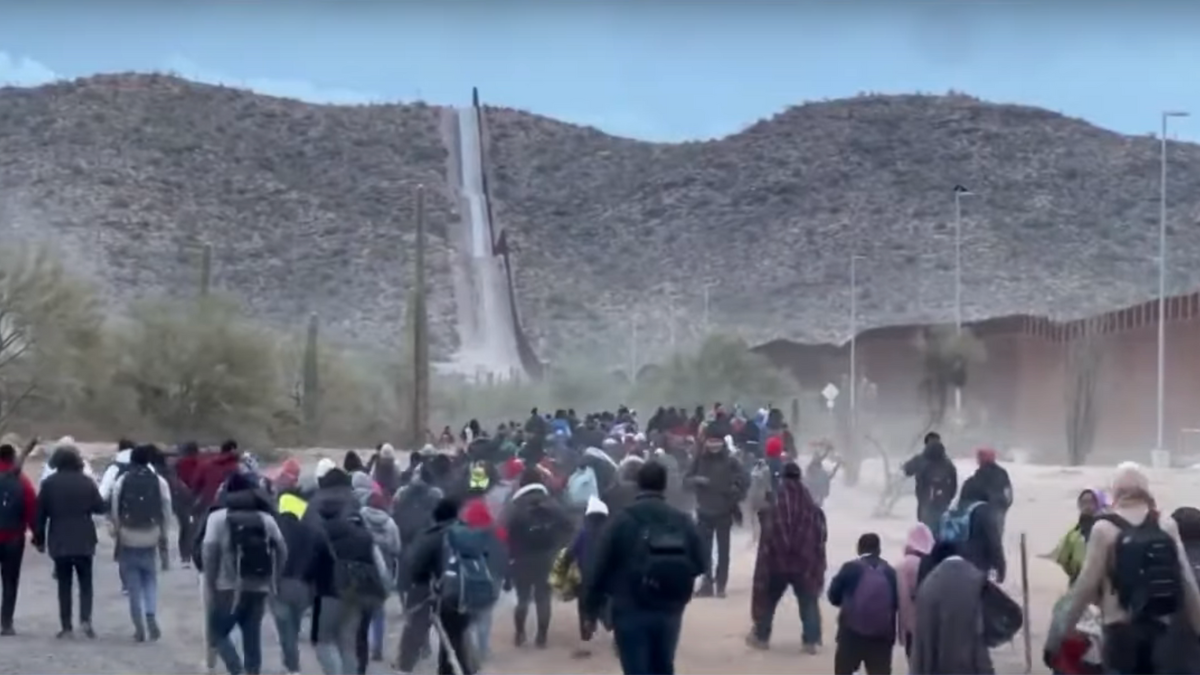
And so they embraced and still embrace Trump’s truculent and often boorish attacks on Brownstein’s coalition, particularly on the border issue, trade, anti-nationalism, and humanitarian warmaking.
With the two parties so far apart in values and residing on a knife’s edge of near political parity (another parallel with the 1850s), small shifts in voting patterns can spawn large directional shifts for the country. This is particularly true given that, with America mired in political gridlock, presidents govern less by influencing Congress and more through executive action. As Thomas Edsall of the New York Times writes, this mix of political realities “makes every election a high-stakes election.”
High-stakes elections breed emotion and anxiety, which in turn drive the factions further apart and toward “gut level hatred and mistrust,” as Jonathan Weiler of the University of North Carolina puts it. He notes that specific issues seem to matter less these days than “the intensity with which partisans are likely to feel that [their opponents] threaten them existentially.”
Thus do we see the inexorably widening gulf within the nation. Knowledge-sector elites view Trump and his constituency as a mortal threat to democracy, as people who “do not respect the Constitution … do not believe in the rule of law … [and] do not recognize the will of the people,” as President Biden put it in his 2022 speech at Philadelphia’s Independence Hall. If granted power, in this view, the Trump contingent will destroy the republic, as Caesar did the Roman republic.
The heartland Americans, in return, consider the country’s elites to be “unhinged,” to quote professor-emeritus Arlie Hochschild of the University of California, Berkeley, who conducted a sociological study of political and cultural attitudes of eastern Kentucky residents. “Regarding threats felt by the right,” she says, “I’d say all of them—especially trans issues—evoke a sense that this is the last straw.” The Kentuckians, she adds, see the increasingly powerful and moralistic elite as “talking to itself in front of [them] while trying to put [them] under its cultural rule.”
It’s difficult to see how these profound antipathies and fears will dissipate soon through any normal political processes. More likely they will spread and harden, steadily diminishing prospects for compromise. When Abraham Lincoln ran for president in 1860, he sought to mollify southern hostility with numerous substantial concessions, including a recognition that the Constitution sanctioned slavery where it already existed; that fugitive slave laws, however distasteful, were also constitutionally mandated; and that slavery prohibition in the District of Columbia required approval by residents there. He even disavowed the idea of placing blacks on an equal social footing with whites.
None of it worked. Southerners couldn’t get beyond his insistence that slavery was a moral wrong and must be placed upon a path of eventual extinction. Lincoln refused to yield “one iota” on that point, for it was here that his moral sensibility intersected with his practical politics. As he wrote to a friend, “The tug has to come, and better now than at any time hereafter.”
The tug led to secession and war. Can that happen again in America? We like to think not. After all, the Framers fashioned an elaborately balanced political system that has proved remarkably resilient over nearly two and a half centuries. But that system did break down once following a decade of discord that ultimately proved irreconcilable. Perhaps today’s America hasn’t reached any such point of irreconciliation. But the history of the 1850s suggests that today’s America is headed in that direction.
The post Are We Living Through Another 1850s? appeared first on The American Conservative.


 News Feed (Home)
 Popular Posts
  Events
  Blog
Blog  Market
  Forum
Forum  Headline News
 VidWatch
 Game Zone
 Top PodCasts