YubNub Social YubNub Social
    Advanced Search
  • Login

  • Night mode
  • © 2026 YubNub Social
    About • Directory • Contact Us • Privacy Policy • Terms of Use • Android • Apple iOS • Get Our App

    Select Language

  • English
Install our *FREE* WEB APP! (PWA)
Night mode
Community
News Feed (Home) Popular Posts Events Blog Market Forum
Media
Headline News VidWatch Game Zone Top PodCasts
Explore
Explore Jobs Offers
© 2026 YubNub Social
  • English
About • Directory • Contact Us • Privacy Policy • Terms of Use • Android • Apple iOS • Get Our App

Discover posts

Posts

Users

Pages

Group

Blog

Market

Events

Games

Forum

Jobs

Conservative Voices
Conservative Voices
2 yrs

How the American and French Revolutions Differed
Favicon 
spectator.org

How the American and French Revolutions Differed

It’s the middle of the summer, and once more our thoughts turn to that special place in our consciousness we reserve for July 4. We will again celebrate what we have and how we got it. We may even argue over how to keep it, but left or right, rich or otherwise, people of every ilk will come together to rejoice that we are in America — that we are Americans. After independence was secure, Americans looked to experience and what history teaches to guide them. But there is another date also in July that stands recognition — that of July 14 — the French Revolution. And as history tells us, the French were there with us in our fight against the British, certainly for their own reasons, but there nonetheless. What is interesting is that most citizens today — American or French — do not realize how unique circumstances (in each country) at the time played a key role in determining why the two revolutions had such disparate trajectories and outcomes. Location along with intent, ideology, inequality, class division, cessation, and subsequent government formation were critical in how the wars were fought and what happened afterwards. In fact, the entire context in which each country waged their campaigns for liberty gave rise to many of the cultural distinctions that still exist today between France and America. (READ MORE from F. Andrew Wolf Jr.: Master of Our Own Consciousness or Slave to the State?) Often compared because of similarities in ideology, era and impact, dissimilarities made a difference between the American (1775-1783) and French Revolution (1789) in context, complexity, and outcome. The American patriots held a distinct advantage in their fight for independence and a new country, which the French did not enjoy. As a result, the setbacks in prosecuting the war and its aftermath had less to do with the French themselves and more with the inherent conditions and circumstances over which the French had little control and with which the partisans had to contend. Pragmatic Americans, descended from early Puritan settlers in New England, looked towards history — keen to employ the tangible lessons they have learned from it. They turned toward experience as their compass in gaining their freedoms. The French, in contrast, primarily ensconced in a feudal system of repression, but because of Enlightenment principles, exalted reason as opposed to experience, while deprecating religion as well as the divine. Location – Colony vs. Country Venue was a key factor differentiating the two wars. America’s war for independence occurred 3,000 miles from the monarchy ruling it in Great Britain. The French Revolution took place amidst the feudal system within France itself, a factor that threatened the French monarchy, directly. Intent — Freedom vs. Overthrow Location also affected the intent of each revolution. American revolutionaries were not looking to overthrow the British monarchy. Their aim was merely to be free from its long distance rule, employing Enlightenment ideas about natural rights and human rights as the basis for their claims. What precipitated the French Revolution involved French partisans demanding change. In essence, Americans intended to break away to form a new government and establish a new form within their own country. The French intended to either tear down or significantly alter the existing French system of government. Ideology — Locke vs. Rousseau Members of the Continental Congress in the American colonies drafted the Declaration of Independence to separate themselves from Britain and to express their belief that every individual has the equal right to “life, liberty and the pursuit of happiness.” The American ideology was based on the works of British philosopher John Locke. France’s Declaration of the Rights of Man and of the Citizen was founded on the teachings of French philosopher Jean-Jacques Rousseau, written with the aim to create social equality and end the political inequalities of King Louis XVI. One of the key differences, therefore, between the American and French revolutions is that, unlike the French in their fight for equality, Americans did not fight for an abstraction. Partisans fought for “liberty, equality, and fraternity.” But historical experience and the  principles of Classical Liberalism demonstrate that neither equality nor fraternity can be achieved through coercion by the state. Perfect equality, advocated by Rousseau in his work, The Social Contract, is elusive at best and, even if it could be achieved, would be inconsistent with liberty (freedom). Whereas Americans struggled for tangible goals, the French took on the Herculean effort of striving for abstractions. With respect to abstractions and universal truths, although the Declaration of Independence incorporates them into the body of the text, historical context is important. The individuals who signed the Declaration understood they were not establishing a national government or founding a national Union when they signed it. They well understood they were simply explaining to a foreign power why it had become “necessary for one people to dissolve the political bands which have connected them with another” and that declared “the causes which impel them to the separation.” The Declaration was a document of dissolution. American and French Inequality Americans initially took up arms against the British to defend and preserve the traditional rights of Englishmen. The slogan “no taxation without representation” aptly summed up one of their chief complaints. The right to not be taxed without the consent of one’s elected representatives was one of the most prized rights of Englishmen. When this became impossible to achieve within the British Empire, Americans declared their independence and then won it on the battlefield. That is, Americans fought for tangible goals; they fought to preserve their traditional rights rather than to overturn an established social order. Taxation played a role in both wars, but the people’s objections to the taxes in each country were dissimilar. Americans objected to the fact that colonists had no say in how the collected taxes were spent — “taxation without representation.” However, American revolutionaries themselves, like George Washington and Thomas Jefferson, were financially successful and lived relatively comfortable lives. In contrast, the revolting French peasants were starving and destitute partially as a result of overtaxation, and thus their fight was in part instinctual — survival. French revolutionists also objected to the inequality in the apportionment of taxes — French clergy and noblemen were taxed less than commoners. Class Divisions vs. Ideology A significant difference exists in the categories of people fighting in each revolution. In France, the combatants were largely separated by economic classes — the rich from the poor, the lower class or the third estate to the upper class. For Americans, the separations were ideological, in that the warring parties were divided over loyalty to the crown and absolute monarchy versus the desire for freedom for American colonists. In some cases, differing political and philosophical views led to divisions within families and resulted in some soldiers fighting brother against brother in many colonies like New York. Cessation – Victory vs. Continued Instability The Treaty of Paris outlined cessation conditions to end the American War for Independence, and its signing on Sept. 3, 1783, marked the conflict’s end and later allowed for the United States of America to be formed. Unrest and conflict, however, continued within France into the 19th century. This political instability and persistent violence make the conclusion of the French Revolution of 1789 rather indeterminate. Although the notorious “Reign of Terror” ended in 1794 and a new constitution was approved in 1795, Napoleon Bonaparte’s coup d’état on Nov. 9, 1799, is most often considered to be the final end of the French Revolution. Establishing Government After independence was secure, Americans looked to experience and what history teaches to guide them in securing their freedoms by establishing government on a secure and concrete basis. Forrest McDonald notes in his work Novus Ordo Seclorum: The Intellectual Origins of the Constitution that it was John Dickinson who cautioned those gathered at the Philadelphia Convention, “Reason may mislead us.” Thus he added, “Experience must be our only guide.” The only safe path forward was to look to history and allow experience to guide their reason. And Dickinson was not alone in his faith in experience and concern for unbridled reason. Experience was “the best oracle of wisdom” and “the least fallible guide of human opinions,” wrote Alexander Hamilton in The Federalist Papers. James Madison, his collaborator in the Federalist, was just as resolute. He wrote that experience was “the oracle of truth” and “the guide that ought always to be followed whenever it can be found.” Experience, they believed, would help temper reason from leading them astray into extremes. (READ MORE: The First Amendment: An Inconvenience to the Government) The French, on the other hand, exalted Reason above not only experience, but also above religion and the divine. Indeed, they transformed Notre Dame Cathedral into a “Temple of Reason” and held pseudo-religious festivals in honor of this new “deity.” Unfortunately, reason unrestrained and untempered by history and experience proved unable to establish a stable government or to secure liberty in France. It led instead to the Reign of Terror, the Empire of Napoleon, and, ultimately, to the restoration of the monarchy that so many died attempting to defend and destroy. To date, there have been 17 separate governments in France since 1789. The Fifth Republic is the most recent. “The American war is over, but this is far from being the case with the American Revolution.” —Patrick Henry The post How the American and French Revolutions Differed appeared first on The American Spectator | USA News and Politics.
Like
Comment
Share
Conservative Voices
Conservative Voices
2 yrs

From Sea to Shining Sea: Exploring the ‘Mental Maps’ of America’s Founding Fathers
Favicon 
spectator.org

From Sea to Shining Sea: Exploring the ‘Mental Maps’ of America’s Founding Fathers

Mental Maps of the Founders: How Geographic Imagination Guided America’s Revolutionary Leaders By Michael Barone (Encounter Books, 234 pages, $22.77) What can geography reveal to us about the lives of America’s Founding Fathers? That would seem an odd question. One might be more prone to ask what politics or philosophy or religion might tell us about the Founders. But geography? According to Michael Barone, geography can tell us much more than we may think. In his latest book, Mental Maps of the Founders: How Geographic Imagination Guided America’s Revolutionary Leaders, Barone explores the lives and ideas of the Founders through the lens of their understanding of the geographic boundaries and topographical works of their time. That understanding in turn would shape the literal boundaries of our nation. Barone’s book takes readers on a unique exploration of the Founders by examining what he and other scholars call their “mental maps.” Though we’re all familiar with the sight of longitude and latitude lines on the physical maps that we saw in our classrooms, the maps we create in our minds are equally important for understanding human behavior. Those maps are fundamental to each of us. As historian Jerry Brotton puts it, “[T]he urge to map is a basic, enduring human instinct.” And yet, unfortunately, Americans have taken for granted their mental maps as technological advances, most notably GPS, have taken the large burden off our backs of ensuring the accuracy of the maps we use in our everyday lives. According to Barone and others, these “mental maps” could be simply summed up as the maps that we create in our minds, though that would be too simplistic to the biological reality. Our sense of navigation and knowing where things are has always been part of our biological nature. As Brotton puts it, “From early childhood onwards, we make sense of ourselves in relation to the wider physical world by processing information spatially.” Scientists such as John O’Keefe have studied “place neurons” in the hippocampus, the part of our brain that processes information regarding location and relative distance. This biological component is in all living things. This was noted by journalist Kathryn Schulz, who stated, “[E]very animal on earth knows how to navigate.” As biological creatures, our capacity to understand the world around us has always been a key part in how we are able to properly navigate to and from places. Barone puts it this way: “When we go to the store, go to work, go to school, we start off with an idea of how we will get there and how we will get back.” Thus our “mental maps” are the result of our very nature. In turn, those mental maps collectively have gone on to shape the behavior and worldviews of cultures and nations across history. That brings us back to the American Founding Fathers. When thinking about the Founders, Barone reveals how their mental maps became their most vital tool as they struggled to comprehend the largely unexplored lands of North America. Their individual mental maps affected the larger geographical map of what became the United States of America, especially given that they (in Barone’s words) had no “reliable maps to guide them. They lived in Atlantic seaboard colonies whose boundaries were not all clearly defined and whose backlands had never been accurately mapped.” Thus, they endeavored to map those new lands. And it’s here that Barone reveals the pure intellect and genius of the Founders. Barone dives into the lives of six of America’s most prominent Founders: Benjamin Franklin, George Washington, Thomas Jefferson, Alexander Hamilton, James Madison, and Albert Gallatin. Readers will be surprised by how the Founders were very much shaped by their geographic orientation as they sought to gain insight into the unexplored regions of North America. Franklin was well known for his interests in maps, as he often bought the latest maps of his day, and was widely known to have “accumulated more knowledge of the British North American colonies than perhaps any other person.” Jefferson and Washington were both accustomed to the mapmaking industry through their familial ties as well as Washington’s military experience, giving them insights as to the geographic nature of what is today the Midwest and land up to the Mississippi River. From their travels within the colonies to their times of service in office or the armed forces, the influences that shaped the geographic imagination of the Founders set in motion their ideas that would shape the trajectory of the United States. Besides their knowledge of topography and geography, it would be their geographic orientation that would have the vital role in shaping the newly independent American republic. For the Founders, says Barone, “their mental maps were full of contingencies, of what the new nation they hoped they were creating would look like and be like.” For Franklin, his knowledge of the limitless terrain of North America and the demographic nature of the exponentially increasing population of the colonies led him to envision a “united trans-Atlantic, English-speaking polity” that he believed would be “a potentially equal part of the British Empire.” After America’s independence, Franklin remained optimistic as he began to see Americans travel beyond the Appalachians, extending the young American republic to new boundaries. For Washington, Madison, Jefferson, and Gallatin, the future of America laid into the unexplored west, leading them to furnish America’s earliest efforts of westward expansion as they sought access to the prized Mississippi River and city of New Orleans. The geographic imagination of the Founders hence facilitated America’s expansion westward, leading to the most significant political developments in American history, such as the Northwest Ordinance of 1789 and Louisiana Purchase in 1803. While westward expansion was vigorously sought by some Founders, Alexander Hamilton saw the course of America’s future eastward. Hamilton’s upbringing on the Caribbean island of St. Croix allowed for him to get “in touch with a much larger and more variegated world, a vast network of trading voyages that spread from Europe to North America, South Asia, Africa, and the Caribbean.” The international trade routes that shaped Hamilton’s mental map led him to envision a young American republic reliant upon the productive and innovative nature of merchants and bankers. The calls for more centralization under Hamilton’s mercantile vision would come directly into conflict with Jefferson’s agrarian vision, which favored a decentralized approach to governance, causing the split between the Hamiltonians and Jeffersonians. Barone’s exploration of the Founders’ mental maps provides readers with a new lens from which to analyze their worldviews, actions, and enduring legacy. Readers will see how the geographic imagination of the Founders was the main driver for much of the political and economic formation of the early American republic from the rise of states across the Midwest to the development of the railroads that connected America’s inlands in the West to the Atlantic Coast in the East. From their geographic imagination arose the ideas and ambitions that would mold future American leaders, including “The Great Compromiser” Henry Clay, Andrew “Old Hickory” Jackson, the “cast-iron man” John C. Calhoun, and “Old-Man Eloquent” John Quincy Adams. Despite the division between the Jeffersonians and Hamiltonians, their ideas laid the foundations that would propel the United States to become the most powerful and productive country on earth. One criticism: While Mental Maps of the Founders offers a new lens to seeing the Founders, readers at times may feel frustrated that the book itself does not have any illustrations or maps. That may be a source of frustration for visual readers and for those expecting a book filled with topographical documents. While the lack of illustration may lessen the book’s appeal, Barone compensates with detailed analysis as to the specific geographic and topographic observations that shaped the political philosophy of the Founders. Mental Maps of the Founders brings forth a breath of fresh air that engages the intellectual curiosity of readers and fills them with a greater appreciation for America’s Founders. One will see that through their geographic imagination, the Founders set forth America’s trajectory to become the greatest nation on earth from sea to shining sea. The post From Sea to Shining Sea: Exploring the ‘Mental Maps’ of America’s Founding Fathers appeared first on The American Spectator | USA News and Politics.
Like
Comment
Share
Intel Uncensored
Intel Uncensored
2 yrs

SILVER RED ALERT! 1st Industrial User PANIC! Takes Large Physical COMEX SILVER Delivery! (Bix Weir)
Favicon 
www.sgtreport.com

SILVER RED ALERT! 1st Industrial User PANIC! Takes Large Physical COMEX SILVER Delivery! (Bix Weir)

from RoadtoRoota: TRUTH LIVES on at https://sgtreport.tv/
Like
Comment
Share
Intel Uncensored
Intel Uncensored
2 yrs

The War on Farming Continues – Denmark to Tax Cattle
Favicon 
www.sgtreport.com

The War on Farming Continues – Denmark to Tax Cattle

by Martin Armstrong, Armstrong Economics: The globalist cabal needs to control the food supply in order to control the masses. The World Economic Forum proposed ending gardening in general. Every nation is watching their farmland bought in bulk, with places like America seeing land taken away through eminent domain laws. The UK imposed a tax on chickens simply to […]
Like
Comment
Share
History Traveler
History Traveler
2 yrs

Highway Dig Uncovers Prehistoric Monument in Czech Republic
Favicon 
www.thecollector.com

Highway Dig Uncovers Prehistoric Monument in Czech Republic

A prehistoric burial site was discovered along the D35 highway. Source: UHK Faculty of Arts.   A prehistoric burial monument was uncovered during the construction and expansion of the Czech Republic’s D35 highway. Archaeologists from the University of Hradec Králové (UHK) discovered the structure near the villages of Dlouhé Dvory and Lípa in the eastern part of the country’s Bohemia region.   Barrow Among Europe’s Longest and Oldest Aerial view of the prehistoric monument in the Czech Republic. Source: UHK Faculty of Arts.   The Czech Republic highway dig revealed a prehistoric burial mound about 620 feet long and 50 feet wide. Archaeologists believe it dates back to the 4th millennium B.C.E., making it one of the earliest known burial mounds in Europe. “Mounds of this type are found mainly in northwestern Bohemia. They have not yet been reliably documented in Eastern Bohemia,” said Petr Krištuf, an archaeology professor at UHK. “In addition, the examined specimen represents the longest prehistoric mound not only in our region, but probably in the whole of Europe.”   So far, the UHK archaeological team has excavated the posthole and gutter of the long barrow’s entrance. (The term barrow refers to an ancient burial site covered by a large mound of earth.) Inside the barrow, the team found two central burials “built as monumental funerary objects, and as such they contain graves,” said the UHK Department of Archaeology in a statement. These central burials were likely constructed for individuals with high status.   Central Burials Contain Human Remains An excavated grave at the D35 highway burial site. Source: UHK Faculty of Arts.   The UHK archaeological team has excavated the two central burials found during the Czech Republic highway dig. The first grave contains a human skeleton and a ceramic vessel offering. The second also contains human remains, as well as five chipped flint artifacts. Both bodies were laid to rest on their left sides facing north. The addition of a later burial pit disturbed the prehistoric graves. As no human remains were found in the pit, laboratory analysis is required to ascertain whether it was ever actually used as a burial site.   Nearby, archaeologists also found thirty additional graves that likely date back to the Eneolithic period (about 5000 to 3300 B.C.E.). Laboratory analysis will help archaeologists determine a more exact timeline for these burials. The team’s working theory is that the burial ground was expanded over time around the long barrow. Krištuf said, “It will be interesting to see how the discovered graves are related to each other and whether they represent the burials of relatives.”   What’s Next for the Czech Republic Highway Dig The entrance to the prehistoric monument. Source: UHK Faculty of Arts.   The UHK archaeological team is currently analyzing grave samples to better understand the scope and historical significance of the barrow. “Similar burial mounds in Central Europe usually consist of only one, maximum two, burials, said Krištuf. “The significance of the discovery of the long mound…is not only in its size. The first results show that the monumental burial mound stood here for many centuries, and funeral and ritual activities of the local people took place in its vicinity. It was thus an important ritual place and landmark in the landscape at that time.”
Like
Comment
Share
Country Roundup
Country Roundup
2 yrs ·Youtube Music

YouTube
Oak Ridge Boys Singer William Lee Golden Loses Son Rusty at 65
Like
Comment
Share
Conservative Voices
Conservative Voices
2 yrs ·Youtube Politics

YouTube
The American Flag Represents Liberty on Earth
Like
Comment
Share
Bikers Den
Bikers Den
2 yrs ·Youtube General Interest

YouTube
Hey it's 102 years old bike ?
Like
Comment
Share
100 Percent Fed Up Feed
2 yrs

LEAKED TRUMP VIDEO: “Joe Biden Is Quitting The Race”
Favicon 
100percentfedup.com

LEAKED TRUMP VIDEO: “Joe Biden Is Quitting The Race”

Brand new leaked video from President Trump shows our President Trump confirming that Joe Biden is quitting the race. And now that means we have Kamala! Watch here: TRUMP SAID HE BROKE BIDEN IN JUST LEAKED VIDEO “Look at that old broken-down pile of crap. He (Biden) just quit, you know, he’s quitting the race. I got him out of the race, and that means we have Kamala. I think she’s gonna be better. She’s so bad. Can you imagine that… pic.twitter.com/YlRs6Elppm — Mario Nawfal (@MarioNawfal) July 4, 2024 Full video player here: BREAKING: A new video of Trump saying Biden will DROP OUT has leaked. “He [Biden] is quitting the race… that means we have Kamala” pic.twitter.com/DFq4FckiHr — George (@BehizyTweets) July 4, 2024 Dom Lucre shared the same video but put a man with a giant pumpkin head in the video. BREAKING NEWS: This footage kits leaked of Donald Trump stating that Joe Biden is “quitting the race” after debate—”I got him out”—and called him an “old broken-down pile of crap.” Trump says he’d prefer to run against Kamala Harris, and called her “so bad” and “pathetic.”… pic.twitter.com/6i7w6ojIVy — Dom Lucre | Breaker of Narratives (@dom_lucre) July 4, 2024 And yes, if you think I’m going to use that as an excuse to share one of my favorite Norm Macdonald jokes ever, you’d be exactly right. Watch here: Ok, ok, for everyone who doesn’t get it, I will explain. The joke is so simple. The joke is basically that you expect the man with a Giant Pumpkin Head to have messed up his third wish somehow by asking for the wrong thing or phrasing it wrong. But in reality, he’s just a moron who literally wished for a Giant Pumpkin Head after getting everything else he wanted. It’s one of my absolute favorites.
Like
Comment
Share
Classic Rock Lovers
Classic Rock Lovers  
2 yrs

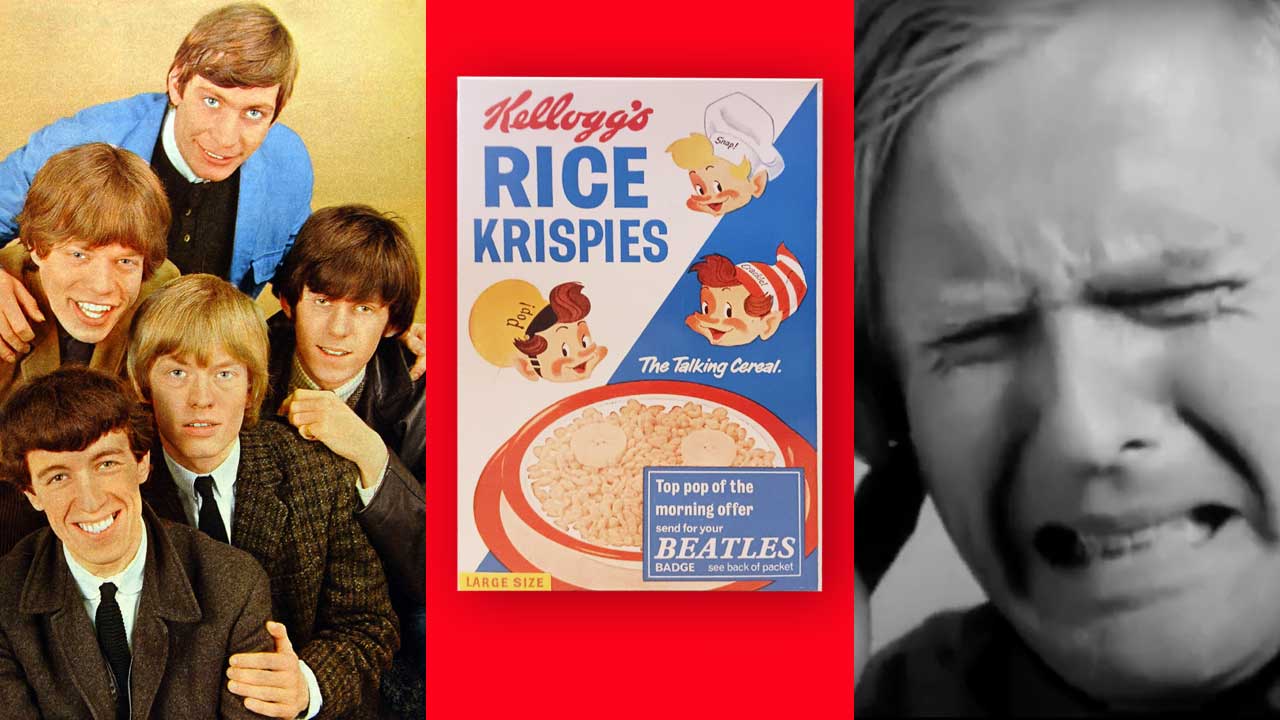
"Rice Krispies for you and you and you!" That time the Rolling Stones were paid £400 to record a jingle for Kellogg's Rice Krispies
Favicon 
www.loudersound.com

"Rice Krispies for you and you and you!" That time the Rolling Stones were paid £400 to record a jingle for Kellogg's Rice Krispies

Woke up this morning, got myself some tasty breakfast cereal
Like
Comment
Share
Showing 21808 out of 56670
  • 21804
  • 21805
  • 21806
  • 21807
  • 21808
  • 21809
  • 21810
  • 21811
  • 21812
  • 21813
  • 21814
  • 21815
  • 21816
  • 21817
  • 21818
  • 21819
  • 21820
  • 21821
  • 21822
  • 21823

Edit Offer

Add tier


Select an image
Delete your tier
Are you sure you want to delete this tier?

Reviews

In order to sell your content and posts, start by creating a few packages. Monetization

Pay By Wallet

Payment Alert

You are about to purchase the items, do you want to proceed?

Request a Refund