reactormag.com
A Secret Meeting Between Warring Queens: Will Cooler Heads Prevail in House of the Dragon Season 2, Episode 3
Movies & TV
house of the dragon
A Secret Meeting Between Warring Queens: Will Cooler Heads Prevail in House of the Dragon Season 2, Episode 3
Plus, some new characters, a very special bastard, and a deliciously creepy tour of Harrenhal!
By Tyler Dean
|
Published on July 1, 2024
Comment
0
Share New
Share
The third episode of this season of House of the Dragon, like the second, clocks in at over an hour. It’s similarly packed with the quiet character moments that made episode two so affecting. That said, we also get some new players on the board, as well as a reminder of why both this and the original series are near-universally lauded for their production design, and even a bit of dragon action to boot! Spoilers abound below, so be forewarned!
The Title
Episode three is entitled “The Burning Mill.” I’ll admit, this one surprised me a bit; I receive the screeners untitled and usually only discover the title after I have watched the episode—this is not what I would have expected from it. But it does make an amount of sense. The Battle of the Burning Mill is the first actual battle in the Targaryen civil war that the maesters later name the Dance of the Dragons. It’s represented as the opening scene of tonight’s episode and it serves as a bit of a microcosm for the whole conflict.
We can see that it doesn’t really have anything to do with the internecine struggle for the throne. It’s a local dispute between families that have always hated one another. Rhaenyra’s supposed child-murdering only gets brought up as an escalating afterthought. It’s the excuse that gets made for bloodshed—a theme that will crop up over and over again this episode. The mill has no name. It’s not incredibly important save that it gets destroyed. We don’t even actually see the battle—just the pointless provocation and horrifying aftermath. The first blood of this conflict is a deleterious loss of life, only vaguely related to the actual conflict, utterly pointless, and named for a landmark that holds no meaning or value. Not a bad episode title and not a bad metaphor for the show’s dismal take on war.
Unraveling the Opening Titles
There are two new panels added to the end of the opening titles this episode. I was worried, after episode 2, that they would remain static, but it seems we just needed to get to the scene that would stand in for Blood and Cheese.
The first new panel shows Prince Jaehaerys’ funeral bier. A golden thread runs across the neck, followed by the ever-present blood stain, reenacting the murder itself. It replaces the death of Lucerys as the most recent atrocity in the Dance of the Dragons and certainly the one that will be remembered as the low point of that time in history. It’s interesting to note that the show opts for the public visual of the death of the Prince. These tapestries are, after all, a sort of public record made after the fact—so it’s nice that the show chooses to show what hundreds of mourners could corroborate and not what only Queen Helaena saw and adumbrated.
Curiously (and tellingly) we also get a panel of the hanged ratcatchers. It’s a minor episode in F&B but the show is making a big deal of it and it might be their way of telling us that history remembers that Aegon was impulsive and vengeful as much as it (mis)remembers that Rhaenyra was a cruel child-murderer. Blood drips down from the hanged men and reaches towards the Iron Throne in the distance. The blood of the smallfolk soaks in beneath the throne, just as Sylvi (Michelle Bonnard) implied last episode.
Sir Simon Russell Beale Appreciation Corner
Credit: Ollie Upton/HBO
This episode marks the first appearance of Sir Simon Russell Beale on a Game of Thrones show. He’s among my favorite actors of all time so I’m going to use some of this space to extoll his virtues and discuss his performance on HotD. A trained singer and stage actor, with longstanding ties to the Royal Shakespeare Company and National Theatre Live, Beale is an expert in lending humanity to oddball, fussy little men. He played the fastidious, flamboyant, and surprisingly wise Egyptologist, Ferdinand Lyle, across all three seasons of Penny Dreadful (you can read more about how excellent I thought his performance was on that show here—yes this is, secretly, a Simon Russel Beale simp account and, yes, I made a custom Funko Pop of him). He was Charles Musgrove in the 1995 TV version—to my mind, the definitive adaptation—of Persuasion (which also stars impeccable, Game of Thrones alum Ciarán Hinds). He plays an incredible Falstaff across multiple episodes of The Hollow Crown (2012). And, among many highlights in an absolutely luminous stage career, he won a Tony for the roles of Henry and Phillip Lehman in the much-fêted Lehman Trilogy (a role I was lucky enough to see him in during the 2022 Los Angeles revival). He’s an international treasure whose knighthood is well-deserved.
He stars here as Ser Simon Strong, the great uncle of Matthew Needham’s Lord Larys Strong and the castellan of Harrenhal. Beale is a great fit for the role. In Fire & Blood, Ser Simon is barely mentioned—he’s the Strong who happens to be at Harrenhal and is promptly imprisoned by Daemon in a decisive coup. I vastly prefer the show’s version, where Daemon is made an uneasy guest, threatening imprisonment. It allows them to make Ser Simon into the sort of character Beale excels at playing—a long-suffering outsider who can comment on the ridiculousness of the proceedings. He is the sort of character one doesn’t expect to find in the Game of Thrones world: a disinterested party with virtually no agenda. It’s a great canvas for Beale to inject some much-needed humor into the series, and I can’t wait to see his story take shape in the weeks ahead.
Harrenhal in Full Glory
Last season, I gave a full recap of the haunted history of Harrenhal and the many families who have fallen victim to its curse. Though it was briefly featured last season both as the site of the Great Council of 101 AC in the opening scene and the site of Lyonel and Harwin Strong’s deaths in episode six, Harrenhal has never been particularly visually interesting, in spite of it serving as a major location across several seasons of the original Game of Thrones series. This is a shame, because it’s described in the books as an absolutely monstrous place. I’ve previously made the argument that Martin is a better horror writer than anything else and that both shows have been occasionally underwhelming when it comes to exploring the spookier side of Westeros. That seems to be a thing of the past, as of this episode.
Harrenhal emerges from a fog-shrouded storm, as Daemon approaches, showing off the unsettling scale of the fortress; as Caraxes flies closer and closer in a long shot, the castle continues to get bigger. Whenever Martin writes about Harrenhal, he underscores the sheer size of it as part of how unnerving it is. In A Clash of Kings (1998), he writes “on the road, Arya had felt like a sheep but Harrenhal turned her into a mouse […]. The size of the castle made even Gregor Clegane seem small […]. Walls, doors, halls, steps, everything was built to an inhuman scale that made Arya remember the stories Old Nan used to tell of the giants who lived beyond the Wall” (457-8). Elsewhere, Martin describes its five towers as a broken hand grasping at the clouds. Caraxes is quite large and manages to look tiny atop the Kingspyre tower.
Then there is the eerie emptiness of the place. Every shot shows us that, even beyond the echoing, cavernous rooms, decay and ruin have made the place feel even larger and emptier as we see cutaways to rooms and courtyards beyond. The five towers, melted by dragonfire, have an unnatural look—almost like huge melted candles. And everywhere that isn’t damaged by century-old char, weirwood roots distort the stones and burst through the walls. Harrenhal was built, in part, by leveling a grove of the sacred, ancient trees and they seem to be having their revenge on the place. Daemon looks down into the hall of a hundred hearths, where the Council of 101 AC was held, and finds it empty and muddy, with tattered House Strong banners rotting off their poles. At one point, a literal swarm of huge bats flies out of the eaves and into the night (in time, the Houses Lothston and Whent will incorporate bats into their sigils, inspired by their gloomy home). Even in the inhabited parts of the castle, the hearth flames gutter and flicker, the ceilings leak, and there is damp sediment underfoot. The two swords that Daemon uses to bar his door look hopelessly flimsy as some unseen force rattles them, demanding entry. In these moments, Harrenhal is, finally, the glorious, Gothic ruin it always should have been… and we can hope to see even more of it in the weeks ahead.
The Soiled Knight
Credit: Ollie Upton/HBO
There are a lot of bad knights in Westeros. In the original ASoIaF books, both Sandor Clegane (aka the Hound) and Sansa Stark have huge portions of their respective plots revolve around the idea that chivalry is a lie and that most knights are as weak and corruptible as any other men. In Fire & Blood, Ser Criston Cole (Fabien Frankel) seems to be an example of this sort of hollow, hypocritical knight—one who abused his power and position to do awful things in the name of the crown. The show has been really interesting, then, in giving us a more nuanced and fraught version of the character that nevertheless fits into Martin’s basic project of showing us that chivalric codes and tales exist to mask the fact that a knight is a killing machine, pure and simple.
This week, we get a tense exchange between a despondent Ser Criston and Alicent’s brother, Gwayne Hightower (The Great’s Freddie Fox), that ends with the latter saying “no one is more delighted than I to march out to war with a Dornishman.” Given that Martin’s world is not particularly colorist, it is sometimes hard to remember that there is quite a bit of in-world racism in the original books. Fabien Frankel doesn’t quite read as “other” by the metrics that White America might employ, but the show never fails to remind us that Westerosi can see his not-belonging from the start. The Hightowers, being powerful Lords from the Reach, have centuries of antipathy towards the Dornish—even more so than the other five kingdoms—and it doesn’t matter that Cole is the Lord Commander of the Kingsguard or the Hand of the King. It doesn’t even matter that he’s an awful person. To Ser Gwayne, he’s always a Dornishman first.
We then witness his most heartbreaking moment, to my mind, in the entire series thus far: Ser Criston asks Alicent if he can wear her favor into battle. Now, in Martin’s books (and, to a lesser extent, in actual European history) a knight might wear the favor of the woman he loves to remind him of what he is fighting or competing for. Especially in the tourney-culture of ASoIaF, it can be used as a way to signify the seriousness of a relationship, or spur on flirtation. It’s kind of the single most romantic move a knight has in Martin’s world.
And, for all of Criston’s flaws, for all that he is a monstrous individual, it’s kind of refreshing to see him motivated by the desire for something that isn’t foul or corrupt. He’s not compromising his integrity and breaking his vow of chastity because he’s carnally motivated and contemptuous of their meaning. He isn’t cloaking himself in virtue because he secretly wants power. In fact, he seems to hate being Hand of the King. He does, genuinely, want to live out this romantic fantasy of being a knight errant, risking life and limb on behalf of the nobly born maiden who has accepted his love and devotion. If we go back to season one, his hatred of Rhaenyra doesn’t stem from her sexual desire—it stems from her Targaryen license, her freedom from the rules he has lived his life by. It’s not even, necessarily, the fact that she rejects his proposal that disgusts him so much as the fact that she rejects his proposal while still wanting to have a sexual and possibly romantic relationship; it’s proof that the difference between them is that she doesn’t have to follow his code.
He’s wrong of course. Please don’t take any of this as an encomium or apology for Ser Criston. He’s a bad guy—a morally weak, deeply misogynistic, spiteful man. He’s certainly one of the major villains of both the book and the show, but that villainy is rooted in buying into the myths of knighthood that have been limiting and pernicious for him in the same way that they have been for those he victimizes. He’s the inverse of the Hound in many ways. Where that character believes that all knights are false so he’ll never be one, Ser Criston believes that all knights are false so he’ll try and be the truest one he can be—even if he has to compromise his basic humanity in service of his goal. The best storytellers have empathy for their monsters, and what could be more empathetic, and more easily twisted, than a man who is desperate to live up to a shining ideal that no human could reasonably embody?
Dragonseeds
Ulf the White (Tom Bennett) gives away the game this week, both claiming to be the bastard son of Baelon Targaryen and describing himself as a “dragonseed.” The latter is a term that Gyldayn uses to describe any bastard children of the Targaryen bloodline—and particularly unacknowledged bastards that grow up out of view of the family. Bastardy is a problem in ASoIaF because it represents a potential challenge to the line of succession. But dragonseeds are special among bastards insofar as they carry the blood of Old Valyria.
Unlike the bastards of other noble families—even of royal families (like the Baratheons in the original show’s timeline or the Starks or Lannisters during the time of Aegon the Conqueror), dragonseeds have the blood of Old Valyria in their veins and, with it, the magic that was supposedly infused into the great dragonriding families. Valyria wasn’t a powerful geopolitical force simply because they possessed dragons—the scions of the great houses are supposedly the only ones who can ride them. After all, the bond between dragon and rider goes far beyond the mere training of a beast. Targaryens are the only dragonriding lords from Valyria that remain and even other noble families of Valyrian descent (like the Velaryons) aren’t capable of it (remember that Laenor and Laena Velaryon were dragonriders because of their Targaryen mother, Rhaenys). Martin sometimes plays coy with whether or not this is Valyrian propaganda or an actual, magical truth but nothing in the books or shows, so far, has completely disproved the theory.
It’s this blood and its dragonriding properties that grants the Targaryens their power. It’s the reason they practice incest in spite of the objections of the Church of the Seven and queasiness of the majority of their subjects. So Ulf, if he truly is a dragonseed, is now engaged in one of the most powerful and dangerous games in Westeros.
The Black Council
Credit: Ollie Upton/HBO
Last week, we took an in-depth look at the Green Council. This week we’ll be examining the Blacks. It’s interesting that the show places nearly all of the named members of the Council from the book around the Painted Table. It gives the impression that Rhaenyra has more supporters than she actually does. Most of her council members are drawn from the houses of the Crownlands—the area immediately surrounding King’s Landing and Blackwater Bay.
Lord Corlys Velaryon — Steve Toussaint plays Lord Corlys, the Sea Snake. Before settling into his current role as the commander of Rhaenyra’s navy and the closest thing she has to a Hand, Corlys went on nine famed voyages across the seas of Westeros, Essos, and Sothoryos. There’s currently an animated adaptation of his voyages in the works at HBO and relics of those voyages are visible in his castle at Driftmark, which was heavily featured in season one. While he recovers from his injuries and rebuilds the navy he nearly lost in the Stepstones, he spends most of his time on Driftmark, just southwest of Dragonstone.
Lady Rhaenys Velaryon — Currently serving in her husband’s stead, Rhaenys is Corlys’ wife as well as a first cousin to King Viserys and the granddaughter of King Jaehaerys I. She’s the “Queen Who Never Was,” given her superior claim to Viserys, which was ultimately denied by Jaehaerys and the Lords of Westeros during the Great Council of 101 AC. She’s played by Eve Best who also played Wallis Simpson in The King’s Speech (2010), making this the second time she’s played a powerful woman involved in a monarchical succession crisis.
Lord Bartimos Celtigar — Played by Nicholas Jones, the show has made Lord Celtigar the calmest and most constant of Rhaenyra’s supporters, even if he tends to undermine her authority. You can tell he’s a Celtigar by the crab-shaped fasteners on his coat.
Ser Alfred Broome — Ser Alfred (Jamie Kenna) appears to be the most outspoken dissenter in Rhaenyra’s small council. Martin never mentions House Broome’s heraldry, but the show has given him the heraldry of the similarly named House Broom— chequy backdrop with a helmet topped by sprig of broom. It is certainly possible that the two houses are meant to be the same and there was a change in spelling at some point in the writing. The Broomes are a Westerland House, sworn to the Lannisters, but Ser Alfred was sworn to service at Dragonstone and commands none of the house levies.
Lord Gormon Massey — Played by James Dreyfus, Massey is the Lord of Stonedance, a castle at the end of Massey’s Hook—the curved peninsula that forms the southern boundary of Blackwater Bay. His daughter is Elinda Massey (Jordon Stevens), one of Rhaenyra’s ladies-in-waiting (and the only named one on the show).
Grand Maester Gerardys — Having been promoted to Grand Maester after having served, simply, as the Maester of Dragonstone Gerardys is played by Phil Daniels. As a maester, his writings survive and are referenced by characters like Tyrion and Varys in the ASoIaF books. He’s probably named after Vince Gerardis, Martin’s literary agent.
Lord Simon Staunton — Played by Michael Elwyn, Lord Staunton is the ruler of the tiny castle of Rook’s Rest, which he asks permission to return to and defend in this episode. Rook’s Rest is located along the peninsula that terminates in Crackclaw Point, forming the Northern border of Blackwater Bay. One can see that between the Masseys and Stauntons, the blockade that keeps goods out of King’s Landing is easy to enforce with sufficient naval power—power supplied by the Velaryons.
Ser Steffon Darklyn — The current head of Rhaenyra’s Queensguard, Ser Steffon (Anthony Flanagan), who accompanies Rhaenyra to King’s Landing this episode, is the son of the current Lord Darklyn of Duskendale. House Darklyn is extinct in the Game of Thrones era after having attempted a coup by kidnapping Aerys II (the Mad King) and holding him hostage behind the walls of Duskendale for six months.
DragonWatch
This episode marks the first appearance of Moondancer, Baela Velaryon’s dragon. In the books, she is described as pale green with pearlescent horns and accents and being not quite large enough to carry Baela during the Dance of the Dragons. The show has made Moondancer a bit larger so that Baela can be a more active combatant in the Dance. The show keeps that pale green coloration and adds some awesome, darker green brindling as well as a particularly punky finned ridge on the top of her head.
We get another shot of Seasmoke, still flying between Dragonstone and Driftmark. Mysaria suggests that he is lonely without his rider. This feels like a soft confirmation of my supposition, last week, that the show would treat Laenor’s exile as equivalent to his death. Or, perhaps, Laenor has died in the intervening years (it’s been about eight since he fled). Either way, I don’t expect we’ll see him again or learn of his fate. Seasmoke is a feral dragon once again.
Tyraxes and Stormcloud also get a shoutout in this episode. They are, respectively, the dragons of Joffrey Velaryon (Rhaenyra’s youngest son with Ser Harwin Strong/Ser Laenor Velaryon) and Aegon Targaryen (also called Aegon the younger, Rhaenyra’s fourth son and her eldest with Daemon). Both dragons are too small to be effective in battle and too small for an adult to ride. Still, it’s always nice to be reminded that they exist off-screen.
The Negroni Sbagliato Summit
Credit: Ollie Upton/HBO
After Season 7 Episode 5 of the original Game of Thrones series, my dear friend and professor of Early Modern literature, Colby Gordon, tweeted “there’s no femme solidarity in Westeros.” It was a lamentation about the fact that much of that season pitted Arya (Maisie Williams) and Sansa (Sophie Turner) against one another as Littlefinger (Aiden Gillen) manipulated the two sisters. The show attempted to deliver a satisfying twist by revealing that the two sisters had been secretly working together all along but, of course, we didn’t trust the show to give us that plot and, for many viewers, the whole thing fell a bit flat. In some ways, the entirety of HotD is that plot writ large; Rhaenyra and Alicent are powerful women, set at each other’s throats by their allegiance to the disappointing men in their lives. It’s a dangerous dynamic to toy with, given how tired that plot has become, but tonight, the show tips its hand a little bit and goes off-book, making for a truly memorable and brilliant final scene.
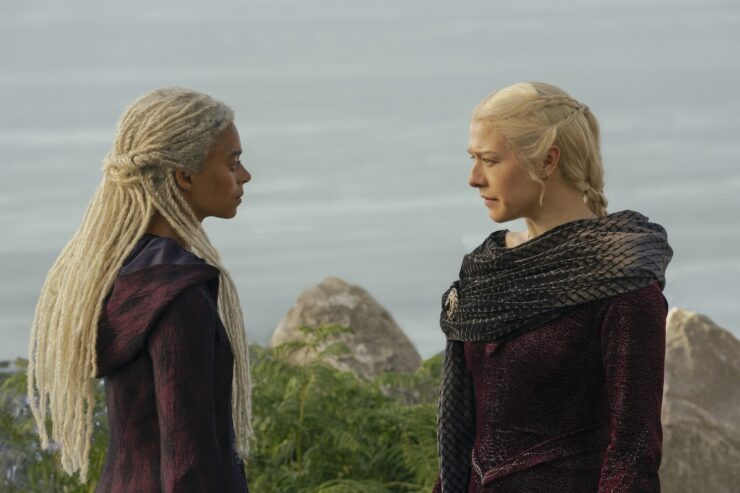
The relationship between Rhaenyra and Alicent is an invention of the show (in the book, Alicent is eleven years older than Rhaenyra and she is not in her stepdaughter’s orbit until Viserys marries her), as is this secret meeting between the two of them in the Sept. There is a lot to unpack about this scene. On one level, it’s great to see Emma D’Arcy and Olivia Cooke share the screen. Beyond the excitement of bringing the show’s two protagonists together, it’s undeniable that Cooke and D’Arcy have an intoxicating chemistry, perhaps best exemplified by the viral interview clip from 2022 where the two actors give their drink of choice. D’Arcy’s breathy, flirtatious enunciation of “A Negroni… sbagliato… with Prosecco in it” paired with their raskish lean forward and followed by Cooke’s flustered “ooh, stunning!” was the moment that launched a thousand ships—so to speak. On Monday mornings, my DMs are filled with memes from friends bemoaning the fact that the show won’t just let Alicent and Rhaenyra be together.
And, while I don’t think the show will deviate from the books so much as to give us the happy, sapphic ending that the two characters clearly deserve, I don’t think that the show is exactly engaging in queerbaiting either. There is a deep love between Alicent and Rhaenyra—even a heavily implied, sublimated, closeted romantic longing. Queerness isn’t as stigmatized in Westeros as is it in our world. The majority of straight characters who are confronted with the reality of a queer character’s sexuality in Martin’s books react with a kind of pragmatic shrug; a disinterest in the opposite sex is considered a problem to be solved, but only insofar as it’s a potential barrier to in-wedlock procreation—the primary anxiety of Westerosi highborn. Alicent and Rhaenyra, as eldest daughters of noble houses, have always been valuable commodities in political marriages—so, despite a lack of moral condemnation, both women have always been under immense pressure to engage in heteronormative relationships and produce legitimate children as a result. And any chance for Alicent and Rhaenyra to be open and honest about their probable interest in one another was dashed when Viserys announced his intention to marry Alicent. Being in love with one’s stepmother and the parent to your siblings is pretty rough (though, if anyone could make it work, a Targaryen could).
So we have two women, harboring long-buried affection for one another if not outright romantic love, whose actors have the kind of on-and-off-screen chemistry most rom-com directors could only dream of, and both of whom are crucial to the impending civil war, finally confronting one another, face to face, for the first time since the Blacks and Greens crowned their respective monarchs.
Early in the episode, Rhaenys wearily articulates what might as well be the thesis of the entire show—“soon they will not even remember what began the war in the first place […] we teeter now at the point when none of it will matter and the desire to kill and burn takes hold and reason is forgotten.” The cycle of revenge, of “a son for a son,” ends up as a mad power grab with no true justification. This is echoed, later in the episode, by Ser Simon Strong who says that the source of the Bracken/Blackwood feud is “lost in time: sin begets sin begets sin.” Rhaenys tells Rhaenyra that she needs to seek out Alicent because it’s the men around them both that want war, and that women’s cooler heads must prevail. She clearly knows what she’s talking about—after all, Rhaenys chose not to raise her banners against her cousin Viserys although her claim was clearly superior. She’s the Queen Who Never Was and her refusal to pursue the thones is what saved the realm from war for a generation. Neither Rhaenyra nor Alicent wants to be the woman whose ambitions, however justified, plunges their world into fire and blood.
It is this pressure that undergirds the meeting itself. There is an easy vulnerability between the two, despite the stakes and the tension. Rhaenyra’s exclamation of “Oh, I have begun badly” after threatening to kill Alicent got an actual chuckle out of me, even considering how on edge I felt during this scene. But it is genuinely affecting to see them struggle to come to terms. I saw a lot of complaints after episode eight of last season to the effect that the showrunners hinged Alicent and Rhaenyra’s antipathy on the former’s misunderstanding of Viserys’ dying words. I think there’s something to be said for that response. The best dramas find reasons, other than the tiniest missed connections, to put likable and rational characters at odds, and this episode seems to be setting that right. Rhaenyra, without revealing the whole of Aegon’s dream, tells Alicent that her father was likely talking about Aegon the Conqueror and not Aegon II. Alicent is clearly harrowed and horrified by the fact that this civil war is coming to pass because she did not have the context to interpret her husband’s incoherent ramblings. There is the glimmer of hope that the two of them, exonerated, in one another’s minds, of the horrible murders that have been laid at their feet, might come back to the mutual love they bore Viserys and the love they hold for one another.
But it’s not to be. Rhaenyra is right: the two of them don’t want war, both believe that she would be the better monarch, and they know they are each other’s best hope for peace. But Alicent is also right: it’s too late and Aegon, Cole, and Aemond won’t be stopped by her. This isn’t the story of how two women were duped into fighting by the men in their lives anymore. It’s the story of how their love for one another and their desire for peace was never going to be enough to defeat the impulsive, bellicose machinations of a patriarchal realm.
So many reviews and comments this season have been characterizing Alicent as the villain of this show and Rhaenyra as the uncomplicated hero. This episode feels like a clear message from the showrunners that they disagree with those assessments. The villain of HotD is and has always been the patriarchy.
Odds and Ends
Credit: Ollie Upton/HBO
The Blackwoods and Brackens are the Westerosi version of the Hatfields and McCoys–ancient feuding neighbors who regularly spill blood in an endless cycle of revenge. Martin often plays their rivalries for laughs but it’s great to see the show’s version of the Battle of the Burning Mill depicted as absolute senselessness horror where what could have been a silly, entertaining, stand-off between some backwoods nobility smash cuts to the aftermath of truly gruesome, widespread violence.
There have been some hints of it in season one but I believe that this episode officially unveils the banners of Aegon’s court. The show reveals a golden, three-headed dragon (representing Aegon II’s dragon, Sunfyre) on a green field (representing the Hightower flame in their calls to war—an invention of the show). In Fire & Blood, the use of the term “green” comes solely from Alicent’s anniversary dress and so their banner is a golden three-headed dragon on the traditional Targaryen black. Making green central to Hightower iconography is a good move as far as the show is concerned, and it lets viewers more readily distinguish the banners of the two factions from one another.
Thus far, the Blacks on the show use the traditional Targaryen banner—a red, three-headed dragon on black. In the book, their banners are those traditional arms quartered with the Velaryon seahorse (white on teal) and the Arryn moon and falcon (white on blue) to represent the families of Rhaenyra’s first husband and her mother. We’ll see if the show chooses to represent those interests in the Blacks’ banners; it seems likely however that they will stick with the purely Targaryen iconography, especially since it means that the field of each banner matches their respective faction’s namesake.
The strange woman who tells Daemon that he’ll die at Harrenhal is fan favorite character, Alys Rivers. Even better, she’s played by Gayle Rankin who definitely stole all our collective hearts (and not just mine, to the concern of all my friends) as Sheila the She-Wolf on the excellent and canceled-too-soon Netflix show, GLOW (she’s also currently starring on Broadway as Sally Bowles in the latest revival of Cabaret).
Let’s talk about Ser Criston’s Dornishness. In last week’s article, I mentioned that, in Fire & Blood, House Cole is a minor noble family from the Dornish Marches. Despite the name, the Marches are actually in the Reach, on the Dornish border. Because of centuries-old border skirmishes between Dorne and the Reach, the Marcher lords (like Game of Thrones’ Beric Dondarrion) are among the most bitter and anti-Dornish people in Westeros. It is unclear if the show has simply placed House Cole farther south and made them a Dornish House (which would make Criston an exile and expat) or if he is a member of House Cole as described but has some significant Dornish ancestry (which would make him the subject of scorn, potentially within his own family). Either way, making him Dornish is a neat change, especially during an era when Dorne isn’t part of the Seven Kingdoms.
Aemond walks the coin that Blood knocked to the ground in episode one over his knuckles. It’s a great little visual reminder of his obsession with the fact that he, alone among the Greens, knows he was the true target of Blood and Cheese’s ill-fated mission.
Corlys, despite being married to the Queen Who Never Was and supporting her claim, still can’t bring himself to name his granddaughter Rhaena as his own heir. He may recognize the exceptional leadership of his wife, but he’s too deeply rooted in Westerosi patriarchy.
Aegon models his new suit of Valyrian steel armor, claiming that it was worn by Aegon the Conqueror. In the books, the only person who wears Valyrian steel plate is Euron Greyjoy, and it’s considered to be a priceless artifact, given the fact that the secrets of forging Valyrian steel were lost with the doom of Valyria. It’s also somewhat ostentatious as the main properties that Martin ascribes to the substance (roughly equivalent to the similarly mysterious, real-world alloy Damascus steel) is the keen edge it keeps even after much wear. Armor doesn’t really need a keen edge. This all overlooks the fact that enough Valyrian steel to make of plate and mail would cost more than a kingdom (the show does mention it cost as much as a castle); Euron’s suit was looted from the ruins of Valyria on one of his dangerous, relic-finding expeditions.
Game of Thrones made a name for itself, in part, by banking on the titillating effect of femme-bodied nudity—let’s not forget that “sexposition” was coined by fans and critics in the early seasons of the show. It’s been interesting to see that nudity, on HotD, is (a) more egalitarian across body types and (b) rarely played for out and out titillation. Between Alicent’s uncomfortable frenetic disrobing ahead of her anxiety bath last episode and Aemond using his nude body as a kind of off-putting defense against his brother in this week’s brothel scene, it’s nice to see HBO using its pro-nudity distribution model for something other than the male gaze.
My HBO screener spoiler list said to say nothing about “the surprise appearance of a season 1 cast member” until this episode aired. I assumed it was going to be Viserys in flashback. A pleasant shock, then, to see Milly Alcock show up as young Rhaenyra in Daemon’s vision. Also, man, the show is making a lot of use of that Prince Jaehaerys prop body.
The original Game of Thrones started to play fast and loose with travel times and distances with characters famously teleporting all over the map. So far, it’s been nice to see the show attempt some accuracy. There are constant references to the armies of Oldtown (and the Hightowers) being months away from King’s Landing and it even takes a few days for Daemon to fly to Harrenhal on dragonback. This also works in reverse. The numerous secret trips to King’s Landing that the show has given us are stark reminders of just how geographically close our two warring courts are.
In Conclusion
The show’s willingness to add new material into the show might have been disastrous. But, thus far, Condal and his writer’s room seem to have a clear idea of who their characters are and are making subtle changes to Martin’s narrative that enhance those characterizations. Additionally, the show looks better than anything else on television. The attention to detail continues to be astounding. I simply don’t have the time or space, in these articles, to call out every incredible bit of production design or amazing VFX vista. With a slower pace, no time jumps, and a solid foundation from season one, House of the Dragon is shaping up to be a wildly rewarding show and the season isn’t even half over yet.[end-mark]
The post A Secret Meeting Between Warring Queens: Will Cooler Heads Prevail in <i>House of the Dragon</i> Season 2, Episode 3 appeared first on Reactor.


 News Feed (Home)
 Popular Posts
  Events
  Blog
Blog  Market
  Forum
Forum  Headline News
 VidWatch
 Game Zone
 Top PodCasts