www.universetoday.com
Lake Shorelines on Titan are Shaped by Methane Waves
Distant Titan is an oddball in the Solar System. Saturn’s largest moon—and the second largest in the entire Solar System—has an atmosphere denser than Earth’s. It also has stable lakes and seas of liquid hydrocarbons on its surface.
New research shows that waves on these seas are eroding Titan’s coastlines.
The research is “Signatures of Wave Erosion in Titan’s Coasts,” and it’s published in Science Advances. The lead author is Rose Palermo, an MIT graduate and research geologist at the U.S. Geological Survey.
In 2007, the Cassini spacecraft spotted lakes and seas of liquid hydrocarbons, mostly methane and ethane, on Saturn’s moon Titan. Titan and Earth are the only two bodies in the Solar System known to have surface liquids. Scientists have only Cassini data from Titan to work with, and they’ve been poring over the data in an effort to understand this strange world.
The moon’s seas are one of the most intriguing features throughout the entire Solar System. But they’re difficult to observe because of the thick atmosphere. Researchers have wondered if waves shape the coastlines, but there are conflicting signs about the nature of the seas. They could be rough, or they could be smooth. A paper from 2014 suggested that transient features in Titan’s northern sea, Ligeia Mare, could be waves.
But there’s no certainty.
“We found that if the coastlines have eroded, their shapes are more consistent with erosion by waves than by uniform erosion or no erosion at all.”Rose Palermo, lead author, U.S. Geological Survey
“Some people who tried to see evidence for waves didn’t see any, and said, ‘These seas are mirror-smooth,'” lead author Palermo said in a press release accompanying the research. “Others said they did see some roughness on the liquid surface but weren’t sure if waves caused it.”
It seems likely that there would be waves on Titan. To investigate this question, researchers at MIT compared Titan’s shorelines to shorelines on Earth to see if they match.
The seas and lakes on Titan look much like some on Earth. They appear to be flooded valleys and depressions. But scientists are uncertain if these bodies of water are eroding their coastlines like those on Earth. “Spacecraft observations and theoretical models suggest that wind may cause waves to form on Titan’s seas, potentially driving coastal erosion, but the observational evidence of waves is indirect, and the processes affecting shoreline evolution on Titan remain unknown,” the authors write in their paper.
The problem is that there’s no reliable way to connect shoreline morphology directly to the mechanisms that shape it, even on Earth. To try to understand how erosion affects Titan’s coastlines, the researchers started with Earth. They examined how different coastal erosion mechanisms shape Earth’s coastlines, then applied the framework to Titan.
There are basically two types of coastal erosion: wave-driven erosion and uniform erosion. Each type produces different coastlines.
Wave erosion is driven by wind and produces a change proportional to the strength of the waves. Waves are usually stronger the farther they travel before they hit a coast. Wave erosion creates long, smooth stretches of coast where the coast is fully exposed and bays in protected areas where less erosion occurs. The distance the wind can blow to generate waves on a particular water body before striking a coast is called ‘fetch.’
“Wave erosion is driven by the height and angle of the wave,” Palermo explained. “We used fetch to approximate wave height because the bigger the fetch, the longer the distance over which wind can blow and waves can grow.”
Uniform erosion is different. It doesn’t rely on mechanical wave action. The compositional differences between Earth and Titan are apparent when it comes to uniform erosion. “Titan’s crust consists mainly of water ice, but its surface solids may also include heavy hydrocarbon molecules, such as benzene, that are soluble in liquid methane and ethane, such that the liquid lakes and seas may slowly dissolve the solid coasts of the north polar terrain,” the authors explain in their research.
Over a long enough period of time, uniform erosion occurs at the same rate in all locations, producing distinct morphological features: shorelines that are generally smooth even inside bays with sharp headlands that punctuate them.
“Here, we test the hypothesis that coastal erosion has shaped Titan’s seas by investigating whether coastline shapes are most consistent with wave-driven erosion, uniform erosion, or no coastal erosion,” the authors write.
This figure from the research illustrates how the two types of erosion would shape shorelines. The images are based on simulated Titan landforms and shorelines. A shows the initial condition of Titan’s water bodies, where rivers carved out channels, and rising seas flooded them. B shows the morphology that wave erosion would produce, where the erosion rate depends on fetch. C shows the morphology that Uniform erosion would produce, where the erosion is uniform in all locations. Darker blue indicates deeper water and lighter yellow indicates higher land. Image Credit: Palermo et al. 2024.
The different morphological features produced by wave-driven erosion and uniform erosion are obvious. Wave-driven erosion tends to smooth exposed sections of the coastline where fetch is large and preserve the coastline where fetch is small inside embayments.
Uniform erosion is different. It widens embayments and smooths out small-scale roughness on the coastline regardless of fetch. Headlands are the exception, which sharpen into thick-necked points that stick out into the main basin.
“We had the same starting shorelines, and we saw that you get a really different final shape under uniform erosion versus wave erosion,” said co-author Taylor Perron, Professor of Earth, Atmospheric and Planetary Sciences at MIT. “They all kind of look like the Flying Spaghetti Monster because of the flooded river valleys, but the two types of erosion produce very different endpoints.”
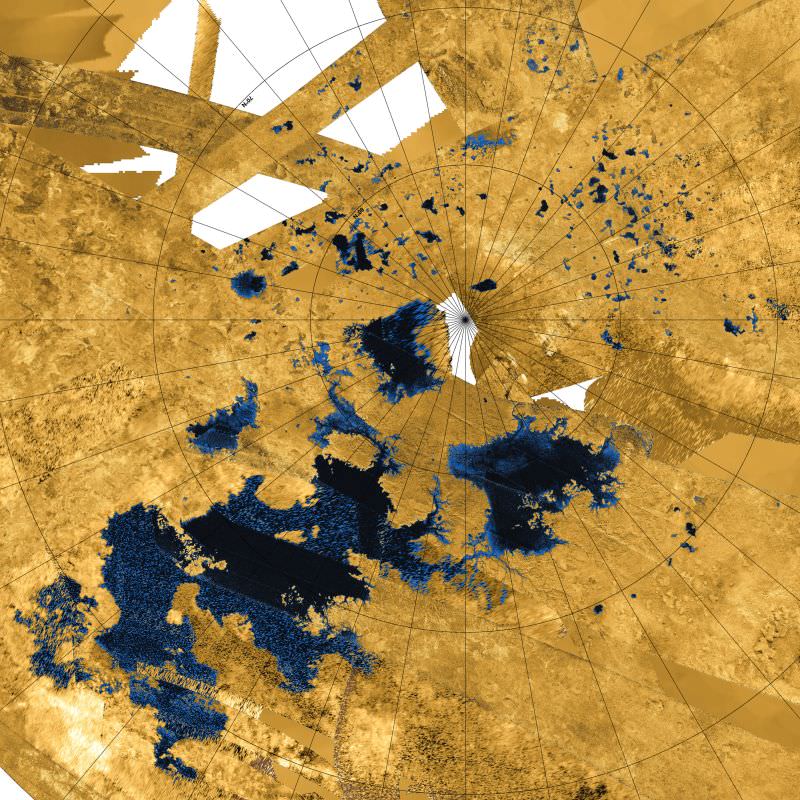
Titan’s Ligeia Mare is the second largest liquid body on Titan. The researchers say that its coastline appears to be altered by wave-driven erosion. Image Credit: By NASA/JPL-Caltech/ASI/Cornell – http://photojournal.jpl.nasa.gov/catalog/PIA17031, Public Domain, https://commons.wikimedia.org/w/index.php?curid=26294960
“We found that if the coastlines have eroded, their shapes are more consistent with erosion by waves than by uniform erosion or no erosion at all,” Perron said.
But these are just simulations, and they have to be tested rigorously. The team’s next step was to quantify these differences in the real world. The researchers explain that they “developed a technique focusing on local relationships between shoreline roughness and fetch area” to understand and quantify the differences. Specifically, they quantified what they call “roughness” to differentiate wave-driven erosion from uniform erosion. “Simply put, a lower roughness means a smoother stretch of shoreline compared to the rest of the lake, and a higher roughness means a comparatively rough stretch of shoreline,” they write.
This figure from the research shows roughness and fetch area for two of Titan’s seas: Kraken Mare and Ligeia Mare. C and D show roughness for each sea. E and F show the normalized fetch area, assuming waves are fetch-limited. Fetch-limited means waves continue to grow as long as the fetch length increases. G and H show normalized fetch area assuming a saturation fetch length of 20 km. That means that waves only grow up to a certain fetch length and then saturate. In that case, the system is saturation-limited, and the “fetch length in all directions is truncated to a maximum value.” Image Credit: Palermo et al. 2024.
The researchers say that “… shoreline roughness and normalized fetch area can be used to fingerprint wave-driven and uniform erosion and distinguish them from a coastline consisting only of flooded river valleys,” as shown in the first image.
So, what does this all boil down to?
“Our results suggest that the coastlines of Titan’s largest liquid bodies are most consistent with shorelines that have been modified by wave erosion and river incision,” the researchers write in their paper. They analyzed four coastlines and found a less than 5% probability of uniform erosion in a saturation-limited scenario and a less than 20% probability of uniform erosion in a fetch-limited scenario. That leaves wind-driven erosion as the most likely cause of erosion, which seems to confirm that Titan’s lakes and seas experience waves. “Therefore, our results suggest that the largest seas and lakes are not consistent with erosion by uniform processes (i.e., dissolution), as previously hypothesized for some of Titan’s landscapes,” they conclude.
That’s the scientific way of presenting their results, and their paper is like part of a long conversation with other scientists. In the press release, they state their conclusion more plainly for the rest of us.
“We can say, based on our results, that if the coastlines of Titan’s seas have eroded, waves are the most likely culprit,” said Perron, Professor of Earth, Atmospheric and Planetary Sciences at MIT. “If we could stand at the edge of one of Titan’s seas, we might see waves of liquid methane and ethane lapping on the shore and crashing on the coasts during storms. And they would be capable of eroding the material that the coast is made of.”
“Waves are ubiquitous on Earth’s oceans. If Titan has waves, they would likely dominate the surface of lakes,” says Juan Felipe Paniagua-Arroyave, associate professor in the School of Applied Sciences and Engineering at EAFIT University in Colombia, who was not involved in the study.” It would be fascinating to see how Titan’s winds create waves, not of water, but of exotic liquid hydrocarbons.”
The next step is to determine how strong Titan’s winds have to be to create coastal erosion. The researchers also hope to decipher which directions the wind is predominantly blowing from.
“Titan presents this case of a completely untouched system,” Palermo said. “It could help us learn more fundamental things about how coasts erode without the influence of people, and maybe that can help us better manage our coastlines on Earth in the future.”
The post Lake Shorelines on Titan are Shaped by Methane Waves appeared first on Universe Today.




 News Feed (Home)
 Popular Posts
  Events
  Blog
Blog  Market
  Forum
Forum  Headline News
 VidWatch
 Game Zone
 Top PodCasts



![Robbery Suspect With An AR-15 Opens Fire On Deputy Constable In Texas [VIDEOS]](https://www.rvmnews.com/wp-content/uploads/2024/06/2024.06.21-05.26-rvmnews-6675b7afc62e6.jpg)