YubNub Social YubNub Social
    Advanced Search
  • Login

  • Night mode
  • © 2026 YubNub Social
    About • Directory • Contact Us • Privacy Policy • Terms of Use • Android • Apple iOS • Get Our App

    Select Language

  • English
Install our *FREE* WEB APP! (PWA)
Night mode
Community
News Feed (Home) Popular Posts Events Blog Market Forum
Media
Headline News VidWatch Game Zone Top PodCasts
Explore
Explore Jobs Offers
© 2026 YubNub Social
  • English
About • Directory • Contact Us • Privacy Policy • Terms of Use • Android • Apple iOS • Get Our App

Discover posts

Posts

Users

Pages

Group

Blog

Market

Events

Games

Forum

Jobs

Living In Faith
Living In Faith
2 yrs

You Could Give Up, Or You Could Do This (2 Corinthians 1:9) - Your Daily Bible Verse - May 16
Favicon 
www.christianity.com

You Could Give Up, Or You Could Do This (2 Corinthians 1:9) - Your Daily Bible Verse - May 16

God does incredible things when we stop relying upon our own abilities and start relying on him.
Like
Comment
Share
Living In Faith
Living In Faith
2 yrs

A Prayer to Find Calm in God's Presence - Your Daily Prayer - May 16
Favicon 
www.ibelieve.com

A Prayer to Find Calm in God's Presence - Your Daily Prayer - May 16

Finding calm in prayer with the Holy Spirit is essential to dig deep and receive the strength needed to overcome trials.
Like
Comment
Share
NewsBusters Feed
NewsBusters Feed
2 yrs

HAMAS MEDIA: CBS Evening News Observes ‘Nakba Day’
Favicon 
www.newsbusters.org

HAMAS MEDIA: CBS Evening News Observes ‘Nakba Day’

As pertains to the ongoing war in Gaza, CBS News continues to solidify its reputation as the most pro-Hamas among the networks. A brief report on the Biden administration’s request for new military assistance for Israel quickly turned into an opportunity to echo pro-Palestinian points and observe “al-Nakba”, which loosely translates to “Catastrophe Day”.  Watch the aforementioned report in its entirety, as aired on the CBS Evening News on Wednesday, May 15th, 2024: NORAH O’DONNELL: Turning now to the war in Gaza. The Biden administration is pushing Congress for a new billion-dollar weapons package for Israel, as so much humanitarian aid could be arriving within days for millions of Palestinians. A floating pier built by the U.S. military is now being moved into position off the Gaza coast. Food and supplies can't come soon enough for Palestinians, who today marked al-Nakba. That’s the Arabic term for the displacement of more than 700,000 Palestinians during the creation of Israel 76 years ago. There is a lot of actual information that was omitted from the report so that Norah O’Donnell could have the time to read the pro-Hamas talking points off of the teleprompter. For example, it is unclear when the billion-dollar military assistance package will actually arrive to Israel. But O’Donnell made sure to juxtapose that assistance with humanitarian aid due to arrive for displaced Palestinians. Compare O’Donnell’s observance of al-Nakba with that of Michigan congresswoman Rashida Tlaib (D-The Squad). Their language is practically identical: As we mark the 76th anniversary of the Nakba, we honor all the lives lost since the ethnic cleansing of Palestinians began, and the Palestinians who were forced from their homes and violently displaced from their land. — Congresswoman Rashida Tlaib (@RepRashida) May 15, 2024 That is certainly one reading of history. The other is that when the British partitioned Mandatory Palestine, they created both a Jewish state and an Arab state, with the Jews accepting statehood and the Arabs refusing to live alongside the Jews. And that the real catastrophe (or nakba) happened when five Arab countries failed to expel Israel after they declared their independence a day before the start of what is now known as the Arab-Israeli War of 1948. Whatever displacement happened, happened as the result of an eliminationist war waged against the Jewish state. Hamas’ barbaric October 7th attack has, unfortunately, triggered further needless displacement and death. This, unfortunately, is more nuance than can be crammed into a 30-second brief intended to elicit empathy for Palestine rather than to report facts.  
Like
Comment
Share
Gamers Realm
Gamers Realm
2 yrs

The Finals' Future Is Looking Bleak After Nexon Says It Performed "Lower Than Expected"
Favicon 
www.dualshockers.com

The Finals' Future Is Looking Bleak After Nexon Says It Performed "Lower Than Expected"

The future of Embark Studios' free-to-play first-person shooter, The Finals, is looking bleak after its parent company Nexon said the title performed "lower than expected."
Like
Comment
Share
YubNub News
YubNub News
2 yrs

California Gov. Gavin Newsom Says His State Has a 'National Model' to Address Homelessness
Favicon 
yubnub.news

California Gov. Gavin Newsom Says His State Has a 'National Model' to Address Homelessness

If you were looking for a national model to end homelessness, why wouldn't you look to the governor of the state with the largest homeless population? The last we looked, San Francisco was having "nurses"…
Like
Comment
Share
YubNub News
YubNub News
2 yrs

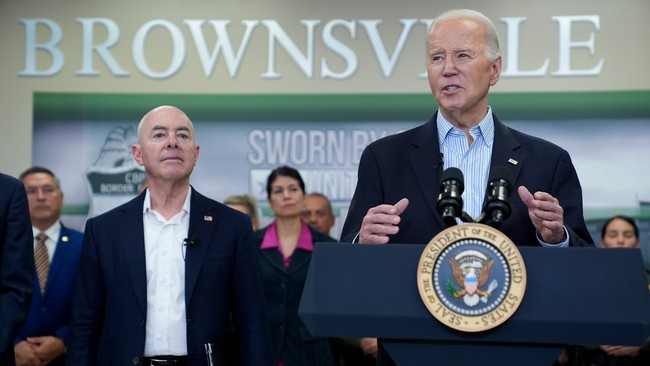
Report: Biden Plans Executive Order to Limit Border Crossings to 4,000 a Day
Favicon 
yubnub.news

Report: Biden Plans Executive Order to Limit Border Crossings to 4,000 a Day

President Joe Biden's poll numbers are so bad that he's challenging Donald Trump to a debate, under his own rules. The Biden camp is obviously desperate, but the New York Post says that Biden is planning…
Like
Comment
Share
YubNub News
YubNub News
2 yrs

Students For Trump — NKY Endorses Pro-Liberty Champion TJ Roberts for Kentucky State House District 66
Favicon 
yubnub.news

Students For Trump — NKY Endorses Pro-Liberty Champion TJ Roberts for Kentucky State House District 66

On March 14, 2024, Students for Trump — NKY issued the following statement where it announced its endorsements of TJ Roberts’ campaign for Kentucky’s 66th State House District: We are proud to announce…
Like
Comment
Share
Conservative Voices
Conservative Voices
2 yrs

This Is Why We Can’t Trust ‘the Science’
Favicon 
spectator.org

This Is Why We Can’t Trust ‘the Science’

It doesn’t matter if you’re a journalist, a health nut, or the average American trying to make a winning point in an argument; you’ve likely uttered the words: “There’s a study that says…” Even those of us who harbor doubts about the modern scientific process tend to use studies the way we use statistics. If they support our argument, we employ them — and we don’t always take our time to ensure those studies aren’t fake. (READ MORE from Aubrey Gulick: Could We Endow AI With Reason? Meta and OpenAI Think So.) Well, we should. The Wall Street Journal reports that Wiley, a 217-year-old publishing company, is closing 19 journals. In the last four years, the company has had to retract 11,300 papers and close four journals — and Wiley certainly isn’t the only publisher being forced to clean house. WSJ assured its readers that “this large-scale fraud represents a small percentage of submissions.” Still, it simultaneously accepted that it “threatens the legitimacy of the nearly $30 billion academic publishing industry and the credibility of science as a whole.” You don’t say. There are many problems with the system, not the least of which is that incentives for scientific research are badly designed. If incentives are problematic, you should expect fraud. (READ MORE: Boycotts Betray the Ethos of Science) Everyone who receives his Ph.D. is under pressure to publish research, and to do so regularly — after all, part of the responsibility of having the Ph.D. in the first place is to advance that field of study. If you, as a professor, want to win research grants, receive tenure, or get a promotion, you have to invest a substantial amount of time and effort into publishing papers in established journals. The problem is that humans are lazy, and lazy humans tend to find any loopholes they can to make their jobs easier. So, a professor could take the time and effort to invest in years of research, write his own paper, edit it, and go through the hassle of submitting it to multiple journals until one accepts it; or he could pay for a paper mill (whether that’s a business or individual) to affix his name to a partially or entirely fabricated article and then get that article published in a journal. The latter, it turns out, is more common than scientists would like to admit. A neuropsychologist named Bernhard Sabel actually designed a program to detect fake papers and quickly discovered that, out of 5,000 papers he screened, “up to 34% of neuroscience papers published in 2020 were likely made up or plagiarized; in medicine, the figure was 24%.” (READ MORE: The ‘Panic-demic’ Is Over; Time to Go Back to the Office) That’s not exactly “a small percentage.” To be sure, the primary party at fault is the paper mill fabricating scientific papers. But the editors at these journals, who should be carefully reading and fact-checking every paper they publish, evidently missed the fact that paper mills had swapped out recognizable terms like “breast cancer” and “fluid dynamics” for “bosom peril” and “gooey stream” to avoid plagiarism detection. WSJ reported that there are, of course, undercover paper mill agents on some of these journals’ editorial boards. I guess the scientific publishing world is just as exciting as a James Bond film. Who knew? But until Bond shows up to save the day, it’s probably worth reading studies thoroughly before citing them — since academic journals aren’t. The post This Is Why We Can’t Trust ‘the Science’ appeared first on The American Spectator | USA News and Politics.
Like
Comment
Share
Conservative Voices
Conservative Voices
2 yrs

Yakima Canutt: The Little-Known but Great American Stuntman
Favicon 
spectator.org

Yakima Canutt: The Little-Known but Great American Stuntman

It’s a fine idea to pay tribute to movie stuntmen, those little-known heroes of the silver screen. But one would have to be far more charmed by endless, overloud, and preposterous action scenes and brain-dead fights than I am in order to enjoy The Fall Guy, which I recently watched at the local Bijou. The American Spectator’s Leonora Cravotta is right about the movie’s boy/girl romance and the welcome clear line between good and bad. These are too rare on the large or small screen these days. But for me these positives were cancelled by the aforementioned dreary chaos at industrial decibel levels. No disrespect to the estimable Leonora. There’s no accounting for taste. RELATED: The Fall Guy Honors Stunt People, Traditional Values Stunt men — and I’m sure we have stunt persons now — have long added value to the action movies we’ve enjoyed. But they get little acclaim. This mostly goes to actors and directors, who, though often talented, rarely put their bodies on the line for our viewing pleasure as the stunt guys do. With AI, photo shopping, and other technical whizbangery these days, it becomes increasingly difficult to tell if a dangerous stunt was actually performed by a human being or is just some inhuman, digital trick. But there was no doubt back in the day. Check out this stunt, which is considered the best and most dangerous movie stunt ever pulled off: The daring stuntman is Yakima Canutt (1895–1986), a cowboy from Washington state who was a rodeo champion bronc rider before his stunt career. (He played both Indians and cowboys — no word on which side he took when he and his young mates played cowboys and Indians, a hate crime now but a popular pastime for young boys in pre-PC days.) This stunt is from the Duke’s breakout movie, 1939’s Stagecoach. It was particularly dangerous as there was not enough clearance for a man under the stagecoach, so an impression had to be dug for him to drop into. The stagecoach driver — that would be Andy Devine — had to hit it right. And Yakima had to know when precisely to let go so that he would drop into the dugout space rather than be reduced to coyote grease on the desert floor. People in the movie biz back then kept saying that Yakima, who did stunts in a lot of the Duke’s movies and for other known Hollywood names, would eventually kill himself in one of his audacious stunts. He didn’t. He died of cardiac arrest at 90, long after his last heart-stopping stunt. He was an innovator in his stunts and also in various safety devices that he devised and that were used by him and other stuntmen. He did some directing after he was too old to continue stunt work. He directed several Westerns, along with the action scenes in various other movies, including Spartacus. He also directed the chariot race in Ben-Hur and coached Charlton Heston on how to drive a chariot without killing himself.  Yakima Canutt. Little known outside the movie biz, but a great American. RIP. And thanks for the memories. The post Yakima Canutt: The Little-Known but Great American Stuntman appeared first on The American Spectator | USA News and Politics.
Like
Comment
Share
Conservative Voices
Conservative Voices
2 yrs

Why No Politician Can ‘Fix’ Prices (And Why That’s OK)
Favicon 
spectator.org

Why No Politician Can ‘Fix’ Prices (And Why That’s OK)

Prices are threads stitching together the fabric of our economy. They guide countless producers, here and abroad, to meet the most urgent demands of countless consumers. Prices enable the economic coordination of millions of individuals — each with his or her own unique preferences, skills, and resources — with no need for a central planner. They direct entrepreneurs and innovators, signaling where opportunities lie and where resources are most needed. Prices are guardians of scarce resources, ensuring that these are allocated to their most valuable uses. Prosperity results from the encouragement given to the production of goods and services that people desire most. READ MORE from Veronique de Rugy: Is the Resurgence of Unions Real? Does It Matter for Workers? There is someone else who sees the price system for its beauty and would like to protect it from continued government interferences: the Cato Institute’s Ryan Bourne. He has an excellent new book, The War on Prices: How Popular Misconceptions about Inflation, Prices, and Value Create Bad Policy. It includes 24 essays written by some of the best economists in the business, each addressing a different aspect of today’s war on prices — the widespread and counterproductive ways governments are trying to control inflation or particular prices. The book opens with a discussion about the largest bout of inflation in 40 years. After an explanation of why it’s still with us (note: it’s not corporate greed or the war in Ukraine), Bourne takes us on a tour of yesterday’s bad policy ideas, including wage and price controls implemented under Presidents Franklin Roosevelt and, later, Richard Nixon. The book then addresses misconceptions about inflation’s causes. One of the most frustrating is the notion that the term covers increases in the prices of certain goods or services. In 2021, for instance, we were told for months that the inflation was nothing more than the result of pandemic restrictions on some supply chains. When the war in Ukraine broke out, inflation was then falsely blamed on the resulting rise in oil prices. But as one contributor, Pierre Lemieux, explains, a change in relative prices — when only the prices of some things rise — is quite different from inflation, which occurs when all prices, including wages, eventually rise. While we can’t blame the public for its confusion, economists and politicians have no excuse for ignoring this distinction. Yet in 2021, the people in charge often failed to see the difference. The Federal Reserve for too long didn’t identify the price hikes as inflation. To be sure, there were some shocks to the supply of plenty of things, but these weren’t the main reasons all prices were going up. Demand, fueled by government spending and the desire to spend easy money (including all those stimulus checks), was the main culprit. As such, the institution tasked with price stability let inflation run loose and the buying power of each dollar sink for too long. Part two of Bourne’s book is about what tends to come next in times like these: government-imposed price controls. Eamonn Butler reminds us that “government attempts to curb rising prices and wage costs are as old as recorded history.” From controls on grain in Fifth Dynasty Egypt, to 1970s energy price controls, to the rent or health care controls we’re still accustomed to, politicians of all stripes are frequently tempted to simply declare price hikes unlawful. But because these are typically cheap attempts to control a symptom of inflation — or to mask poor policies that made something scarce and expensive in the first place — price controls fail spectacularly. They leave in their wake misallocations of resources, shortages, diminished product quality, black markets, and contempt for the law. As the book makes clear, similar problems arise with minimum-wage statutes and other government efforts to keep prices and wages artificially high. The book’s last section is on the value judgments driving the war on prices. Whether these be emotion-laden claims that “CEOs are paid too much” or that “rents are too high,” they’re often the result of uninformed opinion rather than careful economic analyses. In one chapter, my colleague Liya Palagashvili dispels the idea that it’s unfair for companies such as Uber or Lyft to charge different prices at different times. What some people see as unfair, economists like Palagashvili see as a way to prevent shortages and long waiting times. Prices and wages set on market dynamics reflect underlying economic realities and then send out a signal for help. Price controls only mask these realities, which inevitably worsens the economy’s ability to respond with what ordinary consumers and workers need. Veronique de Rugy is the George Gibbs Chair in Political Economy and a senior research fellow at the Mercatus Center at George Mason University. To find out more about Veronique de Rugy and read features by other Creators Syndicate writers and cartoonists, visit the Creators Syndicate webpage at www.creators.com. COPYRIGHT 2024 CREATORS.COM The post Why No Politician Can ‘Fix’ Prices (And Why That’s OK) appeared first on The American Spectator | USA News and Politics.
Like
Comment
Share
Showing 28189 out of 56670
  • 28185
  • 28186
  • 28187
  • 28188
  • 28189
  • 28190
  • 28191
  • 28192
  • 28193
  • 28194
  • 28195
  • 28196
  • 28197
  • 28198
  • 28199
  • 28200
  • 28201
  • 28202
  • 28203
  • 28204

Edit Offer

Add tier


Select an image
Delete your tier
Are you sure you want to delete this tier?

Reviews

In order to sell your content and posts, start by creating a few packages. Monetization

Pay By Wallet

Payment Alert

You are about to purchase the items, do you want to proceed?

Request a Refund