YubNub Social YubNub Social
    Advanced Search
  • Login

  • Night mode
  • © 2026 YubNub Social
    About • Directory • Contact Us • Privacy Policy • Terms of Use • Android • Apple iOS • Get Our App

    Select Language

  • English
Install our *FREE* WEB APP! (PWA)
Night mode
Community
News Feed (Home) Popular Posts Events Blog Market Forum
Media
Headline News VidWatch Game Zone Top PodCasts
Explore
Explore Jobs Offers
© 2026 YubNub Social
  • English
About • Directory • Contact Us • Privacy Policy • Terms of Use • Android • Apple iOS • Get Our App

Discover posts

Posts

Users

Pages

Group

Blog

Market

Events

Games

Forum

Jobs

INFOWARS
INFOWARS
2 yrs

The American Journal: Sinking Global Birth Rates Threaten Humanity

TUNE IN NOW:

https://madmaxworld.tv/channel..../the-american-journa
https://www.infowars.com/posts..../the-american-journa

ȯSUPPORT THE INFOWAR: www.infowarsstore.com

The American Journal
Favicon 
madmaxworld.tv

The American Journal

Taking a record of the heart and minds of the people, American Journal puts the power of the conversation into the callers' hands. Join us Monday through Friday, 8-11AM CST and call in to talk to Harrison Smith about all current topics and stories in the news and on your mind.
Like
Comment
Share
Pet Life
Pet Life
2 yrs

How Similar Housecats Are to Their Wild Ancestors: Olga’s Wild Streak
Favicon 
www.catster.com

How Similar Housecats Are to Their Wild Ancestors: Olga’s Wild Streak

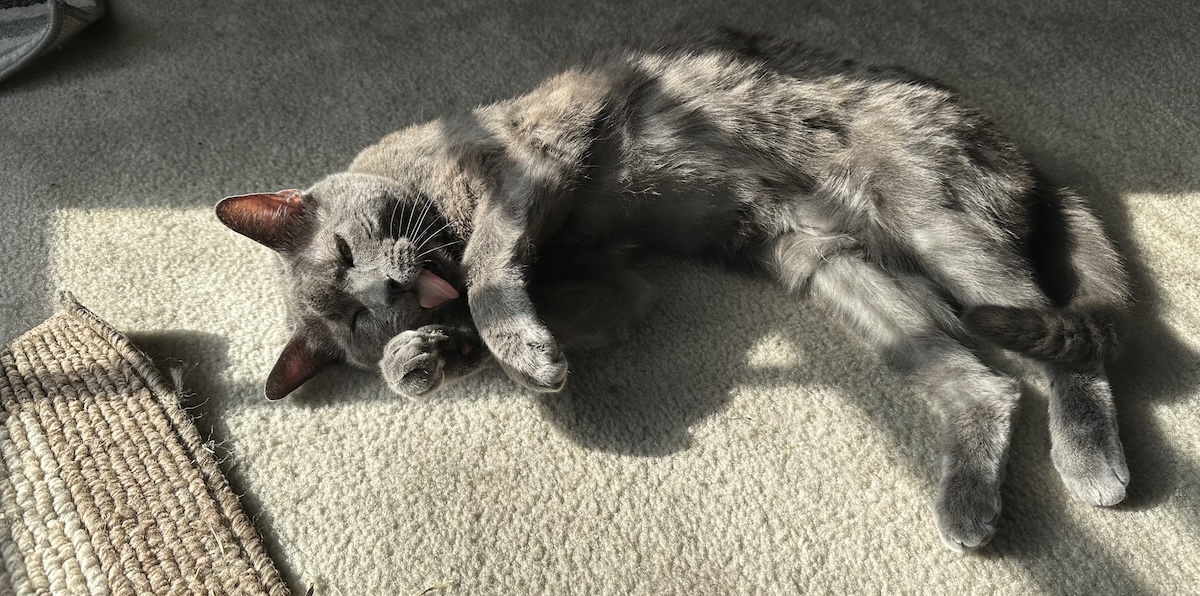
The post How Similar Housecats Are to Their Wild Ancestors: Olga’s Wild Streak by Christopher Bays appeared first on Catster. Copying over entire articles infringes on copyright laws. You may not be aware of it, but all of these articles were assigned, contracted and paid for, so they aren't considered public domain. However, we appreciate that you like the article and would love it if you continued sharing just the first paragraph of an article, then linking out to the rest of the piece on Catster.com. Hi, I’m Christopher! Read my introduction to learn more about me and my silly Russian Blue cat, Olga. The African Wildcat (Felis silvestris lybica) is the ancestor of domestic cats. Although they aren’t endangered, they’ve suffered from interbreeding with housecats. They can catch the same diseases as pet felines, and the healthiest populations live in arid, mountainous regions away from human settlements. Olga doesn’t need to hunt for her food and cannot sit up as straight as an African Wildcat. African Wildcats have longer front legs, and when they’re in a sitting position, their poses resemble those depicted in drawings by ancient Egyptians. However, that’s where their differences end; she’s just as wild as Felis lybica, but she’s trapped in a suburban home. Annie was right, Christopher. It’s a hard-knock life! Feline and Canine Domestication Cats seem wilder than dogs because humans haven’t selectively bred them for specific traits for very long. The farmers in the Fertile Crescent didn’t train their new friends to hunt rodents and had no need to manipulate their breeding pool. They provided shelter, and the cats were happy to prowl around and eat rats. On the other hand, dogs have been with us since the Mesolithic Age when we were hunter-gatherers. We domesticated them before other mammals and trained them to be hunters, guardians, and companions. This is called the Flehmen response, ladies and gentlemen. Olga’s Wild Ways Like most felines, Olga doesn’t want or need to perform a service that benefits humans. She’s an African Wildcat with a gray coat who loves attacking inanimate objects. It took years before she became comfortable sitting in my lap, and she still has a low tolerance for excessive petting. She’s not as agile or athletic as my last cat, but she’s wilder. I read a story on an exotic cat forum that reminded me of Olga. An owner of an African Wildcat mentioned that his cat wasn’t much different than a Domestic Shorthair, but he had scars on his legs and arms from her playful attacks. He also said that the cat was more affectionate in the daytime, and she became more aggressive when the sun went down. After Olga has had her ninth or tenth nap of the day and enjoyed a healthy meal before dusk, she gets a boost of energy. It’s strange because she acts more like a hunter when her belly is full. She runs laps around my house and attacks the back of my legs if I get in her way. Are you finished with that chicken marsala? I’m starving. An Owner’s Duties If I ignore her, she slams my bedroom door and howls if she has trouble opening it. She wants me to participate in her hunting games but only from a distance. Besides being her caretaker, Olga also thinks I’m an estate manager or gamekeeper. I’m in charge of keeping the property stocked with wildlife (toys), and if I fail in my duties, I don’t get fired like a manager of an English estate; I become the prey. I admire Olga’s wild nature and am glad she acts more like her ancestors than her cousins. Although I don’t have a rodent problem, I can always count on my blue panther to keep my home insect-free. The post How Similar Housecats Are to Their Wild Ancestors: Olga’s Wild Streak by Christopher Bays appeared first on Catster. Copying over entire articles infringes on copyright laws. You may not be aware of it, but all of these articles were assigned, contracted and paid for, so they aren't considered public domain. However, we appreciate that you like the article and would love it if you continued sharing just the first paragraph of an article, then linking out to the rest of the piece on Catster.com.
Like
Comment
Share
SciFi and Fantasy
SciFi and Fantasy  
2 yrs

Retelling Classic Fairy Tales: Seven Must-Read Collections and Anthologies
Favicon 
reactormag.com

Retelling Classic Fairy Tales: Seven Must-Read Collections and Anthologies

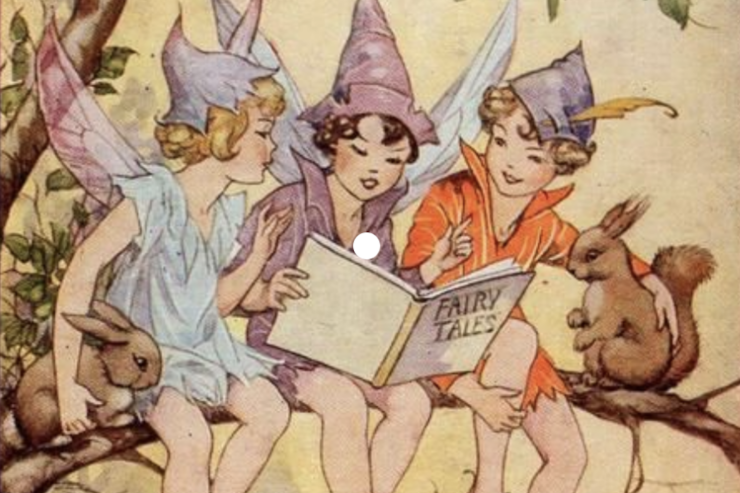
Books Fairytales Retelling Classic Fairy Tales: Seven Must-Read Collections and Anthologies Folklore and fairy tales can be endlessly retold; these books collect some of the most memorable reimaginings of classic stories. By Rachel Ayers | Published on May 13, 2024 Illustration by Dorothy M. Wheeler (1920) Comment 0 Share New Share Illustration by Dorothy M. Wheeler (1920) I love fairy tales. (You may have noticed this if you’ve read my previous columns.) Out of all literary forms, they’re the stories we never stop sharing, retelling, and recreating, and authors have an inexhaustible ability to rework the trappings and imagery and plots of these ancient tales, taking the reader along familiar paths only to find something new along the way. Suddenly there’s a slight twist, an unexpected detour, and unfamiliar elements begin to appear, giving rise to new shades and new meanings… We know that many of these tales were first passed along through oral traditions, and that storytellers would alter the details to suit their audiences’ circumstances and moods. Now authors can play the stories for laughs or tears, and you can find variations on almost any tale ranging from lighthearted to heart-of-darkness. You might seek out an upbeat take on “Little Red Riding Hood” when you need a laugh, or a horror version of “Cinderella” for when romance seems like the worst thing in the world. There’s a tale about Goldilocks getting her comeuppance as well as one where she and her bears become besties. Beauty may fall in love with her Beast, or perhaps she’ll leave him to start her own library. What does the author want to say, in the moment? What does the reader want to experience? Fairy tales are there for all of us, puzzle pieces that we can rearrange to make something reliable and comforting or new and unsettling. Rather than highlighting a specific tale in this piece, I wanted to take a moment to share my appreciation of some of the best collections and anthologies of folklore retellings I’ve come across during a lifetime of reading and rereading fairy tales. Like any other book of stories, fairy tale collections can be hit or miss, but the ones below are filled with stellar stories through and through… Beyond the Woods: Fairy Tales Retold edited by Paula Guran Guran’s anthology consists of all reprints, and she’s picked a selection of real treasures in this volume. This book features more diversity than a lot of “retold fairy tale” anthologies; although there are a number of European tales here, there are many drawn from other cultures as well, and a few that aren’t based on traditional tales but still feel like they should be. Featuring an all-star lineup of authors, Guran chose darker, modern retellings for the majority of the anthology, and everything somehow feels like it could happen to a neighbor or a friend if not to you, yourself, dear readers. Enchanting and haunting, Beyond the Woods comes with content warnings for the worst of human behavior, but is bookended by two Tanith Lee stories that are infused with hope and beauty. The Fairy’s Return and Other Princess Tales by Gail Carson Levine Levine never disappoints with her collection of tales from the faraway kingdom of Biddle, most famously the setting of Ella Enchanted. These shorter stories follow the royal family through the generations as their dealings with fairies often lead them into interesting situations. Though some of the tales are very familiar, Levine also delves into a few stories that rarely get a modern update, such as “The Princess Who Never Laughed” and “Diamonds and Toads.” Coming full circle from “The Fairy’s Mistake” to “The Fairy’s Return,” the titular fairy Ethelinda bookends the collection and proves that even fairies can learn a lesson or two over the course of several hundred years. Kissing the Witch by Emma Donoghue This stellar collection of linked tales follows the women of more-or-less familiar fairy tales backward through time and convoluted history. The stories are set in a gently familiar medieval world where witchcraft might be perceived in a few quiet words of wisdom spoken at the right time, or a bit of knowledge that not all are willing to glean. While some of the tales stand on their own more successfully than others, each one adds to the last even as they work their way back toward a misty, witchy beginning. Delightfully luscious and filled with the countless ways women can relate to one another, this collection is one you can savor or simply devour, depending on your own needs. The Merry Spinster: Tales of Everyday Horror by Daniel M. Lavery This is one of those books that, once I finally picked it up, I immediately began kicking myself for not having read it sooner. With a perfect marriage of horror and folklore, Lavery attacks well-known tales with remarkable skill and ambition, rendering the familiar terrifying and setting the formerly comforting on its head. Some of the stories play with gender and gendered expectations in interesting and thoughtful ways, turning our assumptions sideways. The stories also draw upon religion (the Book of Genesis) and fables like The Wind in the Willows and The Velveteen Rabbit. My favorites by far were the darkly dreadful romances (based on stories like “Beauty and the Beast,” “Cinderella,” etc.), because of course our closest relationships draw the horror closest to our hearts. An outstanding collection. Snow White, Blood Red edited by Ellen Datlow and Terri Windling The difficulty with Datlow and Windling is narrowing down which of their anthologies to include in this list, because they are all, in my experience, superb. I’ve chosen the first of their general fairy tale anthologies, because when I recently read it, I found the quality and staying power of the stories to be remarkable. Well, perhaps that’s unsurprising, with authors like Charles de Lint, Patricia McKillip, Nancy Kress, and, of course, Neil Gaiman included in the lineup. You can pick these anthologies up in any order, and if you’ve wondered if they’re worth it, I am happy to assure you that they are indeed wonderful collections, across the board. The Starlit Wood: New Fairy Tales edited by Dominik Parisien and Navah Wolfe The conceit of this anthology is that the Starlit Wood isn’t always a wood…it isn’t always a dark and mysterious ancient place, but these stories have relevance now and will continue to into the future. Many of the tales take place in the imagined future of our world and across various cultures, told by some of the best voices in contemporary fantasy and science fiction. Catherynne M. Valente retells the tale of “The Armless Maiden” as a dark, drug-fueled horror story. Charlie Jane Anders tackles the Grimms’ bizarre story “The Mouse, the Bird, and the Sausage” with a relentlessly cheerful charm. Theodora Goss, Aliette de Bodard, and Sofia Samatar all retell obscure and/or non-European tales that don’t get nearly enough attention in Western writing: “The Shadow,” “Da Trang and the Pearl,” and “The Tale of Mahliya and Mauhub and the White-Footed Gazelle,” respectively. A fresh and beautiful collection of stories. Troll’s-Eye View edited by Ellen Datlow and Terri Windling Datlow and Windling have also collaborated on a number of volumes collecting fairy tale retellings aimed at younger audiences, and this one is my favorite. Stories and poems by Neil Gaiman, Holly Black, Jane Yolen, Kelly Link, Catherynne M. Valente and others embrace and explore the dark side of fairy tales, reconsidering their villains with skill and empathy. They successfully turn one tale after another on its head, giving readers a range of familiar and obscure stories, adding complexity and rich layers to the traditional interpretations of these tales. Easy to recommend to audiences of any age. What are your favorite fairy tale or folklore collections and anthologies (and particularly those that focus on retelling classic tales)? Please share in the comments![end-mark] The post Retelling Classic Fairy Tales: Seven Must-Read Collections and Anthologies appeared first on Reactor.

Like
Comment
Share
Gamers Realm
Gamers Realm
2 yrs

Full achievement guide for Little Kitty, Big City
Favicon 
www.pcinvasion.com

Full achievement guide for Little Kitty, Big City

Little Kitty, Big City is mostly a fun sandbox game with lots to do. Everything to do in the game can be found in the cat-chievements section, which is incredibly fun to take on. Here is virtually everything to do in Little Kitty, Big City. All achievements in Little Kitty, Big City There are many achievements in Little Kitty, Big City, and they range from story-related progress to ambitious “find-them-alls.” I’ve categorized all of the achievements into groups and labelled them myself, so you can easily locate the achievements you want to find. All achievements are secret until you either complete them, or make progress in them. There are 39 cat-chievements in total, so you’ve got quite the task ahead of you! All story-related achievements in Little Kitty, Big City Screenshot: PC Invasion These cat-chievements are related to your quest to get back home – as well as helping out other animals you meet. Lots of the animal-related activities...
Like
Comment
Share
Hot Air Feed
Hot Air Feed
2 yrs

Ukraine Strikes Oil Refinery Deep Within Russia
Favicon 
hotair.com

Ukraine Strikes Oil Refinery Deep Within Russia

Ukraine Strikes Oil Refinery Deep Within Russia
Like
Comment
Share
Hot Air Feed
Hot Air Feed
2 yrs

Time to Cull the Herd
Favicon 
hotair.com

Time to Cull the Herd

Time to Cull the Herd
Like
Comment
Share
Science Explorer
Science Explorer
2 yrs

Largest-Ever 3D-Mapped Piece Of The Human Brain Could Still Fit On A Grain Of Rice
Favicon 
www.iflscience.com

Largest-Ever 3D-Mapped Piece Of The Human Brain Could Still Fit On A Grain Of Rice

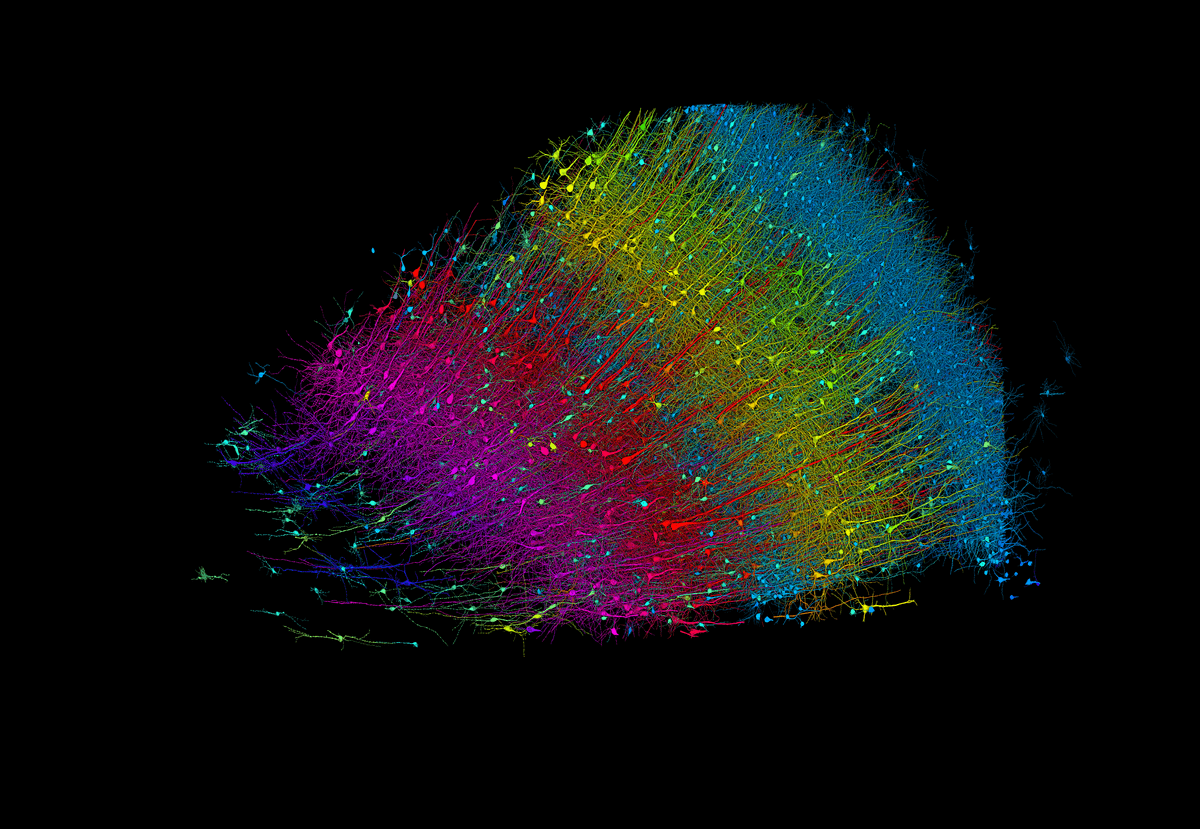
This vivid rainbow of cells represents the largest-ever high-resolution 3D map of a section of the human brain. The largest, yes, but still just a cubic millimeter in size – about half a grain of rice. With this feat, scientists can now see the intricate web of 57,000 cells, connected by 150 million synapses and hundreds of millimeters of blood vessels, that make up this one tiny section of the human cortex.For the last decade, a collaboration between researchers at Harvard University and Google has been working towards the goal of a complete, high-resolution map of the mouse brain. This is one small but important step on that journey, revealing some of the never-before-seen complexity of a fragment of brain tissue down to the synaptic scale.“The word ‘fragment’ is ironic,” said senior author Jeff Lichtman, whose team produced the electron microscopy images that form the basis of the new map, in a statement. “A terabyte is, for most people, gigantic, yet a fragment of a human brain – just a miniscule, teeny-weeny little bit of human brain – is still thousands of terabytes.”With help from AI algorithms developed at Google Research, the imaging from Lichtman’s team at Harvard can be color-coded and reconstructed to reveal unprecedented details. You might consider that neurons, the archetypal nerve cells, would be the most abundant in the major organ of the central nervous system – the clue is in the name, right? But the team found that these cells were actually outnumbered two to one by the supporting glial cells that help keep the brain’s environment just right. The most plentiful cell type was the oligodendrocytes that produce myelin, the vital insulation around nerve axons.Among the oddities in the tissue fragment were powerful neurons connected via 50 or more synapses each, swollen axons filled with what the team described in their paper as “unusual material”, and a small number of axons arranged into “extensive whorls”. Since the sample of tissue was originally taken from a patient with epilepsy, it’s unclear whether these features are related to that condition or not. The importance of mapping down to this level of detail is that it will hopefully provide researchers of the future with new insights into how small-scale connections within brain tissue could potentially be having a big impact, affecting major functions and contributing to disease.This branch of science is called “connectomics”. Other advances in the field in recent years have seen a massive international project to map the total connections within the human brain – just as we’ve mapped the human genome – and the publication of the first complete map of an insect brain. Add this to feats like last year’s announcement of a brain cell atlas, and scientists are now able to look more deeply than ever before inside our bundle of “little gray cells”.To further this aim, and to broaden access to these methods to as many scientists as possible, the Harvard and Google team have developed a series of analytical tools that are publicly available. “Given the enormous investment put into this project, it was important to present the results in a way that anybody else can now go and benefit from them,” said Viren Jain, a member of the Google Research group.The map of the entire mouse brain that is the end goal of this particular project will generate about 1,000 times the amount of data produced from this 1-cubic-millimeter human brain fragment, so there is still some way to go. “Without question, approaches to uncovering the meaning of neural circuit connectivity data are in their infancy,” the authors acknowledge, “but this petascale dataset is a start.”The study is published in the journal Science.
Like
Comment
Share
Science Explorer
Science Explorer
2 yrs

The US Has Ordered Five New Jets For Their New "Doomsday Plane" Fleet
Favicon 
www.iflscience.com

The US Has Ordered Five New Jets For Their New "Doomsday Plane" Fleet

The plan to create the successor to the US Air Force’s Nightwatch aircraft – the so-called "Doomsday plane" that acts as an airborne strategic command and control post in the event of nuclear war – is gaining traction. In April, Sierra Nevada Corporation won a $13 billion contract with the Pentagon to build the Air Force’s new Survivable Airborne Operations Center (SAOC) fleet. In the latest move, Reuters reports that the aerospace company has now bought five Boeing 747-8s planes from Korean Air, South Korea's largest airline. Valued at 918 billion Korean won ($674 million), the planes are expected to be delivered to the US by September 2025.The upcoming SAOC is being developed to replace the aging fleet of Boeing E-4B Nightwatch aircraft, planes that serve as a flying war room for the president, secretary of defense, and other key government and military officials during times of crisis, such as a nuclear war. The US Air Force currently operates four E-4B aircraft with at least one on alert at all times – 24 hours a day, 7 days a week – to “provide direct support to the President, the Secretary of Defense, and the [Joint Chiefs of Staff].” The planes are occasionally spotted in different parts of the world by flight trackers, often for reasons unclear to mere civilians.  An E-4B aircraft sits on the tarmac at California's Travis Air Force Base on September 11, 2017.Image credit: Louis Briscese/US Air Force (Public Domain)The elusive E-4B is a militarized version of the Boeing 747-200, a super-size jet designed for international cargo transportation, and can seat up to 111 crew. Its main deck has been fitted out with six modified areas: a command work area, a conference room, a briefing room, an operations team work area, a communications area, and a rest area."The E-4B is protected against the effects of electromagnetic pulse and has an electrical system designed to support advanced electronics and a wide variety of communications equipment," the US Air Force writes on their website."An advanced satellite communications system provides worldwide communication for senior leaders through the airborne operations center. Other improvements include nuclear and thermal effects shielding, acoustic control, an improved technical control facility and an upgraded air-conditioning system for cooling electrical components."The E-4B has been in operation since the 1970s, when the Cold War was far from over. With the aircraft nearing the end of their shelf life, the US Air Force is developing new planes to tackle the fresh wave of geopolitical turmoil facing the world. Details on the new SAOC’s development are understandably scant, so it’s not yet clear how it will differ from the current E-4B Nightwatch aircraft. However, the US Air Force has indicated it will involve much more digital design than previous models. It’s also unclear when the new system will hit the skies, although most sources suggest it won’t be ready until the 2030s. 
Like
Comment
Share
Strange & Paranormal Files
2 yrs

UFO conspiracy theorist believes ‘demonic entities’ are flying on UFOs
Favicon 
anomalien.com

UFO conspiracy theorist believes ‘demonic entities’ are flying on UFOs

A well-known conspiracy theorist, who notably received a punch from an Apollo astronaut, is doubling down on his claims that “demonic entities” are controlling UFOs. Bart Sibrel, a filmmaker recognized for his series of low-budget films disputing the legitimacy of the Moon landings, recently discussed his belief in the extraterrestrial nature of UFOs during a conversation with podcaster Joe Rogan. He proposed that “demonic entities” are operating UFOs and intentionally presenting themselves as extraterrestrial visitors as part of a malevolent and enigmatic scheme to “dominate mankind”. “The top two UFO researchers said UFOs are real, number one. Number two, they’re not from outer space, and number three they’re demonic,” he declared. “[The Bible] talks about Fallen Angels inter-breeding with humans, as talked about in Genesis Chapter six, and creating a race called Nephilim who were men of renown. World leaders.” Sibrel believes that the enigmatic forces responsible for the increasing UAP sightings have ancient roots, even referenced in the Bible. He said: “It talks about Fallen Angels inter-breeding with humans, as talked about in Genesis Chapter six, and creating a race called Nephilim who were men of renown. World leaders.” Sibrel argues that these “interdimensional” beings masquerade as extraterrestrials with a malevolent plan to dominate mankind. Despite overwhelming evidence to the contrary, Sibrel also continues to assert that the Moon landings were staged. He contends that his documentaries, which utilize official NASA footage to argue his case, receive backing from numerous individuals in the space industry. The post UFO conspiracy theorist believes ‘demonic entities’ are flying on UFOs appeared first on Anomalien.com.
Like
Comment
Share
NewsBusters Feed
NewsBusters Feed
2 yrs

New York Times Roots for Pro-Hamas Competition: 'Al Jazeera Finds Fans On Campus'
Favicon 
www.newsbusters.org

New York Times Roots for Pro-Hamas Competition: 'Al Jazeera Finds Fans On Campus'

The radical leftists on campus don't trust newspaper like The New York Times for their coverage of the Israel-Hamas war, but the Times doesn't mind. On the front of Monday's business section, they offered a laudatory look at the pro-Hamas, Qatar-funded network Al Jazeera, under “Why Al Jazeera is the Go To News Source for Student Protesters.” Santul Nerkar, a young journalist at the paper, never used terms like "leftist" or "radical" or even "progressive." They're just "pro-Palestinian." The print headline: “Al Jazeera Finds Fans On Campus.” He began: Nick Wilson has closely followed news on the war in Gaza since October. But Mr. Wilson, a Cornell student, is picky when it comes to his media diet: As a pro-Palestinian activist, he doesn’t trust major American outlets’ reporting on Israel’s campaign in Gaza. When conservatives say they don’t trust the mainstream press to cover Republicans fairly, they’re often smeared as ignorant or racist or McCarthyite. (The Times certainly doesn't respect the right-leaning New York Post.) Yet when leftists readers spout distrust, journalists from those same outlets under attack sound supportive. Strange how that works. Instead, he turns to publications less familiar to some American audiences, like the Arab news network Al Jazeera. “Al Jazeera is the site that I go to to get an account of events that I think will be reliable,” he said. Nerkar listed a few freak-show outlets, including Jewish Currents, which spouts about “Israel war crimes and “genocide,” as reliable reportorial options. Many student protesters said in recent interviews that they were seeking on-the-ground coverage of the war in Gaza, and often, a staunchly pro-Palestinian perspective -- and they are turning to alternative media for it. There’s a range of options: Jewish Currents, The Intercept, Mondoweiss and even independent Palestinian journalists on social media, as they seek information about what is happening in Gaza. .... Israel’s recent ban on the local operations of Al Jazeera has only elevated the network’s status among many student protesters. They prize coverage from reporters on the ground, and Al Jazeera has a more extensive operation in Gaza than any other publication. Students also noted the sacrifices it has made to tell the story there. Two Al Jazeera journalists have died since the start of the war. What didn’t make it into this report: Al-Jazeera’s pro-terrorist coverage like throwing a “birthday party” with cake and fireworks in 2008, to celebrate the release of a Lebanese terrorist who killed four in Israel, including a four-year-old girl. Al Jazeera reporters Ismail Abu Omar and Mohamed Washah were caught moonlighting as Hamas commanders. In February, The Times of Israel reported that "the IDF revealed a trove of images" that showed Washah in a Hamas uniform training fighters how to shoot rocket-propelled grenades, build warheads, and operate drones armed with an RPG. Nerkar oddly described Hamas as "armed resistance," not as engaged in the slaughter of civilians and hostage-taking. Critics say its coverage veers into support of the armed resistance to Israel. The Israeli government, which has accused Al Jazeera of acting as a “mouthpiece” for Hamas, last Sunday seized its broadcast equipment and shut down its operations in the country for at least 45 days. This is apparently Al Jazeera’s idea of balance: Terrorist videos as well as Israeli government news conferences. Al Jazeera called the government’s accusation “baseless” in a statement, adding that it has broadcast every news conference held by the Israeli cabinet and representatives for the Israel Defense Forces, in addition to videos from Hamas. …. The protesters rattle off a list of mainstream American publications as having coverage they find objectionable, including CNN, The Atlantic, the BBC and The New York Times, among many others. Nerkar approached the truth when he quoted scholar Hussein Ibish that the show’s “distinctly anti-American bent” had found a new fanbase on American college campuses: “There’s a third-worldist, anti-imperial point of view, and that’s also the view that many college kids have adopted.” Can’t disagree with that.
Like
Comment
Share
Showing 28618 out of 56670
  • 28614
  • 28615
  • 28616
  • 28617
  • 28618
  • 28619
  • 28620
  • 28621
  • 28622
  • 28623
  • 28624
  • 28625
  • 28626
  • 28627
  • 28628
  • 28629
  • 28630
  • 28631
  • 28632
  • 28633

Edit Offer

Add tier


Select an image
Delete your tier
Are you sure you want to delete this tier?

Reviews

In order to sell your content and posts, start by creating a few packages. Monetization

Pay By Wallet

Payment Alert

You are about to purchase the items, do you want to proceed?

Request a Refund