reactormag.com
Complete Planetary Destruction Is Not as Easy as It Seems
Books
Science Fiction
Complete Planetary Destruction Is Not as Easy as It Seems
Humans are very bad at taking care of the planet, but the Earth has survived bigger threats than us…
By James Davis Nicoll
|
Published on October 10, 2024
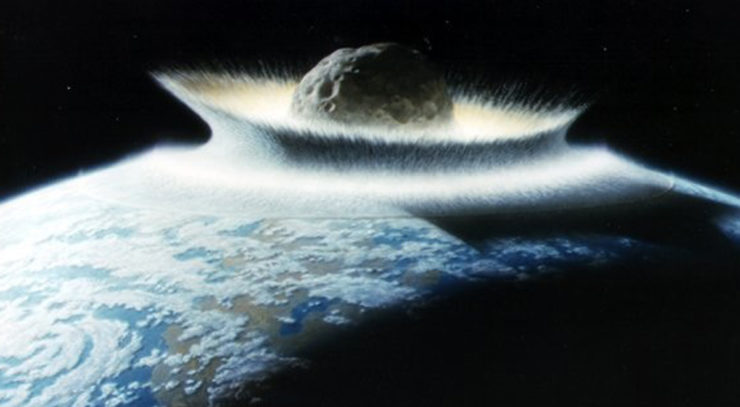
Image Credit: NASA/Don Davis
Comment
0
Share New
Share
Image Credit: NASA/Don Davis
I do enjoy perusing lists of upcoming books. This time round, my eye was caught by the number of books about humans fleeing a dead or dying Earth. This is, of course, nothing new. Humans have been fleeing a dead or dying Earth since Cole Hendron’s fleet set off for Bronson B1. Perhaps before.
While Cole was quite correct to be concerned about the effects of a gas giant slamming into Earth, many of the other “doomed Earth” stories feature considerably smaller scale events. Of particular note to me, those driven by human folly: If humans aren’t reducing Earth to a radiation-soaked sterile wasteland, they’re triggering runaway greenhouse gas crises. I think we all can agree that humans are crappy planetary caretakers, forever finding another rake on which to step. I do not, however, think we’re up to killing Earth.
It’s obvious that writers cannot believe in all the contrivances around which they construct their stories. The point is to tell an entertaining story. We’re all happy reading about bold captains in their faster-than-light starships, even though there’s no evidence FTL is possible and lots of evidence that it’s not. Nevertheless, whenever I see a book in which humans flee an Earth dead or dying at human hands, I wonder2 if the authors are familiar with some of the previous events that failed to expunge all life on Earth3.
Take nuclear war. There are about 12,000 nuclear warheads on Earth. A total war involving nukes would be less than entirely wonderful, Jim and Hilda Blogg’s sunny expectations to the contrary4. Small wonder that some authors have suggested nuclear war could be the end of all life on Earth. They may have hoped to dissuade nations from pushing the button, or they may just have wanted to provide a compelling reason for their characters to decamp elsewhere.
However, there was in the recent past5 an event beside which our pitiful weapons of mass destruction pale into insignificance. A ten-kilometer diameter6 asteroid slammed into the Earth with an impact energy roughly ten thousand times that of our nuclear arsenals. The event was ultra-violent. The shockwave killed animals three thousand kilometers from the impact at Chicxulub. The combination of the immediate and the secondary effects (exacerbated by the geology of the impact site and possibly other factors as well) doomed three quarters of the plant and animal species on Earth.
Estimates vary on how long it took for life to regain its pre-impact diversity (this paper suggests it was about two million years) and of course even when it did recover, many lineages had been completely expunged. Knowing the mammals and birds would do A-OK would have been cold comfort to a T. Rex as it evaporated from the heat of the incoming bolide. The important thing to remember, here, is that an impact many orders of magnitude greater than the combined nuclear arsenals of Earth did not succeed in sterilizing the planet.
Climate change (and anthropogenic ecological collapse in general) is another popular driver for a dead or dying Earth in SF. Again, there are lots of reasons why we might not want to dramatically alter the conditions on which necessities like agriculture depend. Moreover, suggesting that climate change could end all life on Earth might convince people to mitigate climate change. From a plot POV, an Earth on its way to become an abiotic pressure-cooker is an excellent reason to march into our starships and migrate to some other planet (which we are likely to trash in its turn).
Again, Earth’s history suggests that dooming all life on Earth via climate change is probably beyond our current means. Take the end-Permian extinction, for example. It appears to have been driven by the formation of the Siberian Traps, a two-million-year eruption literally the size of Siberia. Side effects included increasing atmospheric CO2 from 400 ppm (roughly the current value) to 2,500 ppm and acidifying and anoxifying oceans while increasing global temperatures by ten degrees. Equatorial oceans may have reached 40o C. Not only were 80% of marine species and 70% of land vertebrate species expunged, just under 60% of biological families vanished.
“Apocalyptic” is not an understatement. No surprise that books about the Permian-Triassic Extinction have titles like When Life Nearly Died: The Greatest Mass Extinction of All Time and Extinction: How Life on Earth Nearly Ended 250 Million Years Ago. However, life as a whole survived! Granted, knowing that an entirely new constellation of species dominated Earth ten million years down the road wouldn’t bring much joy to a Siberian gorgonopsid wondering why the land had suddenly become a sea of lava.
A few novels have turned to runaway replicators to drive humans off-planet: nanotech, von Neumann machines, and the like. This is an effective motivator. Most people would likely decline to be disassembled down to the molecular level and reassembled into a relentlessly replicating machine, if only because that it would probably sting a bit.
Even here, there is precedent in the geological record. Photosynthesizing plants transformed the Earth’s atmosphere, filling it with plentiful oxygen. For anaerobes, the Great Oxygenation Event was as beneficial as having all of the Earth’s water transformed into bleach would be for us. The GEO might have temporarily shrunk the living biosphere by as much as 80%. The much later Neoproterozoic Oxygenation Event may have played a role triggering a “Snowball Earth” event, also not entirely desirable.
But life survived! It even flourished!
Now, I am certainly not saying that humans couldn’t have a significantly negative impact on the Earth or that we won’t end up part of an anomalous sedimentary layer sooner rather than later. In fact, it would a bit surprising if the first terrestrial species to command weapons of mass destruction and other potentially calamitous technologies also happened to possess the right combination of cognitive traits to survive commanding weapons of mass destruction and other potentially calamitous technologies. Maybe we’ll end up as shadows on a scorched wall, or perhaps we will be the Anthropocene’s analog to lystrosaurus7. Whatever happens to us, Earth will be fine, and after a few million years of recovery, so will life. Indeed, given the general trend of increasing encephalization quotients, it would not be surprising if entities as bright as we are and equally capable of shaping the world evolved again and again and again, before becoming part of their own individual anomalous sedimentary layers.
I understand that this may not be the upbeat moral you might like. It is the upbeat moral you’re going to get. There are worse fates than crawling so that the intelligent racoons of one million CE could walk and the hyper-evolved land-squid of five hundred million CE could fly.
When Worlds Collide is a classic SF novel (1933) and a classic SF film (1951). ︎I also wonder if a calamity serious enough to end life on Earth will allow us to relocate to another planet. If a simple pandemic can upend supply chains, what will nuclear war ecological collapse do? ︎Obligatory survivorship bias acknowledgement: for me to write this, life on Earth had to survive until at least September 2024. Not a lot of essays on the resilience of life coming from essayists on Mars or Venus. ︎I’m referring to the film When The Wind Blows, another classic downer movie. A recent paper suggested that a Pakistan-India exchange could kill two billion people, while a US-Russian exchange could kill five billion people. Well worth avoiding, especially for those two to five billion casualties. One cannot help but notice that even the worst-case scenario leaves three billion humans alive, more than were alive before 1960. That said, it would really suck to have a nuclear war and discover the paper underestimated the casualties by a factor of two. ︎Geologically speaking, that is. The Earth was 98.5% of its current age sixty-six million years ago. ︎For the metric averse, ten kilometers is roughly as long as one hundred thousand toupees set end to end. ︎Lystrosaurus was a genus of herbivorous dicynodont therapsids. They looked like the sort of mammal a slacker God would create after a six-day bender, just barely in time for a pressing deadline. Lystrosaurus flourished after the Permian-Triassic Extinction, in some regions comprising 95% of land vertebrates. And then they went extinct without issue. ︎The post Complete Planetary Destruction Is Not as Easy as It Seems appeared first on Reactor.


 News Feed (Home)
 Popular Posts
  Events
  Blog
Blog  Market
  Forum
Forum  Headline News
 VidWatch
 Game Zone
 Top PodCasts