www.theamericanconservative.com
America’s Greatest Tradition
Politics
America’s Greatest Tradition
Curiosity and intellectual ambition are what made this country great.
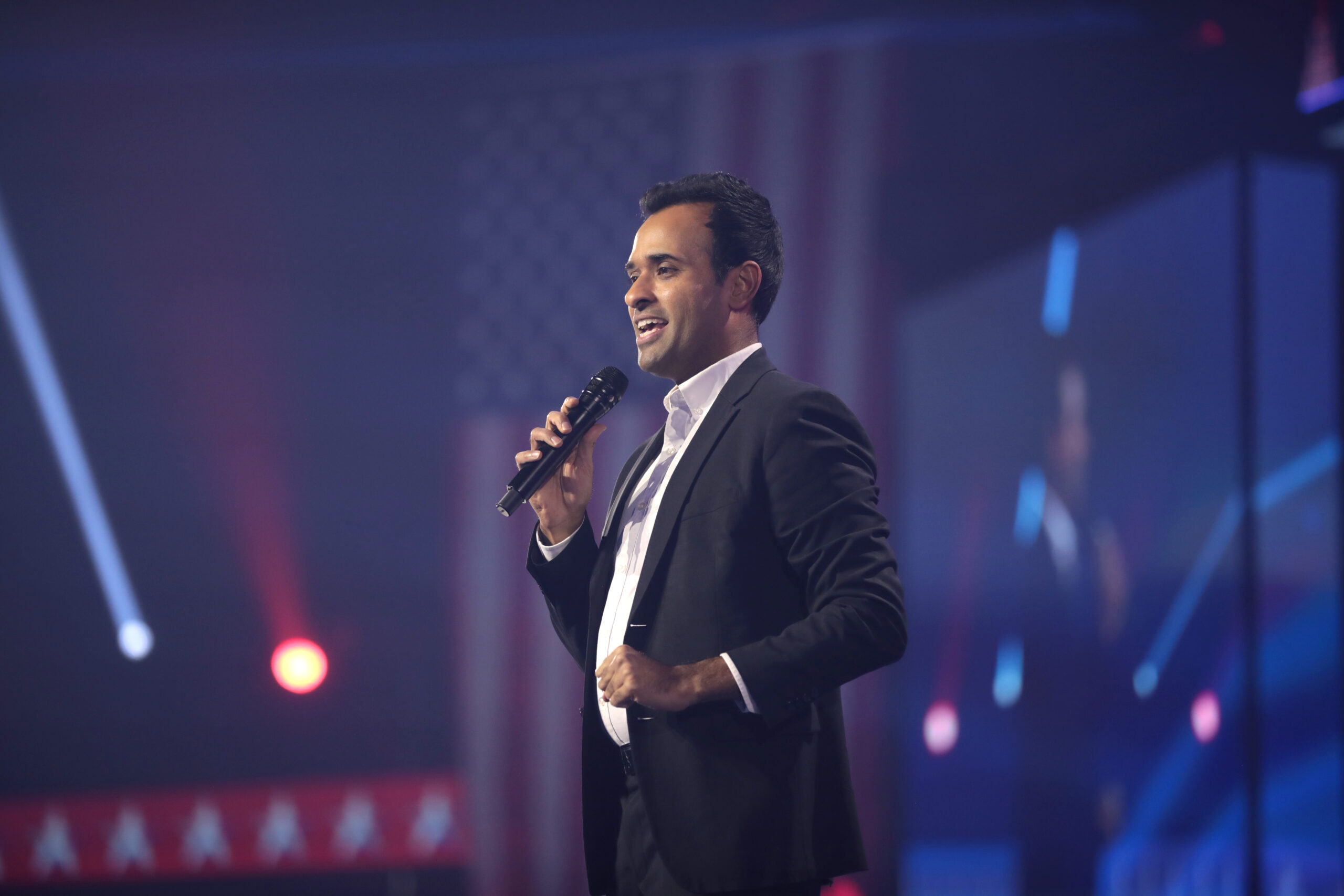
Vivek Ramaswamy (Wikimedia Commons)
Adapted from remarks at Liberty University.
This is a speech about achieving the impossible.My parents came to this country with no money, and I’ve founded multibillion-dollar companies. I’ve written multiple bestselling books. Last year, at age 37, I became the youngest person ever to run for U.S. president as a Republican. At the start of the campaign, no one knew my name; by the end of it, I had beaten out multiple senators, governors, and a former vice president. I did all of that with my lovely wife Apoorva, herself a successful throat surgeon, while raising our two sons in Ohio.But all of that pales in comparison to the one achievement that I thought was truly impossible: most of you now know how to actually pronounce my name. Vivek, like “cake.” Ramaswamy—like “Ramaswamy.”
But my speech today isn’t about me. It’s about all of you. You’re entering your adulthood at a truly special moment in American history. I believe deep in my heart that it’s actually going to be your generation that saves our country. It wouldn’t be the first time that it happened. That was all the way back to 1776.Though I’m talking about our own Founding Fathers, I’ll start with a quote often attributed to the founder of Dubai:[BLOCK]My father rode a camel, I ride a Mercedes, my son rides a Land Rover, and my grandson is going to ride a Land Rover, but my great-grandson is going to have to ride a camel again. Hard times create strong men, strong men create easy times, easy times create weak men, and weak men create hard times.[/BLOCK]
He was the founder of Dubai, but he may as well have been speaking about our generation of Americans.When our nation was born in 1776, we were a nation of underdogs. We were a nation of insurgents. Our Founding Fathers stood up to the most powerful empire in the world, declared their independence, and then somehow turned assertion into reality. They were a band of rebels who defeated the reigning incumbent of their era, an incumbent that went on to become just another small nation on the other side of an ocean.But eventually, the insurgent becomes the incumbent. The underdog becomes the favorite. And the new incumbent starts to apologize for its own success, instead of working even harder to create even more of it. Eventually, that incumbent is unseated by a new insurgent born on the other side of a different ocean.Personally, I think that’s what many of us sensed when we heard the call to Make America Great Again several years ago. But here’s what we missed: In order to know how to make America great again, we have to first know the story of what made America great the first time. That’s the story of our nation’s history. It’s a story we’ve forgotten. Malcolm X famously said a nation without history is like a tree without roots: It’s dead.
One of the things that I think we’ve lost in modern history is an aspect of our founding culture that’s personally important to me, one that we’ve abandoned in recent years, one that has absolutely nothing to do with politics.It’s the death of intellectual curiosity in America.
If you think about who were the most intellectually groundbreaking thinkers of the 18th century, they definitely weren’t our Founding Fathers. Most of them were on the other side of the Atlantic.They were the likes of Locke, Rousseau, Montesquieu, and Hume who led the way in philosophy and sociology; Newton and Leibniz in math and physics; Adam Smith in economics and psychology.The thing that distinguished our Founding Fathers wasn’t their genius in any of these disciplines. They weren’t mathematical or philosophical savants; but they learned from the people who were. And what really distinguished our Founding Fathers was their ability to combine those intellectual foundations with a vision for the future that simply didn’t exist in the Old World.Locke and Leibniz, Newton and Hume—these men were true geniuses. But the European society into which they were born was different from ours in a fundamental way: They valued hierarchy and expertise over curiosity. The monarchs and aristocrats who were supposed to run the government ran the government. The people who were supposed to philosophize about economics and sociology philosophized about it. But they weren’t the same people. And the people who were supposed to make discoveries in math or invent new tools were in a different place altogether. Virtually everyone stayed in their lane.You see, the Old World was reluctant to break down boundaries. Boundaries, they thought, existed for a reason. The ruling class existed to rule; the expert class existed to advise them; the doctors’ guild exists to treat patients; the guild of barristers exists to argue cases in court. It was a culture that revered expertise over curiosity.But our Founding Fathers had a different vision, one without those boundaries. They didn’t even really believe in acquiescence to expertise. They believed that no man was confined to the circumstances of birth and upbringing, and that each of us is so much more than just a product of what we happen to be doing at a given moment.For example, you all surely know that Benjamin Franklin—one of the co-authors of our nation’s Declaration of Independence—was a veritable renaissance man, who, in addition to founding universities and hospitals, was also a prolific author, a dabbler in medicine who discovered a treatment for the common cold, and a creator of musical instruments—including one instrument that went on to be used by Mozart and Beethoven. Some of his devices were incredibly practical—a lightning rod for the home, bifocal glasses, and the Franklin stove, a practical tool for heating houses, derived from recent breakthroughs in the field of thermodynamics. Benjamin Franklin was the archetype of the 18th-century polymath; I think most of you know that.But here’s the remarkable part: he wasn’t an exception. He was the norm. Five men served on the committee which drafted the Declaration and all were similar in their intellectual versatility. Take the two lesser-known members: Robert Livingston and Roger Sherman. Livingston worked with Robert Fulton to build the first steam ship—a fundamental building block of the Industrial Revolution—as a side project, while serving as an ambassador to France. Sherman, who was also a signatory to the Constitution, was a self-educated attorney who never actually went to college or studied law. He taught himself in the library of his local parish minister while working as a shoemaker. He wanted future Americans to have greater access to education, and he ended up serving on the governing body of Yale.And of course, in addition to Franklin, Livingston, and Sherman, there were the two most famous drafters of the Declaration—John Adams and Thomas Jefferson, bitter rivals in politics but close friends in retirement. Jefferson’s interests were more scientific, while Adams was more drawn to the humanities. But they were each deeply curious about everything, and unafraid to compete with one another intellectually.
One of the famous quotes attributed to John Adams is that:
[BLOCK]I must study politics and war, that our sons may have liberty to study mathematics and philosophy. Our sons ought to study mathematics and philosophy, geography, natural history and naval architecture, navigation, commerce and agriculture in order to give their children a right to study painting, poetry, music, architecture, statuary, tapestry and porcelain.[/BLOCK]
But that was a bit of a humble-brag on his part. It’s true that Adams studied politics and war, but he also studied math and philosophy. And also poetry, while being educated in Greek, Latin, and the other classics. In fact, a little-known fact about Adams that I personally find very interesting is that, after serving as our second President, he immersed himself in Hindu scripture, and wrote to Jefferson in a letter that, were he to live again, he’d have studied Sanskrit literature. The man was a lifelong learner.
And so was his great rival. Jefferson was fluent in five languages and capable of reading two more. Over the course of his life, he wrote 16,000 letters. Students in the year 2024 could be forgiven for thinking that means 16,000 letters—that’s like 4,000 words—which sounds doable enough! But no; I’m talking about 16,000 full-length letters, as in essays. That’s basically unheard-of by today’s standards.You might wonder if it was uncomfortable for him to sit in a chair for so long while writing. Well, it turns out he solved that problem by inventing the swivel chair, which he supposedly built and used to write the Declaration of Independence. He was also an amateur architect. The Virginia Capitol building, standing right here in the state where we are gathered today, was designed by Thomas Jefferson.Both Jefferson and Adams had to spend large sums of money to build their own personal libraries, to continue their learning. In fact, Jefferson almost went bankrupt several times. It’s easy to make fun of him for his taste in wine, but he wasn’t just a drinker of wine; he was a scientist of wine too, traveling to southern France to learn about wine production and to figure out how to build a homegrown industry right here in the United States. It was knowledge-directed at every step of the way; the fact that it sometimes left you drunk was, the French like to say, merely an unintended side effect.There was something in the water back then; something in the culture. It was a culture that valued education; autodidacts; exploration; a fundamental curiosity about how the world works; and an unyielding confidence that even if you weren’t an expert in something, you could still figure it out with the right combination of self-education and curiosity.Compared to nations like France and England, it’s true that America was provincial at the time. We were nothing more than a backwater cluster of small towns scattered along an eastern seaboard. Economically, militarily, and geopolitically, it seemed that we were destined to be nothing more than a footnote in global history. Yet the people who wrote those footnotes were deeply curious about the world they inhabited; about the history to which they contributed; and deeply confident in their ability to change every part of it for the better.So what’s the message for us? We need to revive that special combination of curiosity and confidence. Yes, we want to be a country of people who tinker in their garages. We want people who write great essays in the evenings, while working at insurance companies during the day. We should expect more of one another as citizens. We should expect more of ourselves. We should expect more of our leaders. Back then, presidents who left the White House went on to study ancient works in Sanskrit; today, they sign Netflix deals and play a round of golf.It’s easy to say “how cool were our Founding Fathers,” and then go back to the daily drudgery of our modern technocracy. But why can’t we behave like our Founding Fathers? Political conservatives talk a lot about staying true to the political and legal principles in the Constitution, and no doubt that’s important—but as Americans, we should also be inspired to stay true to our founding culture of exploration and curiosity.The irony is that it should be a lot easier for us to do that today than it was for them back then. For starters, the main languages of scholarship in 1776 were French and Latin, and you had to wait weeks or even months to procure a physical copy of a book that you might have wanted to read. Today, almost everything is available in any language you want, and you’re two swipes on your iPhone away from any book you want to read on demand. The only thing stopping us is our own incuriosity, our own veneration of someone else’s expertise, and our own lack of confidence to build our own.You might expect that our Founding Fathers didn’t have the time—as they were fighting the Revolutionary War and then setting up a new nation—to afford the luxuries of intellectual curiosity. Yet actually, the opposite was true. We were never more curious than when we were fighting for our survival. The special sauce that allowed America to succeed as an insurgent was the unmitigated curiosity and the unjustified confidence of our Founding Fathers.And it wasn’t just a matter of self-indulgence. The reason our Founding Fathers were so curious about the world around them wasn’t just to get drunk on it. It’s because they strived to make America, their nation, a better nation. It wasn’t idle interest that moved them; it was a desire to create a thriving country that would outlive them.And they made that country great. They drew minds as curious and courageous as their own. Joseph Priestley, a pioneering chemist, held beliefs well outside the mainstream of English religious thought. In 1791, a mob looted and razed his home to the ground. He fled England to Pennsylvania, where he was welcomed with open arms. This brilliant scientist moved to America precisely for our free society, inaugurating a tradition that so many others, including my own parents, have continued to follow for centuries. My parents came here for the same reason that Joseph Priestley did: Ours is a free society where creative people are able to pursue their dreams however they see fit.
Priestley didn’t come to America for our academic institutions or funding; in fact, we had neither of those things back then. It’s because he had freedom—freedom to explore ideas without fear of being attacked or locked up. Freedom to be himself, including even the freedom to discover who he was. That’s the unspoken part of the American dream: not just the freedom to achieve whatever you want, but also the freedom to discover what it is you want to achieve.It’s precisely at the moment when we stopped being insurgents and started becoming incumbents ourselves that we lost that sense of curiosity and lost that sense of confidence. Why can’t we just remain an incumbent and enjoy it while it lasts? Because pretty soon, we’ll become the Great Britain to someone else’s insurgency. It’s already starting to happen.The way we remain a magnet for the most curious and ambitious people around the world is by cultivating the culture that drew Priestley here, the same culture that drew my own parents here. A culture that prizes free and open debate and inquiry; a culture that doesn’t force a monolithic cultural ideology on everyone; a culture that doesn’t force you to bow down to what a politically appointed expert says on a given day, but instead gives you the latitude to question dogmas in the pursuit of truth.That’s the greatest thing our Founding Fathers invented. It wasn’t a lightning rod or a stove. It was a country that offered freedom of thought, the greatest invention of their era, the one that enabled so many others. That’s the invention we risk losing in a country that focuses on suppressing dissent instead of fostering creativity. Can we sustain that special combination of curiosity and confidence? That’s the defining question of our era, and the answer starts with how we educate the next generation.Those who object to this vision as the exclusive north star for educating our children will say that it’s not enough for our schools and universities to teach our children to be intellectually curious, courageous, and confident, but that we must also teach them to be socially just, and to rectify the injustices created by the likes of our Founding Fathers, who blindly pursued enlightenment without actually abiding by the values that they preached.Yet I’d argue precisely the opposite: that intellectual curiosity and courage, combined with a willingness to traverse boundaries that go beyond your preordained area of “expertise,” beyond your own “lane,” is the most important building block of empathy. And that empathy is the most important building block of justice. The arc of the moral universe is long, Martin Luther King said, but it bends towards justice. I believe empathy is the force that causes it to bend, and I believe that the foundation of empathy is curiosity.So what’s the take-home message from this reflection on our Founders? I’ll leave you with a few.First, it takes about as much effort to do something really small, and to do it well, as it does to do something really big, and to do it well. We’re all given a short time on this Earth. It’s your choice as to whether you want to do the small thing or the big thing. There’s no right answer. But as someone who ran for president at 37, I can tell you that I have my bias.
Second, when the pack runs in one direction, my advice to you is to run the other way. That’s what our Founding Fathers did. Today, calling the other side “weird” is considered a political insult. I’m sure you hear a lot about how “weird” Liberty University is. I’m sure it’s irritating when rival schools mock your beliefs by “coincidentally” scheduling their Pride Day the same day they face Liberty in football. But don’t be afraid of being called “weird.” The Founders would have worn that label as a badge of honor. They ended up winning the American Revolution. And Liberty ended up beating UMass.
For most of human history, the idea that you get to express your opinion, no matter what it is, was a truly weird idea. The idea that we the people create a government accountable to us, rather than the other way around, was downright strange. But that’s what made America great the first time around. And reviving that is how we’ll make America great again.
Third, if you ever find yourself to be the smartest person in a room, then find a different room. I studied biology, worked at a hedge fund, went to law school for fun, started a biotech company, started a health technology company, left all that behind to write a few books, then started an asset management firm before running for U.S. President. Don’t make your identity a product of your occupation. You’re so much more than one thing you happen to be doing at a given time.
And there’s no better time to cultivate that sense of adventure and curiosity than in college. You can take a random elective. Join a club. Learn an instrument. Or go on a service trip, whether that’s halfway around the world or as close by as Boone, North Carolina, where I’ve just learned a team of Liberty students is heading to help with hurricane relief. So what am I going to do next? Well, that’s my final lesson for you—and I’m pretty sure it’d be one that Thomas Jefferson or Benjamin Franklin would affirm if they were here with us today: every time I’ve made an elaborate plan for how my career would go, it never went according to plan anyway. Your plans are silly! But your purpose isn’t. Find your true purpose, and the plan tends to reveal itself for you every time.
We have a longstanding tradition in our country of those who return to public service, even after having successfully served at the highest level. So I’ll close with the story of our first President who wasn’t a Founding Father, but who—perhaps like all of you—took inspiration from them anyway. That was John Quincy Adams.John Quincy Adams was educated by his abolitionist father and went on to serve in Congress after serving as president. He courageously spoke out freely in the tradition of his father’s contemporaries on the Congress floor in defiance of the gag rule when debating slavery. He had a stroke and died in the middle of giving a speech on the Congress floor, and his funeral rites were led by a then little-known first term Congressman by the name of Abraham Lincoln.
That’s American history. That’s American exceptionalism. That’s what I’m asking you to revive. That’s what it’s going to take to remain a nation of insurgents.
The post America’s Greatest Tradition appeared first on The American Conservative.



 News Feed (Home)
 Popular Posts
  Events
  Blog
Blog  Market
  Forum
Forum  Headline News
 VidWatch
 Game Zone
 Top PodCasts