YubNub Social YubNub Social
    Advanced Search
  • Login

  • Night mode
  • © 2026 YubNub Social
    About • Directory • Contact Us • Privacy Policy • Terms of Use • Android • Apple iOS • Get Our App

    Select Language

  • English
Install our *FREE* WEB APP! (PWA)
Night mode
Community
News Feed (Home) Popular Posts Events Blog Market Forum
Media
Headline News VidWatch Game Zone Top PodCasts
Explore
Explore Jobs Offers
© 2026 YubNub Social
  • English
About • Directory • Contact Us • Privacy Policy • Terms of Use • Android • Apple iOS • Get Our App

Discover posts

Posts

Users

Pages

Group

Blog

Market

Events

Games

Forum

Jobs

Survival Prepper
Survival Prepper  
2 yrs

Dear Diary, It’s Me, Jessica: Part 15
Favicon 
preppersdailynews.com

Dear Diary, It’s Me, Jessica: Part 15

Dear Diary, It’s Me, Jessica: Part 15
Like
Comment
Share
Hot Air Feed
Hot Air Feed
2 yrs

Trump Agrees to Fox News Debate With Harris, but What About Kamala?
Favicon 
hotair.com

Trump Agrees to Fox News Debate With Harris, but What About Kamala?

Trump Agrees to Fox News Debate With Harris, but What About Kamala?
Like
Comment
Share
Science Explorer
Science Explorer
2 yrs

What Is A K-Type Star? And Why Do They Matter?
Favicon 
www.iflscience.com

What Is A K-Type Star? And Why Do They Matter?

K-type stars are the overlooked siblings of the stellar world, but they could offer the best chances to find life, so here's a little about them.How Are Stars Categorized?Ancient astronomers noticed that not all stars are the same color. It even influenced what they called some – Antares' name is a reference to its red color resembling that of Mars, which the Greeks called Aries. Intriguingly some classical astronomers described possibly the most famous red star as being yellow, but to the naked eye most stars look white, so there wasn't a lot of categorization to do.With telescopes we could identify more subtle colors, and spectroscopes gave us more information about stellar differences than the eye alone could manage. A star's color indicates the temperature of its outer layers, and astronomers use this to categorize them.Most of the stars we see are part of what is known as the “Main Sequence” and these were put into seven types, with the hottest having temperatures over 30,000° C (54,000° F), while the coolest are between 2,100 and 3,400° C (3,812-6,152° F). You might expect these types to start at A, and therefore never even get to K, but the lettering is much more confusing, being O, B, A, F, G, K, M, for historical reasons.Some stars are off the main sequence, such as white dwarfs and red giants, and don’t fit into this classification system, but these are a topic for another day.Characteristics Of K-type StarsK-type stars have temperatures between 3,400° and 4,900° (6,152-8852° F). By comparison, the Sun’s temperature is 5,500° C, placing it in the middle of the G-type stars. K-type stars have radii 10-30 percent smaller than the Sun and are about 60-90 percent as massive.Even though K-type stars are mostly made of hydrogen, the distinctive hydrogen spectral lines, which are dominant in A-type stars are very weak, and can be hard to see compared to the spectral lines of rarer elements. Based on spectral lines alone, you have to look closely to spot the difference between a K and G-type star. However, in a telescope powerful enough to show the brightness reasonably well, the orange color is often reasonably noticeable compared to the familiar yellow. Why Are K-type Stars Important For The Search For Life?We know that G-type stars can support life around them, and even intelligent life, but the prospects don’t look so good for most other categories. The hotter and more massive a star is, the shorter its lifespan. It’s almost certain that O and B-type stars don’t live long enough for life to develop in their vicinity. Any planets would still be bombarded with enough force to turn their surfaces to magma when the star dies, which stars this massive do in spectacular fashion. A and F stars live longer, and life might develop on the planets they warm, but it’s unlikely conditions would stay stable long enough for complex multi-cellular life to form, let alone anything we could have a conversation with.At the other end of the spectrum, M-type stars (better known as red dwarfs) live very long lives, so that certainly life will not lack for time. However, debate continues whether their planets can be habitable (at least at the surface) because they are so cool any planet warm enough to have liquid water must orbit very close to the star. M-dwarfs produce very strong flares, and there are fears these would strip nearby planets’ atmospheres and make life impossible. Whether this is universal, or if some red dwarfs could have warm planets that escape such fates, remains debated, but many astronomers fear that we won’t find advanced life around M-type stars, if we find life at all. In that case, the field would be reduced to G and K-type stars, and K-type stars are more common. If so, unless there is some obstacle to advanced life around K-type stars we have not noticed, the majority of stars in the galaxy that could host complex life belong to this category. Then again, K-type stars do emit a lot of X-rays and UV light early in their evolution, which probably means that they take a long time to be suited to having life nearby.Why Have K-type Stars Been Overlooked?If this is the case, you might wonder, why do we almost never hear about K-type stars?For one thing, being small and cool, they are also faint. A and B type stars are so luminous they make up most of those we can see with the naked eye. O-type stars are exceptionally rare, but their influence on everything around them is so great it would be hard not to notice the few the galaxy has. And of course, humans are biased in favor of G-type stars since we have such a great opportunity to study the one we orbit.Meanwhile, M-type stars are very common, making up 70 percent of the stars in the galaxy. If you leave out non-main sequence stars like Sirius B almost forty of the nearest 50 stars are M-type, including Proxima Centauri, so they get plenty of attention as well.That’s not to say K-types never draw attention. In June, the star HD 48948 was found to have a planet that may have the best prospects for an Earth-like climate we’ve yet found. You can guess it’s type. Probably the most famous K-type star, is Epsilon Eridani. At 10.5 light years away, this was once considered the nearest star that might have Earth-like planets, until we realized it is less than a billion years old, and any life there would be very basic. There’s a closer K-type star, however. Alpha Centauri B, the equal second closest star beyond the Sun is K-type, but locked in an orbit with a brighter G-type star, and needing a telescope to separate them, this is a star that truly knows what it means to be overlooked.

Like
Comment
Share
Science Explorer
Science Explorer
2 yrs

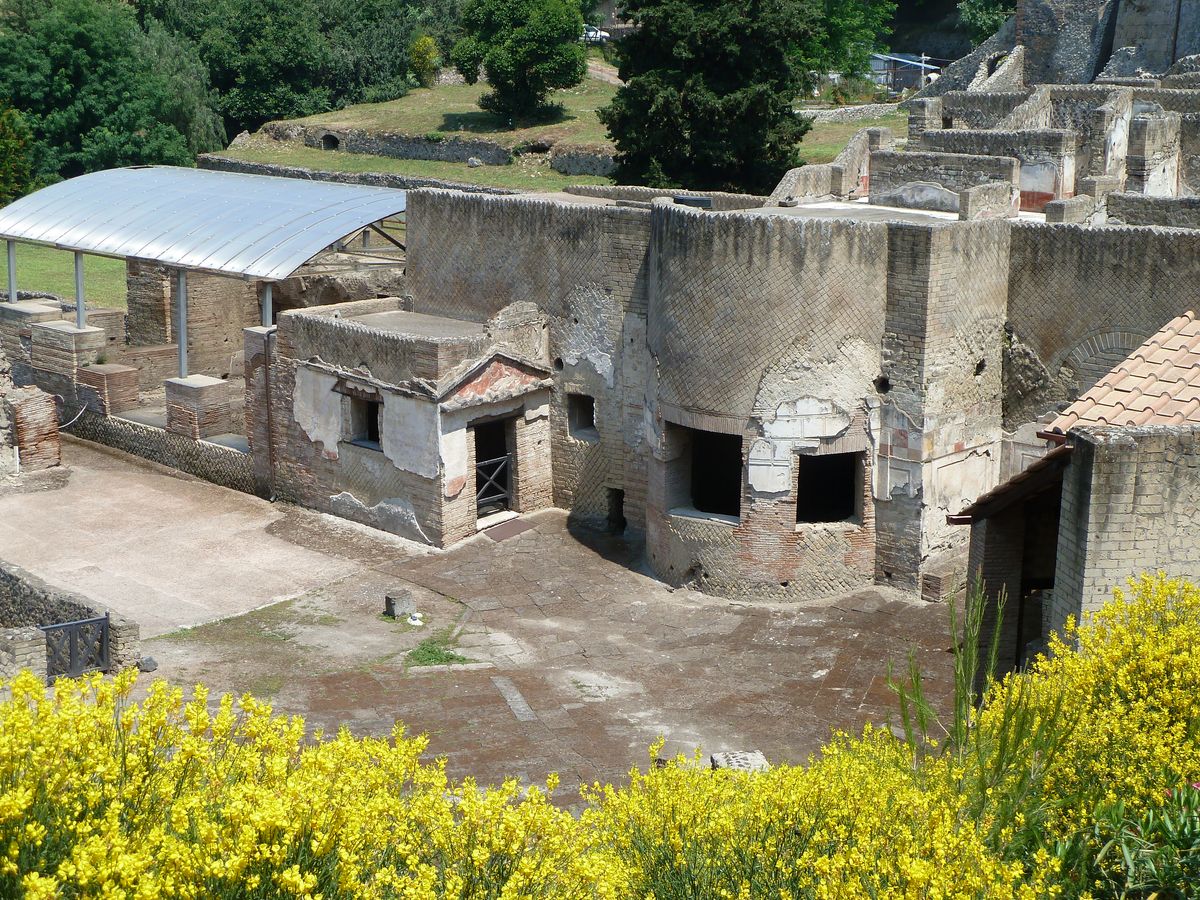
Pompeii's Suburban Bath Frescoes Reveal Insights Into Roman Sexuality
Favicon 
www.iflscience.com

Pompeii's Suburban Bath Frescoes Reveal Insights Into Roman Sexuality

Ancient Romans had ideas about sex and sexuality that were very different from ours today, and many representations of these attitudes have been preserved on the walls of buildings at Pompeii. In particular, the Suburban Baths have images that really show off the Roman’s sexual exploits in their many forms.The bath house beyond the gatesThe Suburban Baths are located to the west of the Marine Gate in Pompeii. Unlike other bath houses in the city, like the Stabian Baths and those of the Forum, the Suburban Baths were private. As these baths were built later than the others, possibly during the reign of Tiberius (14-37 CE), they appear outside of the city gates which, by this point, were no longer used for defensive purposes.The baths are laid out on three levels and can be seen by tourists visiting the city that was lost to the world for centuries after Mount Vesuvius erupted in 79 CE. All the rooms in the complex had windows that looked out over the Gulf of Naples. There were various bathing options for guests, including two rooms for taking cold baths (Frigidarium), a warm bath (Tepidarium), which helped visitors acclimate to the change in temperatures, and then a hot bath (Calidarium).The frescos within the Suburban Bath show many forms of sexual acts, but some of them would have been considered questionable to polite Roman society.Image credit: Sailko via Wikimedia Commons (CC BY-SA 4.0)But in terms of sexual displays, the action, as it were, was housed in the changing room (apodyterium) that followed the entrance hall. The walls of this room were decorated with eight frescos showing off extremely erotic content. The exact purpose of these images is unclear. Some believe they were a kind avert or hint at prostitution that could take place in the baths. This type of activity, though technically illegal, was common in these places. However, there are others who believe they are merely decorations showing off types of scenes that were enjoyable for Romans who appreciated them.Under each painting is a painting of a box with a number on it. It is possible that these painted boxes once had actual boxes on them that were placed on a wooden shelf and were used by visitors to store their clothes.Roman sexuality: what was acceptable and what was depicted It is pretty well known that the Romans were not as shy about sex as much of our society is today. Everything from objects, art, literature and inscriptions recovered from archaeological sites from across the former Roman empire has provided us with a clear idea of their erotic inclinations. But while it is often believed that the Romans operated with a kind of “anything goes” attitude toward sex, the reality is that there were various social norms and legal strictures that governed sexual behavior. For instance, it was socially acceptable and even expected for Roman men to seek sex with both female and male partners. However, there were rules to this. Males were able to have sex with other men as long as they maintained the “active” or “penetrative” role. This protected their masculinity. But if they sought a “passive” role, receiving penetration or performing oral sex on either women or other men, then their masculinity was challenged and could lead to them being labeled effeminate.Obviously, this all hints at a sexual double-standard, as it was considered less acceptable for a man to perform oral sex than for women to provide the same service.As such, there were “abnormal” forms of sexual act, many of which were depicted in art. But just because something appeared in art, does not mean it was encouraged or accepted in real life, for the above reasons. So we must be cautious when viewing erotic materials preserved in places like Pompeii, as they may not be representative of what was actually permitted.Roman art depicts many forms of sexual act, but not all of them were deemed acceptable in wider society.Image credit: Sailko via Wikimedia Commons (CC BY-SA 4.0)An example of this is visible in a few images at the Suburban Baths. In one fresco, a woman is receiving cunnilingus from a man, which would not have been frowned upon in reality. Homosexual acts were permitted and also expected in Roman society, but there were rules to this type of exchange.Image credit: Sailko via Wikimedia Commons (CC BY-SA 4.0)Another example can be seen in a fresco showing a threesome between two men and a woman. In the image, the woman is receiving penetration from behind by one man who is then being penetrated by another behind him.When Pompeii, and other Roman sites, were first excavated, many of their more erotic objects and images were locked away or otherwise censored because of their explicit nature. But today, visitors to Pompeii can see them in all their creative glory. 
Like
Comment
Share
Science Explorer
Science Explorer
2 yrs

World’s Most Durable And Efficient Solar Cell Smashes Existing Records
Favicon 
www.iflscience.com

World’s Most Durable And Efficient Solar Cell Smashes Existing Records

Researchers have developed a method to enhance the lifespan and working efficiency of perovskite solar cells, achieving record outputs following grueling, long-term tests. With a superb power conversion efficiency (PCE) of 20.1 percent after more than 1,500 hours of use, the high-performing cells created during the study may open the door to more widespread use of this much hyped renewable energy solution.Perovskite solar cells have garnered a huge buzz over the past decade due to their superior performance when compared to the more common silicon-based alternative. However, at present the technology is not seen as commercially viable due to its instability and limited lifespan.Seeking to overcome this hurdle, the study authors set out to develop a means of chemically altering the surface of perovskite cells in order to eliminate defects and increase both durability and efficiency - a process known as passivation. Commenting on the team’s motivation in a statement, study author Yen-Hung Lin explained that "passivation in many forms has been very important in improving the efficiency of perovskite solar cells over the last decade.” “However, passivation routes that lead to the highest efficiencies often do not substantially improve long-term operational stability.”Bucking this trend, the researchers found that treating perovskite cell surfaces with specific combinations of chemicals called amino-silanes massively improved their performance and longevity. Overall, they were able to enhance the cells’ photoluminescence quantum yield - which refers to a material’s ability to convert absorbed light into emitted energy - a whopping 60-fold.Moreover, operational stability remained high after more than 1,500 hours of standard testing under full-spectrum sunlight, with PCE remaining at 95 percent of its original value at the end of this extended examination. In absolute terms, the best-performing cells clocked up a PCE of 20.1 percent for the duration of these tests - the best figures ever reported for perovskite cells.Put simply, this means the cells were able to convert an exceptionally high percentage of the sunlight they received into electricity, capturing and processing wavelengths from a wide range of the electromagnetic spectrum. “The design maximizes the use of the solar spectrum by absorbing different parts of sunlight in each layer, leading to higher overall efficiency," said Lin.These exceptional results were achieved using two different cells, measuring 0.25 and one centimeter squared (0.04 and 0.16 square inches). According to the researchers, this breakthrough could now facilitate the large-scale production of stable, durable, and efficient perovskite solar cells.The study has been published in the journal Science.
Like
Comment
Share
Strange & Paranormal Files
2 yrs

Woman alleges she hasn’t slept in over three decades
Favicon 
anomalien.com

Woman alleges she hasn’t slept in over three decades

In the heart of Long An province, Vietnam, lives a woman who has garnered the extraordinary nickname, “the sleepless mutant.” Nguyen Ngoc My Kim, a 49-year-old seamstress, claims to have defied the need for sleep for the past thirty years. Known locally as “the seamstress who never sleeps,” Kim embraces this moniker, asserting that it perfectly reflects her unique lifestyle. Whenever the media spotlight turns her way, Kim confirms that she hasn’t slept in decades, insisting that her health remains unaffected. However, she clarifies that this wasn’t always the case; her journey to sleeplessness was a gradual one. Kim’s insomnia began in her childhood, fueled by her passion for late-night reading. As she grew older and took up seamstressing, her nights were consumed by work, pushing her to forego sleep to meet her deadlines. Over time, her body adapted to this grueling schedule, and sleep became an unnecessary luxury. “Every night, I sat in front of my sewing machine, afraid to sleep because I couldn’t afford to fall behind on orders,” Kim recounted. “Initially, working through the night was challenging. I struggled with constant drowsiness, made numerous mistakes, and often felt tired and dizzy, even experiencing a few traffic accidents.” But after months, then years, of sleepless nights, Kim’s body acclimatized. “Eventually, I couldn’t sleep even if I wanted to,” she admitted. Though her claims of decades-long insomnia remain unverified by medical professionals, they are more than mere rumors. Her relentless work ethic is visible to anyone who passes by her sewing stall in Long Cang commune. The light is always on, and the door always open, allowing anyone to witness her ceaseless activity. “In the beginning, people didn’t really notice my lack of sleep,” Kim explained. “But gradually, they observed that I was always at my stall, always working. Realizing the rumors were true, they spread the word, and soon enough, I became famous for my ability to stay awake continuously.” The post Woman alleges she hasn’t slept in over three decades appeared first on Anomalien.com.
Like
Comment
Share
Strange & Paranormal Files
2 yrs

The Cardiff Giant Story: From Giant Discovery to Giant Hoax
Favicon 
anomalien.com

The Cardiff Giant Story: From Giant Discovery to Giant Hoax

In the 19th century, the belief in giants and the fascination with bones and bodies came together to produce an odd phenomena–that of the petrified giant. The most famous and best documented of these hoaxes occurred in 1869, when two laborers digging a well near Cardiff, New York discovered a giant stone man under the ground. The find was dubbed the Cardiff Giant, and it would go on to create a craze for petrified giants that would last for the next forty years before finally dying out in the early 20th century. Uncovered in New York in 1869, the Cardiff Giant was a 10-foot-tall “petrified humanoid” that countless Christians believed was proof of the existence of Biblical giants. An 1869 photo shows the excavation of the Cardiff Giant. Credit: Bain News Service/Library of Congress A giant discovery, and an even bigger fraud The odd story of the Cardiff Giant begins not in the ancient past, but in 1866 with a man by the name of George Hull. A cigar-maker and a staunch atheist, Hull found himself in Iowa on business when he crossed paths with a Methodist revivalist, Reverend Turk. Hull and the good reverend exchanged heated words. The minister mentioned the scripture from Genesis referring to the antediluvian giants, which birthed an idea in Hull’s mind. To put his odd plan in motion, Hull returned to Iowa in 1868 to find a suitable stone for his purposes. Once secured, he hired men to quarry the 11 foot block of gypsum, telling them it was for a monument to Abraham Lincoln to be built in New York. Then, he had the giant block shipped to Chicago, where it was shaped by a German stone cutter, who was sworn to secrecy. The finished giant, measuring about 10 feet long and weighing in at 3000 pounds, was shipped by rail to Cardiff, New York in November 1868, where Hull and his cousin and co-conspirator William Newell buried the bulky sculpture. EXCAVATION OF THE CARDIFF GIANT, 1869 A year later, Newell hired Gideon Emmons and Henry Nichols to dig a well on his property. On October 16, 1869 the workers hit stone beneath three feet of soil. One man reportedly exclaimed, upon clearing away dirt and seeing a large stone foot: “I declare, some old Indian has been buried here!” What followed after the excavation of the statue could be described as “giant fever.” Once word got out, people flocked from miles around to see the sight. Hull and Newell erected a tent over the statue and charged $.25 a head to view it. When the crowds swelled and Hull saw he could bilk even more money from the eager sightseers, he doubled the price of admission. The giant electrified the public. Many believed they’d laid eyes on a petrified giant straight out of the pages of scriptures. A pastor from Syracuse declared as much, and since when was the clergy wrong about anything? Other experts did not agree. Some believed it was a statue built by missionaries to impress local Indian tribes, while others thought perhaps it was a statue made by some sort of ancient people who predated the coming of the white man, and perhaps the Indians themselves. Andrew White, first president of Cornell University, visited the site to lay his skeptical eyes on the sensational find. Even the skeptic was impressed by the theatrics of it–a giant being lay in its grave, lit only by the soft light of candles, as quiet onlookers stood in quiet awe of its bulk and age. Of course, upon a closer look White found that the figure was a carved statue, and not a particularly good one at that. Seeing White’s skeptical reporting, added to the fact that Newell himself had let the cat out of the bag, made Hull nervous. . He sold the giant to David Hannum and a syndicate of businessmen who were interested in the spectacle for a cool $23,000. The businessmen took the giant’s show on the road toward New York City. Meanwhile, P.T, Barnum heard of the row surrounding the giant. The legendary showman offered Hannum and his cabal $50,000 as is for the statue. When Hannum declined, Barnum simply sent a man to view the Cardiff Giant. The agent molded a lump of wax into the likeness of the giant, and Barnum paid to have his own version of the giant carved. When Hannum heard that Barnum’s giant was drawing crowds, he uttered famous words often attributed to P.T. Barnum himself: “There’s a sucker born every minute.” In the first three weeks after the Cardiff Giant was unearthed, more than 4,000 people came to see it. Giant mania ends The Cardiff Giant was not the only so-called petrified man found in mid to late 19th century America. The country seemed to be teeming with the stone encased bodies of the ancient dead. Hull himself made another hoax body, this one called the Solid Muldoon, sporting a monkey-like tail no less. Hotels in New York commissioned their own giants, using the stone bodies to draw in crowds of curiosity seekers. For its part, the Cardiff Giant was falling on hard times. Hannum took Barnum to court over the copying, where a judge told the hoaxer that he could have his injunction if the giant came and swore to his own genuineness. Needless to say, the skeptical judge threw the case out. Meanwhile, Yale paleontologist Othniel C. Marsh denounced the giant as a fraud, writing that the statue was probably of recent origins. George Hull finally confessed the hoax on December 10. The statue that spawned dozens of imitations was outed as a fake. Still, over time the giant and its many imitations still brought in money for sideshows and scam artists, although the returns never matched those of the early giant craze. In 1901, the statue made an appearance at the 1901 Pan American Exposition in Buffalo. Few paid it any attention, its moment of glory forty or more years gone. A publisher from Des Moines, Iowa bought the Cardiff Giant. He sold it in 1947 it to the Farmer’s Museum in Cooperstown, New York, where it is currently on display. Sources: “The Cardiff Giant.” Farmersmuseum.org. The Farmer’s Museum. January 1, 2015. http://www.farmersmuseum.org/node/2482; Rose, Mark. “When Giants Roamed the Earth.” Archaeology. Volume 58, number 6. November/December 2005. Retrieved from: http://archive.archaeology.org/0511/etc/giants.html The post The Cardiff Giant Story: From Giant Discovery to Giant Hoax appeared first on Anomalien.com.
Like
Comment
Share
Classic Rock Lovers
Classic Rock Lovers  
2 yrs ·Youtube Music

YouTube
The Police, Queen, Scorpions, Nirvana, Bon Jovi | Classic Rock Anthems - Discover the 70s, 80s 90s
Like
Comment
Share
Gamers Realm
Gamers Realm
2 yrs

Ark Survival Ascended to add an adorable pal alongside Aberration DLC
Favicon 
www.pcgamesn.com

Ark Survival Ascended to add an adorable pal alongside Aberration DLC

As the Ark Survival Ascended Aberration DLC creeps closer, developer Studio Wildcard lifts the lid on another accomplice joining the roster. Arriving alongside the new expansion pack, which is currently scheduled for the start of September, this cutesy critter will be available to players who have purchased the Bob’s Tall Tales add-on for the dinosaur survival game, and it feels like a make-good for people sad that a similar option missed out on the community Aberration creature vote. Continue reading Ark Survival Ascended to add an adorable pal alongside Aberration DLC MORE FROM PCGAMESN: Best survival games, Best dinosaur games, Best co-op games
Like
Comment
Share
Twitchy Feed
Twitchy Feed
2 yrs

Dem Rep. Raskin's Attempt to Tie Venezuela's Maduro to 'Right Wing' Gets Community Note Nuked
Favicon 
twitchy.com

Dem Rep. Raskin's Attempt to Tie Venezuela's Maduro to 'Right Wing' Gets Community Note Nuked

Dem Rep. Raskin's Attempt to Tie Venezuela's Maduro to 'Right Wing' Gets Community Note Nuked
Like
Comment
Share
Showing 17924 out of 56670
  • 17920
  • 17921
  • 17922
  • 17923
  • 17924
  • 17925
  • 17926
  • 17927
  • 17928
  • 17929
  • 17930
  • 17931
  • 17932
  • 17933
  • 17934
  • 17935
  • 17936
  • 17937
  • 17938
  • 17939

Edit Offer

Add tier


Select an image
Delete your tier
Are you sure you want to delete this tier?

Reviews

In order to sell your content and posts, start by creating a few packages. Monetization

Pay By Wallet

Payment Alert

You are about to purchase the items, do you want to proceed?

Request a Refund