YubNub Social YubNub Social
    Advanced Search
  • Login

  • Day mode
  • © 2026 YubNub Social
    About • Directory • Contact Us • Privacy Policy • Terms of Use • Android • Apple iOS • Get Our App

    Select Language

  • English
Install our *FREE* WEB APP! (PWA)
Night mode
Community
News Feed (Home) Popular Posts Events Blog Market Forum
Media
Headline News VidWatch Game Zone Top PodCasts
Explore
Explore Jobs Offers
© 2026 YubNub Social
  • English
About • Directory • Contact Us • Privacy Policy • Terms of Use • Android • Apple iOS • Get Our App

Discover posts

Posts

Users

Pages

Group

Blog

Market

Events

Games

Forum

Jobs

Daily Caller Feed
Daily Caller Feed
2 yrs

FLASHBACK: CNN Panel Debates Whether Harris Is ‘Black’ Or ‘African American’
Favicon 
dailycaller.com

FLASHBACK: CNN Panel Debates Whether Harris Is ‘Black’ Or ‘African American’

'I think you're falling into a trap'
Like
Comment
Share
Daily Caller Feed
Daily Caller Feed
2 yrs

FACT CHECK: Did Samsung Pull Sponsorship Of Paris Olympics?
Favicon 
checkyourfact.com

FACT CHECK: Did Samsung Pull Sponsorship Of Paris Olympics?

A post shared on social media purports Samsung withdrew a $1 Billion sponsorship from Paris Olympics after the controversial opening ceremony. If your looking for electronics…may I suggest these guys…? Samsung Withdraws $1 Billion Sponsorship from Paris Olympics, “Woke Agenda”https://t.co/A3ZlgZgzUA pic.twitter.com/YufEDTWKNG — 0️⃣BlackBetty ⚓️ (@BabyD1111229) July 29, 2024 Verdict: False The claim is inaccurate. Fact Check: Olympic […]
Like
Comment
Share
Daily Caller Feed
Daily Caller Feed
2 yrs

College Student Falls Hundreds Of Feet To His Death At Grand Canyon National Park
Favicon 
dailycaller.com

College Student Falls Hundreds Of Feet To His Death At Grand Canyon National Park

'This individual was hiking off trail which is a pretty common place occurrence'
Like
Comment
Share
Daily Caller Feed
Daily Caller Feed
2 yrs

Trump’s Truth Social Announces Major New Product Rollout
Favicon 
dailycaller.com

Trump’s Truth Social Announces Major New Product Rollout

'We're establishing a reliable home for great TV content'
Like
Comment
Share
Daily Caller Feed
Daily Caller Feed
2 yrs

Channing Tatum Is Seriously Vying To Be The Go-To Leading Man In ‘Blink Twice’ Trailer
Favicon 
dailycaller.com

Channing Tatum Is Seriously Vying To Be The Go-To Leading Man In ‘Blink Twice’ Trailer

Tatum is a force to be reckoned with
Like
Comment
Share
The Lighter Side
The Lighter Side
2 yrs

Miracle At Sea: Dog Rescued Miles From Shore And Reunited With Owners
Favicon 
www.sunnyskyz.com

Miracle At Sea: Dog Rescued Miles From Shore And Reunited With Owners

Like
Comment
Share
Homesteaders Haven
Homesteaders Haven
2 yrs

When to Harvest Watermelon: 5 Ways to Tell It’s Ripe
Favicon 
homesteadandchill.com

When to Harvest Watermelon: 5 Ways to Tell It’s Ripe

Nothing says summer like a sweet juicy homegrown watermelon. Yet knowing when to harvest your watermelon can be tricky. If done too early, the melon won’t be sweet or edible. And if you wait too long, it can get mealy and gross. So, come learn exactly when to pick a watermelon – including five signs that it’s ripe and ready to harvest. As you read through the list below, do not rely on any one signal alone. The more of these boxes you can check before harvest, the better your watermelon will be! I’ll also cover tips on the best way to store whole and cut watermelon after harvest. After all the hard work and time you spent growing it, you’ll be rewarded with the best-tasting watermelon possible. RELATED: Come learn how and when to harvest butternut squash, pumpkins, and other winter squash – along with essential tips on curing and storage. Does watermelon continue to ripen after harvest? No. Unlike some other melons or fruit, watermelon will NOT continue to ripen off the vine if picked too early. That means it will only get as sweet (or, not sweet at all) as it is at the time of harvest. Most of the sweet flavor develops during the final couple weeks on the vine, so patience is a virtue! 5 Signs a Watermelon is Ripe 1) Brown Tendrils Take a close look at your watermelon vine. Near each fruit, you will find a small curly vine tendril. When a watermelon is almost ripe, the tendril closest to the melon stem will start to dry up and turn brown and crispy instead of green. Remember, this isn’t the only indicator it’s ready though! Still green = not ready! Brown and crispy = ready to harvest soon 2) Yellow Spot Gently turn your watermelon over. When laying on the ground, watermelons will have a large white spot on their skin where they rest on the soil. When it’s almost time to pick the watermelon, that spot will turn from white to yellow. The darker yellow, the more ripe it is! This tip doesn’t apply to melons hanging from a trellis however. 3) Deep Hollow Sound If you gently spank a watermelon with your hand, an underripe melon will have a more sharp, high-pitch, flat sound. As the fruit grows more ripe and juicy, the sound will become increasingly deep, resonant, and hollow-sounding. This one admittedly takes a little practice to decipher. Slap a couple melons to compare the different sounds! 4) Rind Changes You know it’s almost time to harvest your watermelon when the skin or rind becomes dull-looking. A young watermelon rind is usually quite bright or shiny, but changes to a more dull or matte appearance as it ripens. 5) Expected Days to Maturity Last but not least, check the stats for the variety of watermelon you’re growing! The seed packet or plant tag should list an expected “days to maturity” – or the timeframe you could expect it to be ready to harvest. Different varieties of watermelon can take anywhere from 65 to 120 days to mature after planting. For example, we love to grow Blacktail Mountain watermelon, an early-maturing variety that only takes about 75 days. While weather, soil, water, and other factors can also influence how quickly a watermelon grows and ripens, that number should give you at least a ballpark estimate of when harvest time is near. How to Harvest Watermelon Once you’ve decided it’s time to harvest your watermelon, simply use sharp scissors or garden shears to cut the stem just above the melon to remove it from the vine. Take care not to cut the main vine, especially if there are still other melons growing on it. What happens if I wait too long to pick a watermelon? Thankfully, watermelons usually stay good on the vine for a couple weeks past their optimal harvest window. However, the crisp melon flesh will become increasingly mealy, watery, and soft over time. If you wait too long, it may split open or start to go bad. How to Store Whole Watermelon It’s best to store freshly-picked whole watermelon at room temperature. Choose a temperate location away from direct sunlight, such as your kitchen counter. 60 to 70 degrees Fahrenheit is ideal. Like other warm-weather crops (including tomatoes), watermelon’s flavor, quality, and even some of the nutrients can deteriorate when it’s stored in colder conditions. If stored at room temperature, plan to eat your watermelon within a week or two after harvest. The sooner after harvest, the better it will taste! It will last a couple weeks longer if stored in the fridge, but at the expense of the flavor and texture. If you prefer to eat your watermelon cold, pop it in the fridge for a few hours before you cut into it. Storing Cut Watermelon Once cut, watermelon must be refrigerated for food safety. Cut watermelon is technically good in the fridge for about 5 days, but should be consumed within 1 to 3 days for the best quality. Oxygen exposure causes it to rapidly degrade, so be sure to wrap or store cut watermelon in an air tight container. Keeping it in larger chunks (e.g. only cutting up one half at a time) can also help extend the shelf life in the fridge. When we had too much fresh watermelon to eat before it went bad, we preserved it by juicing a few to freeze the juice for refreshing future mocktails! And with that, you know everything you need to know to pick and store some delicious homegrown watermelon. I hope these tips are helpful. Please feel free to ask questions in the comments below, and happy harvesting! You may also like: DIY Berry Trellis: How to Build a Wire Raspberry or Blackberry Trellis (Video) How to Grow Cucamelons: Mexican Sour Gherkins 18 Fantastic Fig Tree Varieties to Grow at Home How to Thin Fruit Trees: Apples, Peaches, Plums and More Did you enjoy this article? Want to hear more? Stay in touch! Sign up below to receive weekly updates on new posts from Homestead and Chill. The post When to Harvest Watermelon: 5 Ways to Tell It’s Ripe appeared first on Homestead and Chill.
Like
Comment
Share
Hot Air Feed
Hot Air Feed
2 yrs

Director Rowe Personally Crippled Trump's Secret Service Team
Favicon 
hotair.com

Director Rowe Personally Crippled Trump's Secret Service Team

Director Rowe Personally Crippled Trump's Secret Service Team
Like
Comment
Share
Science Explorer
Science Explorer
2 yrs

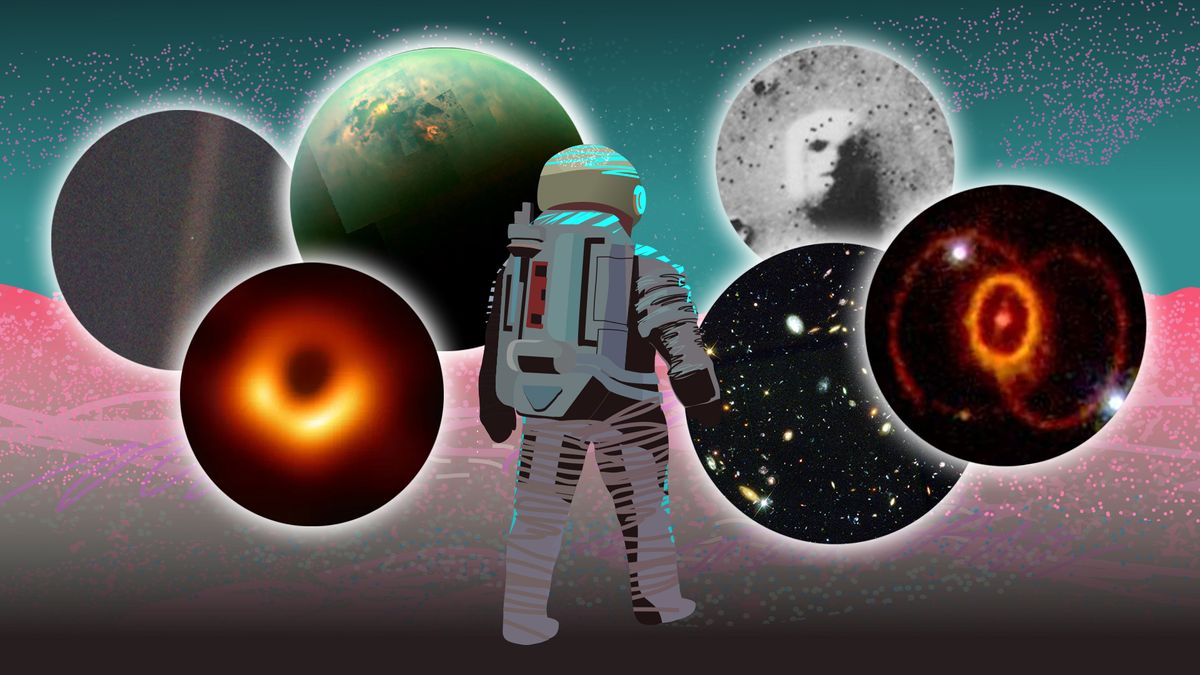
These Are Some Of Our Favorite Space Images
Favicon 
www.iflscience.com

These Are Some Of Our Favorite Space Images

It soon will be the 30th anniversary of my decision to become a space scientist (before then, the dream was palaeontologist – not that I am over dinosaurs, mind!) and since then I have devoured any astronomy image I have come across. Small, big, detailed, or pixelated, there is so much wonder out there and I can’t get enough.Science communicators from other disciplines often joke that engaging the public with astronomy is easy because we have so many pretty pictures. There is certainly truth in that. But I believe that there are also other factors. Astronomy is as old as the human race. If we were looking at the sky, we were doing astronomy. And through astronomy we will also get closer to some of the big dilemmas of humanity: why are we here? Are we alone? Etcetera, etcetera.Space images might not be worth a thousand words, but together with the insights of scientists and communicators, they build an extraordinary narrative for our understanding of the universe and our place in it. These are some of my favorite images. I’m certain there are many that have higher scientific value, but these are special to me.  Pale Blue DotThe blueish pixel in the rightmost light beam is the pale blue dot.Image credit: NASA/JPL-CaltechProbably the worst picture of our planet ever taken and obviously the most iconic. Taken by Voyager 1 from a distance of 6 billion kilometers (3.7 billion miles), Earth is just a pixel within that image, truly evocative of just how empty space is. The photo was taken as the result of astronomer and communicator Carl Sagan asking NASA to turn the Voyager camera around and snap back at the Solar System.The image itself is of the uttermost simplicity, but it is Sagan’s words that raised it to iconic status. The whole comment on it is poetry and science, and I can’t help tearing up reading it no matter how many times I've read it before.  "Look again at that dot. That's here. That's home. That's us. On it everyone you love, everyone you know, everyone you ever heard of, every human being who ever was, lived out their lives. The aggregate of our joy and suffering, thousands of confident religions, ideologies, and economic doctrines, every hunter and forager, every hero and coward, every creator and destroyer of civilization, every king and peasant, every young couple in love, every mother and father, hopeful child, inventor and explorer, every teacher of morals, every corrupt politician, every "superstar," every "supreme leader," every saint and sinner in the history of our species lived there – on a mote of dust suspended in a sunbeam."Sagan set an impossibly high bar for every science communicator ever since. How are we meant to compete with the line “on a mote of dust suspended in a sunbeam”?The Face of MarsThe region of Cydonia as seen by Viking 1 in 1976.Image credit: NASAThere was one space image that had such a chokehold on my childhood that there could be no competition there: the Viking 1 orbiter view of Cydonia and the mysterious “face on Mars”. Long before I knew about pareidolia, the tendency of humans to see faces everywhere, I knew there was a face looking at us from Mars. Unlike H.G. Wells’ Martians, the face was not regarding the Earth with envious eyes. It was simply looking up.The iconic image is from 1976 but it took decades for follow-up observations of high enough quality to deliver the true features of the Face of Mars – a windswept hill eroded in such a way that it could be mistaken for a face.A valuable lesson in the scientific method. Follow-up work is definitely as important as the original, and often delivers more insights, challenges some expectations, and even alters the conclusions.A higher-resolution view of The Face reveals that the features we spotted were nothing more than slopes.Image credit: By NASA / JPL / Malin Space Science SystemsSupernova 1987AI am lucky that my family was very supportive of the growing obsession I had with space. Back in 1996, I went on holiday with my grandparents and they took me to a bookshop to pick a book to bring with me. I saw one book and I knew it was the one. I still have it. Margherita Hack’s L’Universo Alle Soglie Del Duemila (The Universe at the Threshold of the Year 2000). The cover had an extremely pixelated view of Supernova 1987A, taken just three months after Hubble was fixed in 1994.Supernova 1987a as seen by Hubble in 1994.Image credit: Dr. Christopher Burrows, ESA/STScI and NASAThe image was cutting edge. And weird. The overlapping rings made it look a bit like an arcane symbol. What kind of magic was hidden within? This was the first supernova that modern astronomers were able to study in great detail, the closest to Earth since 1604. But it wasn’t that close. It took place in the Large Magellanic Cloud, a small galaxy satellite to the Milky Way.The supernova is encircled by three rings of glowing gas. They are not really intersecting in real life, they are on different planes, but we are seeing the system at an angle. The central ring is in the plane of the supernova; the wider ones are one in front and one behind.                                               The progenitor star released material during its red and then blue giant phases. This material should have been organized in an hourglass shape. The presence of the rings is unexpected and one explanation is that radiation is highlighting these rings around the hourglass.Hubble and JWST deep fieldsThe original Hubble Deep Field.Image credit: Robert Williams (NASA, ESA, STScI)What do you hope to find looking at a patch of empty sky? Astronomers in 1995 hoped for something. The concept was the Hubble Deep Field, a series of hundreds of observations focused on a tiny patch of the sky where no stars or other sources were known to exist. The result of those many hours created a spectacular image.Within it, astronomers found 3,000 galaxies that had never been seen before. Some of them were among the most distant and youngest known to humanity – an incredible achievement, and the beginning of a new approach to studying the most distant universe.There are 50,000 infrared sources of light captured in this spectacular image.Image credit: NASA, ESA, CSA, I. Labbe (Swinburne University of Technology), R. Bezanson (University of Pittsburgh), A. Pagan (STScI)Many deep field views are available to astronomers now. A more recent one from JWST had 50,000 sources, most of them galaxies, some of which were at an even greater distance (and so much younger) than what had been seen by Hubble.Supermassive Black Hole M87*The first view of M87*Image credit: EHT CollaborationBased on the comments on Pale Blue Dot, you'll know that I easily get emotional about space images. And there was another iconic time for me to get emotional: the unveiling of the first image of a supermassive black hole. To provide you with some insights into how the sausage is made, I wrote the article from the airport and then from the plane I was taking to get me to a conference.We are often given news and studies a few days in advance, but not this time, so there was a lot of adrenaline at work to make sure the article was out as soon as possible. When I clicked submit, the captain announced that we would be slightly delayed, but I didn’t care. I was hypnotized by the beauty of it all. The tears rolled down my cheeks while staring at that orange and black image. My neighbors on the flight asked if I was ok. Potentially a big mistake on their part, because I went into an impromptu lesson on why that image is iconic.Let’s be honest: if you do not know about it, it is just a fuzzy glow. But that glow is the light of matter just as it falls into a supermassive black hole. A supermassive black hole that weighs 6.5 billion times our Sun. Located in a galaxy over 50 million light-years away. And it was only possible because we connected radio telescopes across the world, all pointing at the same object, a global effort that resulted in an incredible image. An image worth more than a few tears.Sunlight glistening on TitanTitan in infrared, with sunlight glinting off of Titan's north polar seas.Image credit: NASA/JPL-Caltech/University of Arizona/University of IdahoI had a personal connection to the Cassini mission. The spacecraft that orbited Saturn for 13 magnificent years was a collaboration between NASA, the European Space Agency, and the Italian Space Agency. The agencies announced a plan to get signatures from people across the world and put them on a CD-ROM to be inserted in the spacecraft. If you think that having those on a CD is dating me, consider that I had to send my signature via fax (remember those?). Together with 616,419 other people, I wished Cassini well.I loved the mission. The incredible discoveries and insight into the system included the hydrothermal activity on icy moon Enceladus, a place where life might exist beyond Earth. But my heart is on Titan. The largest moon of Saturn has a thick atmosphere, which gives it an orange color. Well, looking at it in visible light – in infrared is different.Titan has rain, rivers, lakes, and seas. They are not made of water, but hydrocarbons. And those thick orange clouds let the infrared light through. Cassini caught the glistening of the Sun on the surface of a lake on a distant world. Astronomy, for me, is to discover what is out there, to understand our little corner of the cosmos. And this image is both alien and familiar. It’s a lake of methane on a distant moon only visible through light we cannot see. And yet, it’s a little sunlight, reflected and sparkling, like it does on the sea on a summer day on Earth.
Like
Comment
Share
Science Explorer
Science Explorer
2 yrs

Wonky Giraffe, Hamster Vaccines, And Wildlife Rock Art
Favicon 
www.iflscience.com

Wonky Giraffe, Hamster Vaccines, And Wildlife Rock Art

 This week on Break It Down: a wonky-necked giraffe is somehow still alive, an extraordinary fossil find shows a tyrannosaur with a stubby snout, a vaccine to stop COVID transmission is a success (at least, in hamsters), ancient stars are not where we expect them to be, 12,500-year-old rock art is a wildlife masterpiece, and we debunk some cortisol-based misinformation. Available on all your favorite podcast apps: Apple Podcasts, Spotify, Podbean, Amazon Music, and more.So, sit back, relax, and let’s Break It Down…LinksWonky giraffeNew tyrannosaurHamster vaccinesAncient starsWildlife rock artCortisol liesGregorian calendarThe Big Questions
Like
Comment
Share
Showing 18042 out of 56670
  • 18038
  • 18039
  • 18040
  • 18041
  • 18042
  • 18043
  • 18044
  • 18045
  • 18046
  • 18047
  • 18048
  • 18049
  • 18050
  • 18051
  • 18052
  • 18053
  • 18054
  • 18055
  • 18056
  • 18057

Edit Offer

Add tier


Select an image
Delete your tier
Are you sure you want to delete this tier?

Reviews

In order to sell your content and posts, start by creating a few packages. Monetization

Pay By Wallet

Payment Alert

You are about to purchase the items, do you want to proceed?

Request a Refund