YubNub Social YubNub Social
    Advanced Search
  • Login

  • Night mode
  • © 2026 YubNub Social
    About • Directory • Contact Us • Privacy Policy • Terms of Use • Android • Apple iOS • Get Our App

    Select Language

  • English
Install our *FREE* WEB APP! (PWA)
Night mode
Community
News Feed (Home) Popular Posts Events Blog Market Forum
Media
Headline News VidWatch Game Zone Top PodCasts
Explore
Explore Jobs Offers
© 2026 YubNub Social
  • English
About • Directory • Contact Us • Privacy Policy • Terms of Use • Android • Apple iOS • Get Our App

Discover posts

Posts

Users

Pages

Group

Blog

Market

Events

Games

Forum

Jobs

Daily Caller Feed
Daily Caller Feed
2 yrs

‘Knew Exactly What They Were Doing’: NFL First-Round Pick Reports Car Stolen From Apartment Complex Garage
Favicon 
dailycaller.com

‘Knew Exactly What They Were Doing’: NFL First-Round Pick Reports Car Stolen From Apartment Complex Garage

'Knew exactly what they were doing'
Like
Comment
Share
Nostalgia Machine
Nostalgia Machine
2 yrs

Vintage Photos And Surprising Facts From Helen Mirren’s Career
Favicon 
www.pastfactory.com

Vintage Photos And Surprising Facts From Helen Mirren’s Career

Helen Mirren is an English actress and recognizable to just about everyone that has a passion for film. She began her career as a stage actress before moving on to television and film where she has established herself as one of the most respected women in the profession. With countless awards and nominations under her belt, she has proven herself to be one of the best in the business. Source
Like
Comment
Share
Daily Signal Feed
Daily Signal Feed
2 yrs

Biden Invokes Privilege, a Taxpayer-Funded ‘Catch and Kill’ Operation, to Block Release of Special Counsel Interview
Favicon 
www.dailysignal.com

Biden Invokes Privilege, a Taxpayer-Funded ‘Catch and Kill’ Operation, to Block Release of Special Counsel Interview

President Joe Biden’s invoking of executive privilege to shield the audio recording of his interview with a special prosecutor about his retention of classified documents amounts to a taxpayer-backed “catch and kill” operation, contends one litigant seeking to obtain the audio.  Biden’s position against releasing the audio of his exchanges with special counsel Robert Hur comes as the House Oversight and Accountability Committee was poised to vote Thursday evening on holding Attorney General Merrick Garland in contempt of Congress for withholding the recording from Congress.  The House Judiciary Committee also voted to hold Garland in contempt of Congress. The full House would have to approve such an action.  Joe Biden disregarded over 250 years of Constitutional executive privilege when he orchestrated an unprecedented raid on President Trump’s home to obtain Presidential records that President Trump was allowed to have under the Presidential Records Act. Now, Joe Biden is hiding… pic.twitter.com/Xmq5nc4oIx— Rep. Elise Stefanik (@RepStefanik) May 16, 2024 That situation is separate from a private lawsuit filed by watchdog groups and news organizations—including The Heritage Foundation’s Oversight Project—under the Freedom of Information Act that insists the Biden audio belongs to the public.  “You have for the first instance executive privilege used in a context that in my mind is explicitly used for campaign purposes,” Mike Howell, executive director of Heritage’s Oversight Project, told reporters Thursday. (Heritage founded The Daily Signal in 2014.) In February, Hur released a report on Biden’s improper possession of classified documents from his vice presidency and Senate service. Hur declined to charge the president, in part because of  what he called “diminished faculties” evident during his interview with Biden.  “It is beyond a shadow of a doubt that this recording would be devastating to President Biden,” Howell said.  “I see Merrick Garland as acting more in a campaign role than as attorney general. There are no legitimate grounds for this invocation.”  ?FLASHBACK?In February, White House spokesman Ian Sams bragged about Joe Biden not asserting executive privilege during Special Counsel Hur's investigation. "He had nothing to hide."Why is Biden hiding behind Executive Privilege now? pic.twitter.com/UyJlezliv1— House Republicans (@HouseGOP) May 16, 2024 Howell later drew parallels between the efforts of Biden and Garland to block release of the audio with the New York case against former President Donald Trump for attempting to prevent news stories about extramarital flings that occurred two decades ago.  “This is essentially what they are alleging of President Trump in New York,” Howell said. “This is a catch and kill using government resources and taxpayers money to pay to kill a story. You have President Biden doing exactly what Trump has already been cleared of by the federal government, but on steroids. This is election interference.” Howell was referring to the Federal Election Commission and the Justice Department, both of which declined to allege that Trump violated campaign finance laws by paying one or more women for their silence before he ran for president in 2016. White House counsel Ed Siskel argued Thursday that release of the audio would serve only the political ends of Biden’s opponents.  “The absence of a legitimate need for the audio recordings lays bare your likely goal—to chop them up, distort them, and use them for partisan political purposes,” Siskel wrote in a letter to House Republicans.  “Demanding such sensitive and constitutionally protected law enforcement materials from the executive branch because you want to manipulate them for potential political gain is inappropriate,” Siskel wrote. Garland, in a letter to Biden, advised the president that the audio recording—the contents of which were already available in an official transcript—is protected under executive privilege because the president must be able to have candid counsel without fear of immediate public disclosure. White House press secretary Karine Jean-Pierre told reporters: “Law enforcement files like these need to be protected, and so the president made his determination at the request of the attorney general.” To House Oversight and Accountability Chairman James Comer, R-Ky., however, this response indicates a “five-alarm fire at the White House. “Clearly President Biden and his advisers fear releasing the audio recordings of his interview because it will again reaffirm to the American people that President Biden’s mental state is in decline,” Comer said in a public statement. “The House Oversight Committee requires these recordings as part of our investigation of President Biden’s mishandling of classified documents. The White House is asserting executive privilege over the recordings, but it has already waived privilege by releasing the transcript of the interview.”  If the audio becomes public, Heritage’s Howell argued, it will be because of the FOIA lawsuit. If the full House votes to hold Garland in contempt of Congress, he said, it would be up to the attorney general’s Justice Department to enforce the contempt citation, which would be unlikely.  Other plaintiffs in the Freedom of Information Act case include Judicial Watch, a conservative watchdog group, and  left-of-center news organizations such as The Associated Press and CNN. “It’s an interesting hodgepodge of organizations that spans ideological lines,” Howell said, “and I think that is a major rebuttal to the charges from House Democrats that this is some partisan venture.” The post Biden Invokes Privilege, a Taxpayer-Funded ‘Catch and Kill’ Operation, to Block Release of Special Counsel Interview appeared first on The Daily Signal.
Like
Comment
Share
Daily Signal Feed
Daily Signal Feed
2 yrs

Debating Founders’ Intent on Appropriations, Justices OK Dodd-Frank Agency’s Funding Scheme
Favicon 
www.dailysignal.com

Debating Founders’ Intent on Appropriations, Justices OK Dodd-Frank Agency’s Funding Scheme

Is it concern for history or the present that underlies the Supreme Court’s ruling upholding the constitutionality of the perpetual funding scheme granted to the Consumer Financial Protection Bureau under the Dodd-Frank Wall Street Reform Act?  Citations of the 17th and 18th century may have dominated the opinions, but concern for flexibility in funding the modern administrative state is at work here as well.  There is much to digest and debate in the four separate opinions that ultimately gave the CFPB a 7-2 win, but one upshot is perfectly clear: This decision will not help to restore legislative control over federal agencies.   Those who assume that this court is reflexively skeptical of the administrative state may be surprised by the outcome— and even more surprised by the fact that the author of the majority opinion was Justice Clarence Thomas. At its core, the case turned on how to define the word “appropriation” as used in Article I, Section 9 of the Constitution, which provides, in pertinent part, “[n]o Money shall be drawn from the Treasury, but in Consequence of Appropriations made by Law … .”  The case began as a challenge by an industry trade group—Community Financial Services Association of America—attempting to prevent the bureau’s payday-lender rule from taking effect. But the particular merits of that rule were quickly submerged by foundational constitutional considerations.  Before the lower courts, the challengers pointed to the anomalous way in which the bureau gets its annual operating budget.  The Dodd-Frank Wall Street Reform and Consumer Protection Act, the 2010 law enacted when Democrats held the White House and both houses of Congress, created what can fairly be described as an agency without analogue. (It was named for its sponsors, then-Sen. Chris Dodd, D-Conn., and then-Rep. Barney Frank, D-Mass.) The CFPB is vested with a broad portfolio of legislative and executive enforcement power, is headed by a single director, and enjoys the unique ability to determine and draw its own annual “non-appropriated” funding directly from the Federal Reserve, up to 12% of the latter’s annual operating expenses.  By contrast, the vast majority of other agencies must go annually before Congress to request the necessary funds.  Community Financial argued that the bureau’s perpetual financial independence from Congress violated the appropriations clause and the U.S. Court of Appeals for the 5th Circuit agreed, holding that the bureau was unconstitutionally funded and that the rule was, by extension, invalid. For all the red flags these features raise for skeptics of agency independence, the court nonetheless held that Bureau’s funding was constitutional.  The 7-2 vote was a comfortable win for the bureau, but the lopsidedness of the outcome is a little misleading, given that case produced four separate opinions: one majority, two concurrences, and one dissent. A methodological focus on history united three of the four opinions, including the dissent. But the particulars of that history divided the justices in multiple different directions, and the divisions were particularly sharp within the court’s Republican-appointed majority. Thomas surveyed the history of legislative control over government expenditures from the Stuart monarchs of 17th-century England to the practices of the first Congress after the Constitution’s ratification. Although he acknowledged that the animating principle in this history was one of legislative control over government funding, he noted the variety of ways in which that principle had been embodied in legislation.  Key to Thomas’ understanding of the constitutional limits was the historical practice of lump-sum appropriations as well as the existence of some self-funding agencies that was extant since the Founding, including the post office and Customs. Those, Thomas said, evidenced the need for appropriations laws to designate a source of funding and a purpose for the expenditure. But he saw no warrant for applying a time limit to all appropriations, particularly where the only textual time limit on appropriations related to military funding (another provision of the Constitution specifically limits military funding to two years).    Justice Elena Kagan joined Thomas’ opinion in full but wrote separately to supplement the historical basis for the decision.  Whereas Thomas was concerned with the pre-Founding historical currents that would have influenced the drafters of the Constitution, Kagan looked to the post-ratification history of appropriations. Claiming for herself the mantle of “tradition,” Kagan sought to reconcile the Founding with the present by pointing out how freewheeling Congress’ appropriations had at times been.  That approach, sometimes called constitutional “liquidation,” demonstrates the way in which past exceptions to general practice tend to become the rules of the future.  Determining the meaning of constitutional provisions written in 1787 through evidence well beyond the Founding is not originalism, and surely that does not bother Kagan.  But it is striking that Kagan’s concurrence garnered the votes of two Republican appointees, Justices Brett Kavanaugh and Amy Coney Barrett. Justice Ketanji Brown Jackson’s approach was the outlier.  Eager to stake out her claim as being the justice more-textualist-than-the-textualists, Jackson penned a few pages’ worth of concurrence, insisting that the raw words of the appropriations clause were sufficient to resolve the dispute in the bureau’s favor—the implication being that laborious review of the mixed historical record was not just tedious, but unnecessary. That approach has a tempting clarity to it.  There are plenty of opportunities to mischaracterize history, especially when the analytical aperture ranges from Runnymede in 1215 to fiscal year 2022 (referenced by Kagan). But it’s far from evident that the term “appropriation” is self-defining in the way Jackson insists. Not only rights, but limits can be discerned in the Constitution by structural implication. Clarity itself is not a constitutional virtue, as the lone dissent by Justice Samuel Alito,  joined by Justice Neil Gorsuch, reminds us. Alito maintained that while the majority’s holding “has the virtue of clarity,” such clarity “comes at too high a price.” “There are times when it is our duty to say simply that a law that blatantly attempts to circumvent the Constitution goes too far,” Alito wrote. And circumventing the appropriations clause is exactly what the 111th Congress attempted to do when it insisted that the CFPB’s funding would be “non-appropriated.” As for history, Alito was quick to note that bureau has no historical precedent anywhere in the annals of Anglo-American governance. While Alito draws different inferences than the majority from the history of appropriations, in the main, he is unwilling to countenance a legislative attempt to avoid what the Constitution instantiates: the principle of legislative control.  For several years, the court has steadily adopted an approach to ambiguous constitutional provisions based on a close examination of history.  It has done so in cases involving the establishment clause, the Second Amendment, and the 14th Amendment’s due process clause, among others. History offers judges more in the way of guidance and limits than an airy conception of humanity (e.g., Obergefell v. Hodges), but the degree of historical guidance can vary considerably with any given dispute.  Further, whether the historical evidence tends one way or another depends much upon the instincts of the judge. Judges who are self-conscious about restrained decision-making will require greater historical support before endorsing a view.  Here the court determined that, as in the debates over substantive due process, principles can fail to translate into concrete constitutional rights or limits for want of enough historical particulars to ground them. Whether that is correct in this case is debatable.  There seems to have been enough overlap between the desire for restraint and the desire to save the CFPB to make up a majority.  Those looking to the court to enforce constitutional norms that favor legislative control over policymaking are undoubtedly disappointed, even if they concede the general validity of the majority’s approach. A Congress that has this much leeway in the matter of appropriations has considerable power to create novel agency structures and then place those agencies beyond the regular means of popular influence. The de facto power to restructure the federal government in this way sounds more like the absolute sovereignty that belonged to the British Parliament than America’s constitutionally constrained Congress. If this is really all that the appropriations clause offers in the way of limits, then it is hardly the “most complete and effectual weapon” in Congress’ arsenal, as James Madison believed. Those hoping for greater public control of the administrative state must now await rulings in Securities Exchange Commission v. Jarkesy; Loper Bright v. Raimondo; and Relentless v. Department of Commerce, all expected before the end of June.    The post Debating Founders’ Intent on Appropriations, Justices OK Dodd-Frank Agency’s Funding Scheme appeared first on The Daily Signal.
Like
Comment
Share
Hot Air Feed
Hot Air Feed
2 yrs

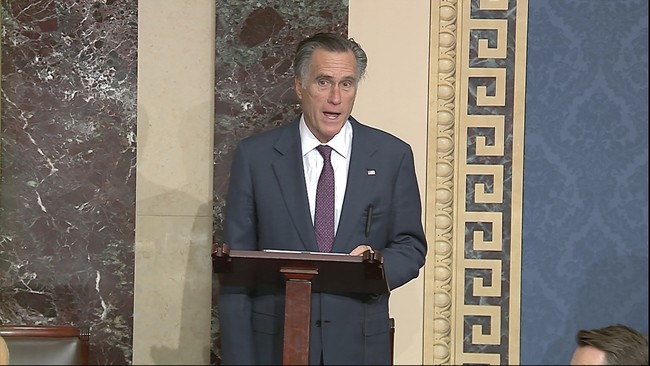
Romney: Biden Should Have Pardoned Trump
Favicon 
hotair.com

Romney: Biden Should Have Pardoned Trump

Romney: Biden Should Have Pardoned Trump
Like
Comment
Share
The Blaze Media Feed
2 yrs

Glenn Beck: It may be five years before 'true slavery' as AI gets alarmingly smarter
Favicon 
www.theblaze.com

Glenn Beck: It may be five years before 'true slavery' as AI gets alarmingly smarter

The future is here — and not in a good way. Stu witnessed it on a recent trip to Los Angeles, recalling autonomous robots making deliveries all over the city. “There are robots, robot vehicles that look like you could have put them in a 'Star Wars,'” he explains. “They’re just driving around the city by themselves crossing traffic.” While that’s bad enough, there has also been a major announcement regarding ChatGPT, which is that there’s a new version. “The new version of this is like full-out female voice, personality, you have a conversation with,” Stu tells Glenn and Pat, adding, “This is not a future, ‘Hey. in 20 years we’ll have this.’ It’s out right now.” The new version also allows the app to turn into a teacher, explaining math problems without giving the answer to those struggling. “Our kids are going to have conversations with these things and think it’s totally normal to do so,” Stu says, terrified. But it gets worse. As soon as ChatGTP came out with its new version, Google came out with its own update to its AI, Gemini. “Now, when you Google something, instead of prioritizing search results which is their entire multi-billion dollar business, they’re one of the biggest companies on Earth — they now prioritize AI answers through its Gemini,” Stu explains. “What is prioritized now is just their large language model going through all the results and giving you their summary of what they want you to read,” he adds. Glenn is extremely concerned but has a theory. “I am convinced that a massive solar flare may actually in the end be God freeing us from the electronic overseer, because that’s what’s going to stop it,” Glenn says, noting that the outlook isn't pretty otherwise. “We’re five years away from true slavery, and it won’t look like slavery to most people.” Want more from Glenn Beck?To enjoy more of Glenn’s masterful storytelling, thought-provoking analysis, and uncanny ability to make sense of the chaos, subscribe to BlazeTV — the largest multi-platform network of voices who love America, defend the Constitution, and live the American dream.
Like
Comment
Share
The Blaze Media Feed
2 yrs

Massive Trump rally takes over New Jersey town; could the state FLIP RED?
Favicon 
www.theblaze.com

Massive Trump rally takes over New Jersey town; could the state FLIP RED?

The tide is turning as former President Trump dominates Biden in five crucial swing states. And his recent rally in Wildwood, New Jersey illustrates that perfectly. While 40,000 attendees were expected, over 80,000 — some are even saying 100,000 — passionate MAGA supporters showed up. “Joe Biden can’t even half fill up an ice cream shop when he stops by,” Pat Gray says, adding, “I mean there’s like four people there and that’s a big crowd for him.” “But that man had 81 million votes,” he adds sarcastically. During Trump’s speech at the rally, he made a prediction about New Jersey. “As you can see today, we’re expanding the electoral map, because we are going to officially play in the state of New Jersey. We’re going to win the state of New Jersey,” Trump said triumphantly. “I always talk about we have enemies on the outside and we have enemies from within. The enemies from within are more dangerous to me than the enemies on the outside. Russia and China we can handle, but these lunatics within our government that are going to destroy our country, and probably want to, we have to get it stopped,” Trump continued to an eruption of cheers from the crowd. Gray is in agreement. “If you were trying to destroy the country, what would you do differently? They’re doing it all,” he says. Want more from Pat Gray?To enjoy more of Pat's biting analysis and signature wit as he restores common sense to a senseless world, subscribe to BlazeTV — the largest multi-platform network of voices who love America, defend the Constitution, and live the American dream.
Like
Comment
Share
History Traveler
History Traveler
2 yrs

Sam Giancana: Chicago Godfather, CIA Collaborator, And The Man Who May Have Put JFK In The White House
Favicon 
allthatsinteresting.com

Sam Giancana: Chicago Godfather, CIA Collaborator, And The Man Who May Have Put JFK In The White House

Chicago Outfit boss Sam Giancana aided a CIA plot to kill Fidel Castro, allegedly helped assassinate President Kennedy, and may have been with Marilyn Monroe on her last night alive. The post Sam Giancana: Chicago Godfather, CIA Collaborator, And The Man Who May Have Put JFK In The White House appeared first on All That's Interesting.
Like
Comment
Share
History Traveler
History Traveler
2 yrs

Archaeologists Just Unearthed A Roman Villa Complete With An Indoor Pool In Albania
Favicon 
allthatsinteresting.com

Archaeologists Just Unearthed A Roman Villa Complete With An Indoor Pool In Albania

While excavating the site of a future school building, Albanian archaeologists discovered the ruins of ancient villas where Roman elites once lived — and one held an elaborate indoor pool. The post Archaeologists Just Unearthed A Roman Villa Complete With An Indoor Pool In Albania appeared first on All That's Interesting.
Like
Comment
Share
History Traveler
History Traveler
2 yrs

An Algerian Man Who Disappeared At Age 19 In 1998 Has Just Been Discovered Alive In His Neighbor’s Basement
Favicon 
allthatsinteresting.com

An Algerian Man Who Disappeared At Age 19 In 1998 Has Just Been Discovered Alive In His Neighbor’s Basement

Omar Bin Omran, now 45, has allegedly been held captive by the neighbor the whole time he's been missing. The post An Algerian Man Who Disappeared At Age 19 In 1998 Has Just Been Discovered Alive In His Neighbor’s Basement appeared first on All That's Interesting.
Like
Comment
Share
Showing 28065 out of 56670
  • 28061
  • 28062
  • 28063
  • 28064
  • 28065
  • 28066
  • 28067
  • 28068
  • 28069
  • 28070
  • 28071
  • 28072
  • 28073
  • 28074
  • 28075
  • 28076
  • 28077
  • 28078
  • 28079
  • 28080

Edit Offer

Add tier


Select an image
Delete your tier
Are you sure you want to delete this tier?

Reviews

In order to sell your content and posts, start by creating a few packages. Monetization

Pay By Wallet

Payment Alert

You are about to purchase the items, do you want to proceed?

Request a Refund