YubNub Social YubNub Social
    Advanced Search
  • Login

  • Day mode
  • © 2026 YubNub Social
    About • Directory • Contact Us • Privacy Policy • Terms of Use • Android • Apple iOS • Get Our App

    Select Language

  • English
Install our *FREE* WEB APP! (PWA)
Night mode
Community
News Feed (Home) Popular Posts Events Blog Market Forum
Media
Headline News VidWatch Game Zone Top PodCasts
Explore
Explore Jobs Offers
© 2026 YubNub Social
  • English
About • Directory • Contact Us • Privacy Policy • Terms of Use • Android • Apple iOS • Get Our App

Discover posts

Posts

Users

Pages

Group

Blog

Market

Events

Games

Forum

Jobs

The Blaze Media Feed
2 yrs

3 profound claims CS Lewis makes about Jesus in forgotten essay
Favicon 
www.theblaze.com

3 profound claims CS Lewis makes about Jesus in forgotten essay

The historical Jesus, who speaks to us through the Gospels, makes claims about himself that are inconsistent with those of a man who was merely a Jewish prophet and nothing more. As C.S. Lewis famously argued in book 2, chapter 3 of "Mere Christianity," a man who said the kinds of things that Jesus said could not have been a prophet, plain and simple. Either he was, as he claimed to be, the eternal Son of God, or a madman on the order of someone who thinks he is a poached egg, or the devil of hell.American apologist Josh McDowell, in good preacher form, boiled down the options to three words all beginning with the letter "L": liar, lunatic, or Lord. Either Jesus was the worst blasphemer who ever lived (as Caiaphas and the Sanhedrin ruled) or a crazy person who needed to be locked up (as his own family thought; see Mark 3:21) or the promised Messiah and Son of the living God (as his disciples came to recognize and believe).No one at the time said he was only a prophet: neither his friends nor his enemies made that unsustainable claim. More to the point, no one disputed Jesus had made the claims he made. They either believed what he said, or they used his words as proof of his blasphemy or his lunacy. Those who heard his message either attacked him or ridiculed him or worshiped him. What they didn’t do was domesticate him as a mere prophet.We who live on the other side of Easter may not find such things particularly surprising, but those who lived at the time of Jesus would certainly have recognized the radical nature of Jesus’ claim to suspend the rules on account of his presence in the world.Lewis’s argument is a powerful one, but it rests squarely on the contention that Jesus actually claimed to be the Son of God. Fewer and fewer critics of the Gospels can get away with claiming that Jesus did not say the things attributed to him — the Gospels are too early and reliable in their eyewitness testimony to be dismissed as legends — but many still try to bend Jesus’ words so as to avoid their implications.And yet, as Lewis, McDowell, and others have shown, Jesus’ claims cannot be so easily brushed away. John’s Gospel is filled with “I am” claims by which Jesus links himself to the God of the Old Testament, whose name is Yahweh (“I am”): “I am the bread of life” (John 6:35; ESV throughout), “I am the light of the world” (John 8:12), “I am the door [to salvation]” (John 10:9), “I am the good shepherd” (John 10:11), “I am the resurrection and the life” (John 11:25), “I am the way, the truth, and the life” (John 14:6), and “I am the true vine” (John 15:1).The “I am” claims reach their climax when Jesus assures a group of skeptical religious leaders, “Before Abraham was, I am” (John 8:58). That the religious leaders recognized the blasphemy in Jesus’ words is made clear by their response: “They picked up stones to throw at him” (John 8:59).Again and again, Jesus presents himself as the revelation of God: To know him is to know God; not to recognize him is not to recognize God. Thus, in his last public discourse, Jesus says, “Whoever believes in me, believes not in me but in him who sent me. And whoever sees me sees him who sent me” (John 12:44-45). Earlier, he faults the Pharisees for failing to recognize who he is: “You know neither me nor my Father. If you knew me, you would know my Father also” (John 8:19).That Jesus claimed to be equal with God is made clear in the fourth Gospel, but it is equally clear in the first and seemingly less “theological” Gospel of Mark. Almost as soon as he appears on the scene, Jesus claims the right to forgive sins (Mark 2:5), a right which belongs only to God, who is the wronged party when we sin. That this is so is evidenced by the fact that the teachers of the law recognize his claim as blasphemous (Mark 2:6-7).Jesus’ teachings frequently put the focus on him rather than on God, contrary to what one would expect from a mere prophet: “For whoever is ashamed of me and of my words in this adulterous and sinful generation, of him will the Son of Man also be ashamed when he comes in the glory of his Father with the holy angels” (Mark 8:38). Indeed, he makes it clear that to accept him is equivalent to accepting God: “Whoever receives one such child in my name receives me, and whoever receives me, receives not me but him who sent me” (Mark 9:37). Jesus promises that those who give up home and family for his sake will receive their reward (Mark 10:29-30); or, more strongly: “For whoever would save his life will lose it, but whoever loses his life for my sake and the gospel’s will save it” (Mark 8:35).When Caiaphas asks Jesus if he is “the Christ, the Son of the Blessed,” he replies: “I am, and you will see the Son of Man seated at the right hand of Power, and coming with the clouds of heaven.” In response, Caiaphas rips his cloak and declares Jesus guilty of blasphemy, a sentence to which all agree (Mark 14:61-63).I could list many more examples from Matthew and Luke where Jesus makes claims that would brand him as a blasphemer or megalomaniac were he not, in fact, the Son of God. Instead, I would like to close by considering three subtler claims to deity that Lewis mentions in passing in a lesser-known essay anthologized in "God in the Dock": “What Are We to Make of Jesus Christ?”After explaining how Christ’s claim to have the authority to forgive sins identifies him with God, Lewis draws his readers’ attention to an easy-to-overlook verse that carries remarkable implications:Then there is a curious thing which seems to slip out almost by accident. On one occasion this Man is sitting looking down on Jerusalem from the hill above it and suddenly in comes an extraordinary remark — 'I keep on sending you prophets and wise men' [Matthew 23:34]. Nobody comments on it. And yet, quite suddenly, almost incidentally, He is claiming to be the power that all through the centuries is sending wise men and leaders into the world.In the Old Testament, it is Yahweh, and Yahweh alone, who sends prophets and wise men to teach and admonish his people. For Jesus to assert that he is the person who has been doing the sending is tantamount to identifying himself with Yahweh. It is not a human prophet who sends the prophets but the God who created them. Moses, David, Isaiah, Daniel: None of these divinely chosen leaders would have made such a claim. Great as they are, they are the ones who are sent, not the one who sends.These great men of the faith would also not have made the shocking claim that Lewis highlights next:Here is another curious remark: in almost every religion there are unpleasant observances like fasting. This Man suddenly remarks one day, 'No one need fast while I am here' [Mark 2:18-20]. Who is this Man who remarks that His mere presence suspends all normal rules? Who is the person who can suddenly tell the School they can have a half-holiday?Here we have a man who is not only obeyed by the wind and the sea but who claims the right to redefine the very nature of the Jewish religion, of which he is a faithful follower. We who live on the other side of Easter may not find such things particularly surprising, but those who lived at the time of Jesus would certainly have recognized the radical nature of Jesus’ claim to suspend the rules on account of his presence in the world.By highlighting these two seemingly minor verses, Lewis demonstrates that Jesus’ claims to divinity are pervasive, underlying nearly everything he said and did. But he does not stop there. Lewis next finds evidence for Jesus’ divinity in something that he did not say in any of his sermons or discourses:Sometimes the statements put forward the assumption that He, the Speaker, is completely without sin or fault. This is always the attitude. 'You, to whom I am talking, are all sinners,' and He never remotely suggests that this same reproach can be brought against Him.Neither Moses (Deuteronomy 32:50-52) nor David (Psalm 51:1-5) nor Isaiah (Isaiah 6:5) nor Daniel (Daniel 9:7-11) ever claimed to be free from sin. The same goes for the New Testament epistles, where Paul (1 Timothy 1:15), James (James 3:1-2), Peter (1 Peter 2:24), and John (1 John 1:8-10) all count themselves among the sinners whom Christ came to save. Christ alone of God’s chosen vessels presents himself as sinless.If a preacher continually accused his congregation of sin but never even intimated that he was a fellow sinner, we would conclude that he was filled with pride and deluded as to his own nature. Yet, Jesus comes across in the Gospels as humble and sane: neither self-righteous like the Pharisees he exposed nor out of his wits like the demoniacs he set free.Surely, this man was the Son of God!Editor's note: This essay was originally published in the Worldview Bulletin Substack and was republished with permission.
Like
Comment
Share
The Blaze Media Feed
2 yrs

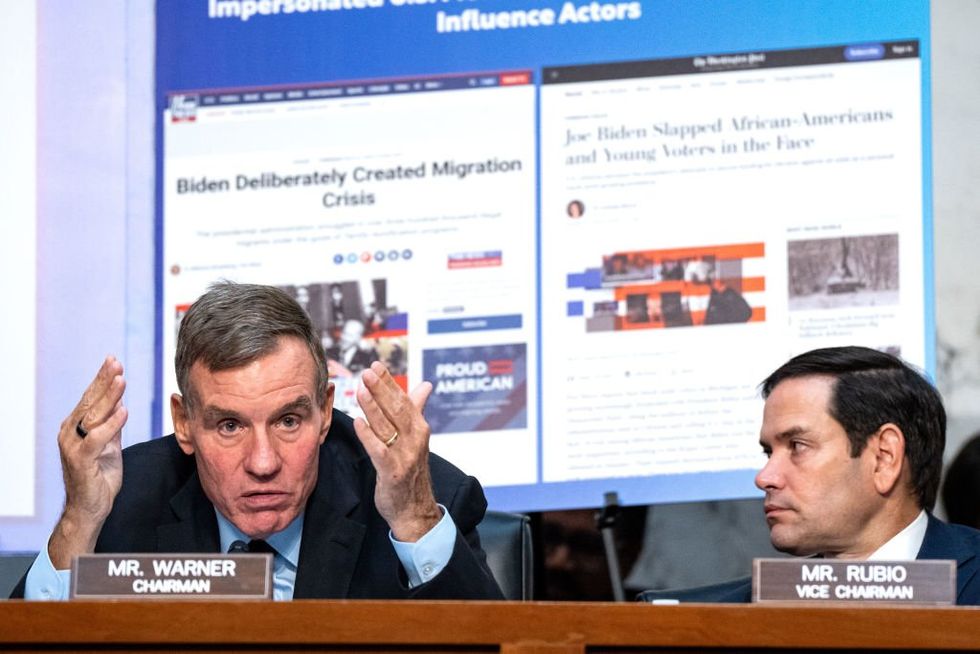
The Democrats' new 'disinformation' power grab
Favicon 
www.theblaze.com

The Democrats' new 'disinformation' power grab

The term "Orwellian" gets thrown around today like baby lotion at a Diddy party — overused and squeezed dry. But sometimes, it’s the only word that fits. Right now, as we look at the path the United States is heading down, "Orwellian" feels all too appropriate. Sen. Mark Warner's (D-Va.) recent call for the Biden-Harris administration to boost Big Tech collusion for the 2024 election isn't just a minor deviation from the democratic process.What we’re witnessing is a massive power grab that seeks to dictate what Americans can see, read, and ultimately think. It's censorship with a fresh coat of paint.If anything, it's an alarming leap toward corporate and government overreach that makes Orwell's darkest predictions look like a rough draft. And, of course, the administration jumped at the opportunity, announcing a new initiative focused on "AI" and "disinformation," pulling together a who's who of Big Tech: Meta, Anthropic, Google, IBM, Microsoft, Nvidia, and OpenAI, all happily working alongside the U.S. State Department.What could go wrong?Obviously, this isn’t a coalition out to save democracy from the perils of misinformation. After all, it’s a lineup of some of the most politically biased, powerful corporations on the planet — most of whom are major donors to the left — conveniently gearing up for a big censorship push just in time for the next presidential election. What they call "disinformation" should worry every American. Who gets to decide what counts as truth? And with so much political clout behind this new coalition, as Election Day nears, it’s hard not to see this as yet another attempt by the powerful to tip the scales in their favor.Former President Donald Trump has already been sounding the alarm bells, recently calling for Google to be criminally prosecuted over what he calls bias toward Kamala Harris. His calls are warranted. According to conservative watchdog Media Research Center, Google’s search results prominently displayed Harris’ campaign website while burying Trump’s official site beneath articles from outlets like the New York Times, the Washington Post, and Politico, all glowing with praise for Harris. Obviously, this isn't an innocent algorithmic hiccup; it's the calculated use of Google's vast influence to shape what voters see and think.The power of GoogleDr. Robert Epstein, a former editor in chief of Psychology Today and an expert in Big Tech’s impact on public opinion, has been documenting Google's manipulative practices for years. In his aptly titled monograph "The Evidence," which he was kind enough to provide me with in advance, Epstein lays bare Google’s use of the Search Engine Manipulation Effect. This is a method by which the tech giant can sway undecided voters simply by altering the order of search results. His research reveals that Google’s influence over undecided voters can be as high as 80% in certain demographic groups — more than enough to sway an election. It doesn't stop there. With Google, it never does. Epstein also points to the Search Suggestion Effect, where Google uses autocomplete suggestions to shape public perception. During the 2016 U.S. presidential election, Epstein found that Google’s autocomplete consistently favored positive suggestions for Hillary Clinton while allowing both positive and negative suggestions for Donald Trump. His studies showed that users are much more likely to click on negative suggestions, meaning that Google's skewed suggestions had a profound effect on how voters viewed the candidates. The reality is, Google’s bias may not have been enough to get Clinton elected, but it certainly wasn’t for lack of trying.The bigger pictureAnd now, this tech-government alliance is expanding internationally. Enter Melissa Fleming of the United Nations, who is now framing misinformation as a threat to the U.N.’s Sustainable Development Goals. It's important to remember that terms like “misinformation” and “disinformation,” in the parlance of the elites, simply mean information that doesn’t align with their narratives.As the investigative journalist Didi Rankovic points out, Fleming’s call for a crackdown on what she describes as "toxic information systems" coincides suspiciously with the upcoming U.S. election. It hints at a coordinated effort to control the narrative. Fleming’s background in state-sponsored propaganda, as Rankovic notes, is telling. Under her influence, the U.N. is moving away from its role in peacekeeping and toward becoming an international thought police, ready to label any inconvenient truth as dangerous misinformation.And right on cue, the Biden administration seems eager to participate. With government and Big Tech in lockstep under the guise of fighting "disinformation," what we’re witnessing is a massive power grab that seeks to dictate what Americans can see, read, and ultimately think. It's censorship with a fresh coat of paint.This is not hyperbolic fearmongering. Google and OpenAI, two of the biggest players in this new initiative, along with other Big Tech giants, recently held a fundraiser for Kamala Harris. They are not hiding who they want to see elected in November.Ominous timesFor conservatives, this represents nothing less than a crisis. The coalition between government, Big Tech, and now international organizations like the U.N. threatens not only the conservative movement but the very fabric of democracy itself. The fight against "disinformation" has morphed into a fight against dissent — a way to silence anyone who doesn’t align with the coalition's narrative. The consequences are as obvious as they are dire: an American electorate whose access to information is increasingly under the control of a small, ideologically homogeneous group of powerful elites.If we allow this coalition to go unchecked, it won't stop at censorship. It's about reshaping society, dictating which voices are amplified and which are silenced, influencing voting patterns, and ultimately deciding who gets elected.
Like
Comment
Share
Twitchy Feed
Twitchy Feed
2 yrs

She's HELPING: Watch Kamala Harris Awkwardly Pack Toiletry Bags for Hurricane Helene Victims
Favicon 
twitchy.com

She's HELPING: Watch Kamala Harris Awkwardly Pack Toiletry Bags for Hurricane Helene Victims

She's HELPING: Watch Kamala Harris Awkwardly Pack Toiletry Bags for Hurricane Helene Victims
Like
Comment
Share
Twitchy Feed
Twitchy Feed
2 yrs

James Woods WRECKS Kamala Harris for Wearing PRICEY Belt More Expensive Than Hurricane Relief Payments
Favicon 
twitchy.com

James Woods WRECKS Kamala Harris for Wearing PRICEY Belt More Expensive Than Hurricane Relief Payments

James Woods WRECKS Kamala Harris for Wearing PRICEY Belt More Expensive Than Hurricane Relief Payments
Like
Comment
Share
RedState Feed
RedState Feed
2 yrs

Upset Week Brings Poll Obliteration to College Football Week #6—All New Rankings
Favicon 
redstate.com

Upset Week Brings Poll Obliteration to College Football Week #6—All New Rankings

Upset Week Brings Poll Obliteration to College Football Week #6—All New Rankings
Like
Comment
Share
RedState Feed
RedState Feed
2 yrs

Kamala Trips Over Huge Word Salad and Throws Bibi Under the Bus in '60 Minutes' Interview
Favicon 
redstate.com

Kamala Trips Over Huge Word Salad and Throws Bibi Under the Bus in '60 Minutes' Interview

Kamala Trips Over Huge Word Salad and Throws Bibi Under the Bus in '60 Minutes' Interview
Like
Comment
Share
RedState Feed
RedState Feed
2 yrs

Surprise Virtual Guest Sends Crowd Wild at Jason Aldean Concert
Favicon 
redstate.com

Surprise Virtual Guest Sends Crowd Wild at Jason Aldean Concert

Surprise Virtual Guest Sends Crowd Wild at Jason Aldean Concert
Like
Comment
Share
Trending Tech
Trending Tech
2 yrs

Your complicated password might be doing more harm than good
Favicon 
bgr.com

Your complicated password might be doing more harm than good

We all struggle to keep track of our seemingly endless and growing list of passwords. Trying to follow the so-called rules makes an overwhelming task all but impossible, which is why you'll be pleased to learn that complexity isn't guaranteed to make your online accounts safer. As spotted by Forbes, the US National Institute of Standards and Technology (NIST) recently released new guidelines for keeping government information systems secure, and they made some significant changes to long-standing password best practices. If you've ever used Google Chrome's password generator to create a password for one of your accounts, you must have noticed how ridiculously obtuse it was, loaded with countless random letters, numbers, and symbols you could never hope to memorize. In its guidelines, NIST makes it clear that the benefit of complexity is usually outweighed by the downsides. You're likely never going to memorize a password that consists of a random jumble of numbers, letters, and symbols. As a result, you'll probably end up writing it down or storing it somewhere that a hacker could potentially access in the future. Therefore, length has become an easier metric than complexity by which to judge an effective password. As the guidelines note, online services require users to create passwords that use a mix of character types, but multiple "analyses of breached password databases reveal that the benefit of such rules is less significant than initially thought." You're much better off using a lengthy string of words that you can actually remember. That way, you are less likely to have to store the password in a note on your phone or reuse it ad nauseam and risk having all of your online accounts breached at once. Keep in mind that these aren't actually meant to be guidelines for everyone, but they're still worth considering. If you reuse the same overly complex password on every website, you're now at far greater risk than if you used numerous long, memorable passwords. Don't Miss: 10 billion stolen passwords shared online in record-breaking leak The post Your complicated password might be doing more harm than good appeared first on BGR. Today's Top Deals Today’s deals: $2.75 smart plugs, $79 Ninja air fryer, $6.49 Anker USB-C chargers, $219 Dreo ChefMaker, more Today’s deals: $60 Insignia smart TV, $735 black Apple Watch Ultra 2, $120 Ninja food processor, more Best Echo Dot deals for Fall Prime Day 2024 Today’s deals: Early Prime Day sales, $189 Apple Watch SE, Philips OneBlade 360, Crest 3D Whitestrips, more
Like
Comment
Share
History Traveler
History Traveler
2 yrs

Castro San Vicenzo Excavations Unveil Celtic Symbols and Other Iberian Age Symbols
Favicon 
www.ancient-origins.net

Castro San Vicenzo Excavations Unveil Celtic Symbols and Other Iberian Age Symbols

Excavations conducted over the month of September at Castro de San Vicenzo in Plane, Ourense, Spain, has led the uncovering of several well-preserved artifacts connected to the Castro culture from the Iberian Iron Age. These finds include a triskele, a swab, and other symbols that have deep ties to this ancient society, some of the best that have ever been found in this region. Celtic Symbols, Heavy Fortification: A Castro Way of Life The triskele, a Celtic symbol made up of spirals, and often found in Celtic decorative art, was the first artifact found, buried in the rubble of a collapsed circular structure. These symbols were commonly associated with ritual saunas in Castro communities in religious and purification ceremonies, dated to the 3rd and 4th centuries BC. Irish and Celtic Symbols: The True Meanings Behind Signs of Pride and Power The Restless Peninsula: The Proud and Colorful History of Iberia Read moreSection: ArtifactsAncient WritingsNewsHistory & ArchaeologyAncient PlacesEuropeRead Later 
Like
Comment
Share
NEWSMAX Feed
NEWSMAX Feed
2 yrs

Sen. Tillis: N.C. Recovery Efforts Have Scope 'Like Katrina'
Favicon 
www.newsmax.com

Sen. Tillis: N.C. Recovery Efforts Have Scope 'Like Katrina'

The scope of the recovery efforts in North Carolina after Hurricane Helene is "more like Katrina" and demands a coordinated response, including efforts between the U.S. military and the Federal Emergency Management Agency, Sen. Thom Tillis said Sunday.
Like
Comment
Share
Showing 9260 out of 56670
  • 9256
  • 9257
  • 9258
  • 9259
  • 9260
  • 9261
  • 9262
  • 9263
  • 9264
  • 9265
  • 9266
  • 9267
  • 9268
  • 9269
  • 9270
  • 9271
  • 9272
  • 9273
  • 9274
  • 9275

Edit Offer

Add tier


Select an image
Delete your tier
Are you sure you want to delete this tier?

Reviews

In order to sell your content and posts, start by creating a few packages. Monetization

Pay By Wallet

Payment Alert

You are about to purchase the items, do you want to proceed?

Request a Refund