reactormag.com
15 Reasons Why the 1970s Were a Golden Age for TV Terror
Lists
horror movies
15 Reasons Why the 1970s Were a Golden Age for TV Terror
Some of the horror greats cut their teeth on made-for-TV fare
By Don Kaye
|
Published on October 1, 2024
Comment
0
Share New
Share
There’s no question that the 1970s was a groundbreaking era for television. Shows and miniseries like All in the Family, The Mary Tyler Moore Show, M*A*S*H*, and Roots, among many others, heralded a time when subjects like racism, sex, human rights, feminism, and the cost of war—just to name a handful—were suddenly being brought to the forefront every week on millions of screens. While no one is ever going to hail TV as a consistent bastion of quality and profundity, and its impact has waxed and waned ever since, there’s no doubt that the ‘70s did indeed forge a new and often more mature path.
Not only was the decade filled with more sophisticated TV in general, but it also proved to be a fertile time for, of all things, horror. While horror cinema in the ‘70s was truly subversive and even transgressive (as the likes of The Texas Chain Saw Massacre and Dawn of the Dead attest), small-screen terror—most often in the form of “movies of the week”—set out with new fervor just to scare the pants off viewers.
Usually working in the 90-minute format (74 minutes without commercials), but sometimes two or even four hours, television horror auteurs like Dan Curtis (Dark Shadows) and genre titan Richard Matheson (I Am Legend), along with up-and-coming filmmakers like John Carpenter and Tobe Hooper, provided a steady stream of genuinely creepy tales, while working with the limited budgets of TV and confined by broadcast standards to only a certain level of gore or violence.
Of course, many of these films have aged accordingly and should probably be viewed now with the proper nostalgic perspective. Nevertheless, the ‘70s still yielded some indelible TV movies that not only garnered sizable ratings but seared themselves into the memories of viewers and remain there years later. Here are 15 reasons why the 1970s were a golden age for TV terror.
Duel (1971)
The prime of ‘70s TV horror kicked off on ABC-TV with a bona fide classic: Duel, adapted by Richard Matheson from his own short story, chronicles the battle of nerves between traveling salesman David Mann (Dennis Weaver) and the unseen driver of a tanker truck. The latter pursues the salesman in his modest sedan along largely deserted roads in the Mojave Desert, making it clear that the truck driver (whose motives and identity are never revealed) fully intends to run Mann off the road… or worse.
This riveting cat-and-mouse thriller was the first TV movie directed by a young Steven Spielberg, who had helmed episodes of various TV shows before getting the assignment on Duel. The results were so successful that additional scenes were shot in order for Duel to be released theatrically in Europe (which happened with a number of TV movies), essentially making it Spielberg’s feature debut. Although he directed another horror-tinged TV movie immediately thereafter—the more tepidly received Something Evil—Spielberg never looked back. Duel remains an impressive achievement today, a minimalist tale of terror that makes effective use of its location setting and the familiar turned frightening.
The Night Stalker (1972)
Adapted by Richard Matheson (told you you’d see his name pop up here quite often) from an unpublished novel by Jeff Rice, ABC-TV’s The Night Stalker follows pesky, slightly down-and-out Las Vegas newspaper reporter Carl Kolchak (Darren McGavin) as he investigates a string of bizarre murders in which all the victims are drained of their blood. Kolchak comes to believe that the killer thinks he’s a vampire—until it becomes all too clear that the murderer (Barry Atwater, best known to sci-fi fans as the Vulcan philosopher Surak from Star Trek: The Original Series) is a vampire for real. And yet Kolchak can convince neither his editor nor city officials of the danger the city faces.
The Night Stalker, which became the highest-rated TV movie ever at the time of its airing, was the first of many horror collaborations between producer-director Dan Curtis, who had previously created the Gothic soap opera Dark Shadows, and the prolific Matheson, who was already a top-tier genre author and screenwriter. Curtis did not direct this one, but assigned it to John Llewellyn Moxey, who had directed the cult classic The City of the Dead (aka Horror Hotel) a decade earlier. While aspects of it are certainly dated now, the eerie confrontation between the hard-boiled Kolchak and the feral vampire Janos Skorzeny (no Twilight pretty boys here) would have a far-reaching impact on genre TV.
The Screaming Woman (1972)
Journeyman director Jack Smight, whose resume veered wildly between disaster movies (Airport 1975), literary drama (Rabbit, Run), and schlocky sci-fi (Damnation Alley), helmed this early 1972 TV movie-of-the-week for ABC that starred screen icon Olivia de Havilland and was inspired by a Ray Bradbury short story (it also featured a score by film composing legend John Williams). That’s quite a combination for what is really a pretty simple story about a rich but elderly woman (De Havilland) who returns to her home in the country to recover from mental illness, only to begin hearing a woman screaming somewhere on the property and become convinced that the woman is buried alive.
Smight actually manages to wring a fair amount of suspense out of this premise, and De Havilland is quite strong as she attempts to solve the mystery of the screaming woman while fending off suspicions that her mind is once again buckling. Fellow Hollywood vets Joseph Cotten and Walter Pidgeon also show up in the cast, but are mostly underused. The cinematography is quite striking as well, giving this a luster that lifts it above the average TV movie of the time. It’s a minor gem worth rediscovering.
When Michael Calls (1972)
Based on the 1967 novel of the same name by renowned horror and suspense author John Farris (The Fury), When Michael Calls centers on Helen Connelly (Elizabeth Ashley), who begins getting a series of phone calls from her 13-year-old nephew Michael—who has been dead for 15 years. Directed by Philip Leacock and scripted by James Bridges (The China Syndrome), the movie makes effective use of a conceit that has always terrified us—the sudden phone call with a strange, disembodied voice on the other end. Those calls freak us out here just as they did in the classic Twilight Zone episode “Night Call.”
Ben Gazzara and a young Michael Douglas also show up in the film, which goes for the slow burn and psychological terror over jump scares and gore, and takes a turn during the homestretch that arguably shifts it out of strictly horror territory. The ABC-TV movie is also very much of its time, when things like DNA identification, smartphones, and even call waiting simply didn’t exist. But watch it on its own terms (like many others on this list) and you should have a good time.
Gargoyles (1972)
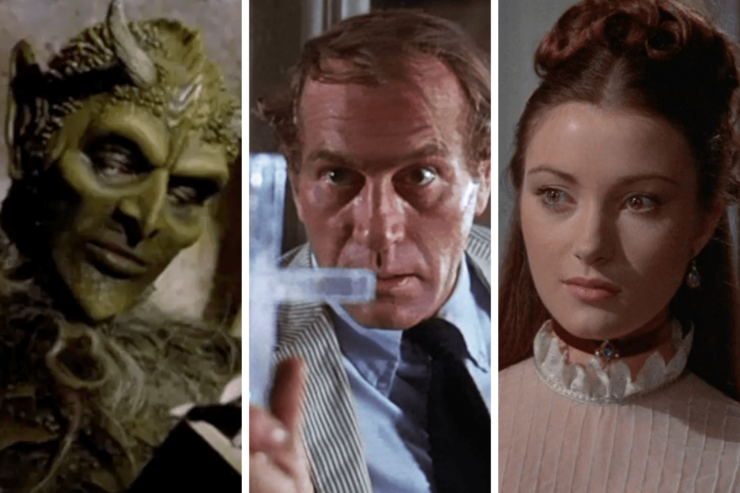
This CBS-TV effort (directed by Bill L. Norton) is probably remembered most for its striking gargoyle makeup by VFX artist Stan Winston, who won an Emmy for his debut efforts here and later achieved legendary status with his work on The Terminator, Aliens, The Thing, Jurassic Park, and countless other genre staples. Here Winston encased actor (and former pro football player) Bernie Casey and others in full-body costumes, as flying humanoid creatures who emerge from a 500-year hibernation with plans to wipe out humanity. Only a scientist (Cornel Wilde) and his daughter (Jennifer Salt) stand in their way.
Gargoyles not only channeled those old-school monster movie vibes but also tapped into the “weird Americana” lore of loopy yet eerie roadside attractions, localized mythology, and conspiracy theories. The direction and screenplay aren’t great, and the characters not especially likable (plus Salt’s outfits give away the game that she is only along for the cheesecake factor), but Winston’s makeup is a blast and there are far worse B-movies out there to kill some time with.
The Night Strangler (1973)
Darren McGavin returns as investigative reporter Carl Kolchak in this sequel to The Night Stalker, with Dan Curtis himself directing this time and Richard Matheson back to write the teleplay. After getting bounced from Las Vegas, Kolchak finds himself in Seattle, working again for a newspaper under editor Tony Vincenzo (Simon Oakland, also back). A series of mysterious murders—all of young dancers—puts Kolchak on the trail of a near-immortal being who goes on a killing spree every 21 years, to obtain the blood he needs for the elixir that has kept him alive for a century and a half.
While McGavin is excellent again in the role, the fact that the story is basically a remix of the first one makes The Night Strangler entertaining but a bit less unique. Still, the sequel was a huge hit as well, and while a third film was initially planned by ABC, that was scrapped in favor of a TV show. Kolchak: The Night Stalker premiered in September 1974 but was canceled after one season and 20 episodes, with the show getting into a “monster of the week” rut fairly quickly. Nevertheless, its portrayal of a lone, dogged investigator who believes in the possibility of paranormal or supernatural forces was acknowledged by The X-Files creator Chris Carter as a direct inspiration for his own massively influential series.
A Cold Night’s Death (1973)
A full decade before John Carpenter unleashed his masterful The Thing upon the world, a little-known TV director named Jerrold Freedman (who went on to direct two first-season episodes of The X-Files, among other things) and a writer named Christopher Knopf (who penned the 1957 Ray Harryhausen classic 20 Million Miles to Earth) fashioned this unnerving little chiller for ABC set in the Arctic Circle. That’s where two scientists, played by Robert Culp and Eli Wallach, are sent to check on a colleague at an isolated research station and discover that he’s dead. Worse, they begin to realize they may not be alone.
The claustrophobic setting and atmosphere bear more than a passing resemblance to The Thing, while the presence of Culp brings to mind The Outer Limits, for which the actor headlined three of its most famous episodes. He and Wallach both deliver strong performances here, as the two men begin to lose their minds and their trust in each other while whatever is haunting them draws closer. The ending may have been polarizing (if not a little puzzling as well), but it only adds to the weird, creepy vibe of the film.
Don’t Be Afraid of the Dark (1973)
Kim Darby (perhaps most familiar to Reactor readers as the title character from the Star Trek: The Original Series episode “Miri”) stars in this slow-burn shocker from ABC about a young housewife who moves into the old mansion she inherited from her late grandmother with her husband (Jim Hutton), only to discover that three small, malevolent creatures live beneath the house. Inadvertently setting them free when she opens a bricked-up fireplace in the basement, the woman can’t convince her spouse or friends of the danger until it’s too late.
Don’t Be Afraid of the Dark (helmed by One Step Beyond director and host John Newland) remains one of the more memorable efforts from this era, with the film often rerun throughout the years in syndication and getting several home video releases. One person it had a profound effect on was filmmaker Guillermo del Toro, who was so affected by the film as a child that he later produced and co-wrote a remake in 2011, starring Guy Pearce and Katie Holmes.
Frankenstein: The True Story (1973)
Director Jack Smight was back behind the camera again for NBC’s ambitious, four-hour, two-part reimagining of Mary Shelley’s timeless tale, which often veers fairly far from the source material. The end results, however, are surprisingly captivating, grisly, and imaginative. In this telling (co-written by novelist Christopher Isherwood and his partner, artist Don Bachardy), Victor Frankenstein (Leonard Whiting) is motivated by the death of his brother to find a way to bring the dead back to life. His creation (Michael Sarrazin) is initially blessed with incredible physical beauty – until a flaw in the experiment causes the creature to begin rapidly decomposing.
Whiting, Sarrazin, Jane Seymour (as a late-in-the-game bride of the monster), and David McCallum (as Frankenstein’s mentor Clerval, whose brain ends up in the creature’s head) are all excellent, as is James Mason as Polidori—no, not the real John Polidori, one of the people in the room when Shelley started writing Frankenstein (and author himself of “The Vampyre”), but a take on Dr. Pretorious from The Bride of Frankenstein. The production values are sumptuous, and the film’s many macabre pleasures include a decapitation at a society ball, an acid bath, a crawling hand, rotting body parts, and electrocution on the stormy seas. It may not be the “true” Frankenstein, but it’s one of the more entertaining ones.
Bram Stoker’s Dracula (1974)
Dan Curtis and Richard Matheson pivoted from modern-day vampires to the biggest bloodsucker of them all with this CBS adaptation of Bram Stoker’s all-timer, starring Jack Palance as the Count and Nigel Davenport as Van Helsing. And it’s actually fairly faithful to the book: Much of the narrative remains intact, although some of the supporting characters (including Renfield and Dr. Seward) are jettisoned as usual and Jonathan Harker is turned into a vampire himself. Palance is excellent as Dracula, adding a hint of tragedy to an otherwise ruthless, menacing monster who adheres pretty close to the text.
Interestingly, Francis Ford Coppola borrowed two elements from the Curtis-directed films when he made his own Bram Stoker’s Dracula almost two decades later (actually, make that three: he nabbed the rights to the title, so the Curtis film is now known as either Dan Curtis’ Dracula or just Dracula). Coppola took the idea of Dracula actually being Vlad the Impaler (or someone like him) from Matheson’s screenplay, while also making one of his modern victims the image/reincarnation of his late wife (here it’s Lucy Westenra, while Coppola makes it Mina Murray/Harker). Despite Coppola’s film being the last definitive adaptation of the Stoker novel to date, Dan Curtis’ Dracula has risen in esteem over the years.
Bad Ronald (1974)
Based on a novel by famed science fiction writer Jack Vance, ABC’s Bad Ronald stars Scott Jacoby as the title character, a teen misfit who lives with his overbearing mother (Kim Hunter from Planet of the Apes). When Ronald is ridiculed one day by the younger sister of a girl who rejected his offer of a date, he knocks the girl down and accidentally kills her. His mother hides him in a space under the stairs to avoid the police – and there Ronald stays, even after his mother abruptly dies and the house is sold to a new family who have no idea that someone is living in the walls.
There are no supernatural elements afoot in Bad Ronald, but the idea of someone hiding in your house—watching you and your family (including young daughters) through various peepholes and sneaking into the kitchen to steal food—is unsettling enough. To be fair, Bad Ronald amps up the cheesiness of the premise more than several other entries on here; but you might still find it to be an enjoyably tawdry romp.
Satan’s Triangle (1975)
A helicopter rescue team (Doug McClure and Michael Conrad) is sent to investigate a distress call coming from the region of the Atlantic Ocean known as the Bermuda Triangle. There they find three dead bodies and one survivor, a woman named Eve (Kim Novak), aboard a derelict vessel. While the pilot returns to shore to refuel, Eve tells the McClure character that the other people on the boat all died from what she insists were supernatural causes. He has an alternate explanation for everything, but in the end it’s Eve who knows the truth all along.
Directed for ABC by Sutton Roley (who helmed the 1974 feature Chosen Survivors, in which a group of nuclear war survivors are besieged by vampire bats in their bomb shelter), Satan’s Triangle is remembered for its thoroughly creepy imagery, including a demonic priest and a corpse “floating” in mid-air, as well as its twist ending, which today’s savvier audiences can probably see coming but freaked out viewers (like this one) back in the day. Add in the then-relevant elements of Satanism and the mythology surrounding the Bermuda Triangle, and you have a very potent brew.
Trilogy of Terror (1975)
Trilogy of Terror, or at least the final third of it, may be Dan Curtis and Richard Matheson’s crowning achievement in TV horror, and is certainly up there with Duel and The Night Stalker among the most unforgettable entries of the era. The ABC film is an anthology consisting of three separate stories (all based on short stories by Matheson, with the first two adapted by William F. Nolan and the third by Matheson himself), all of them starring Karen Black in what amounts to a tour de force four-character performance. The first two tales, in which Black stars respectively as a teacher with a secret (“Julie”) and twin sisters, uh, also with a secret (“Millicent and Therese”) are just okay, if not borderline sleazy.
The third story, “Amelia,” elevates Trilogy of Terror into the pantheon of TV horror greats – with one major caveat. Black’s title character purchases a fetish doll that supposedly houses the spirit of a vicious hunter. When the chain that keeps the spirit bound falls off the doll, all hell breaks loose. The scenes of Amelia battling the doll inside her apartment are harrowing, despite the fact that the basic scenario—a vulnerable white woman pursued in her home by a “dark” invader—is racist even by the standards of the day. The doll itself is referred to as “Zuni,” but since the Zuni people are based in the American Southwest, this seems like racism on Matheson’s part, whether intentional or not: the doll’s features and costume are fashioned in an exaggerated African style that only makes its racialized aspects clearer, especially to modern audiences.
Keeping that in mind, it’s still a classic 20 minutes or so of horror television thanks to Black’s performance and Curtis’ relentless pacing. The director and Matheson tried the three-part anthology format again in 1977 with Dead of Night, but with less memorable results.
Someone’s Watching Me! (1978)
Right before he became one of horror’s greatest filmmakers with the release of Halloween, John Carpenter directed this made-for-TV chiller starring Lauren Hutton as Leigh, a new-to-Los-Angeles TV director who finds herself the target of a stalker – and not just any stalker, but a predator who has access to her apartment and monitors her every move via recording devices. With her pursuer careful to avoid doing anything that could technically constitute a crime, Leigh and two friends are on their own as they try to figure out who the stalker is before he crosses the ultimate line.
Carpenter originally wrote the script for Someone’s Watching Me! as a feature film for Warner Bros., but was offered the chance to direct it when the studio decided to turn it into a TV movie for NBC instead. While skirting the line between suspense, mystery, and horror, the film nevertheless turned out to be a proving ground for techniques that Carpenter put to use when he began filming Halloween less than a month later, while adopting a more Hitchcock-like style as well. Someone’s Watching Me! was hard to find for a long time, leading some fans to call it Carpenter’s “lost” film.
Salem’s Lot (1979)
Director Tobe Hooper’s (The Texas Chain Saw Massacre) two-part, four-hour CBS adaptation of Stephen King’s beloved second novel was in development almost since the book’s publication in 1975, with the studio (Warner Bros.) struggling to adapt it as a feature film before shunting it off to the TV division. At a little over three hours (minus commercials), Paul Monash’s script compresses the story and combines characters, but remains faithful in many ways to King’s book. Hooper is limited by what he could show on TV at the time, but Salem’s Lot still manages to convey several chilling sequences—the most memorable being the vampire child Danny Glick floating in mid-air, scratching at his friend’s window.
David Soul stars as Ben Mears, a writer who returns to the small, provincial Maine town in which he spent his childhood, only to discover that the inhabitants are being turned into vampires. The acting is often TV-level for the period (Soul is either earnest or dull, your mileage may vary) and the script changes the king vampire, Barlow (Reggie Nalder), from a baroque Dracula-esque nobleman to a savage, Nosferatu-like monster. The show is anchored by an excellent James Mason as Barlow’s human familiar, Straker, as well as the atmospheric set pieces that Hooper conjures up. While flawed, Salem’s Lot successfully rang the closing bell on a decade of TV terror that still elicits fondly frightening memories to this day.
Miss any of your favorites? Sound off in the comments![end-mark]
The post 15 Reasons Why the 1970s Were a Golden Age for TV Terror appeared first on Reactor.


 News Feed (Home)
 Popular Posts
  Events
  Blog
Blog  Market
  Forum
Forum  Headline News
 VidWatch
 Game Zone
 Top PodCasts